World
Some Attacks and U-Turns, but Ships Sail Red Sea Despite Houthi Blockade

This Video Is Trending Right Now
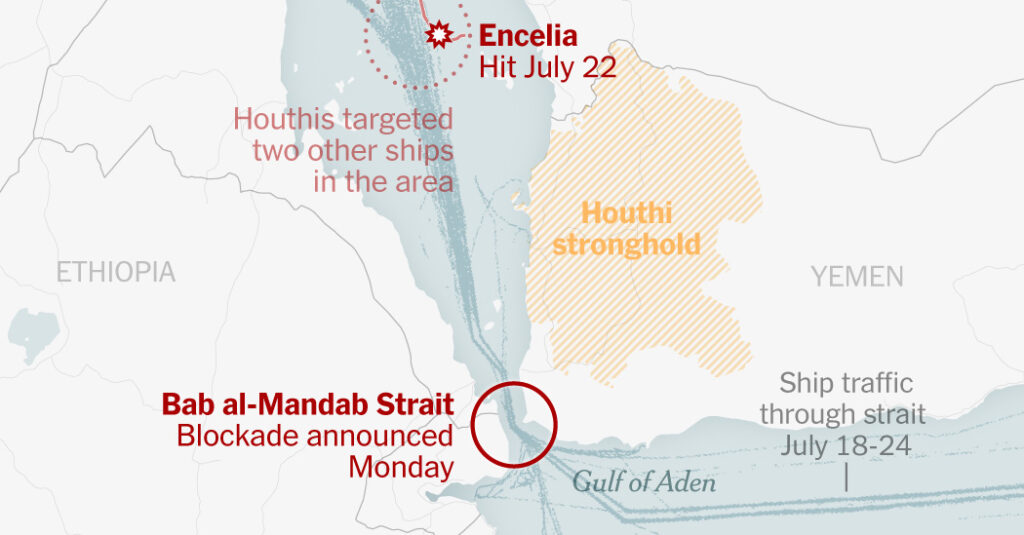
Days after the Iranian-backed Houthi militia announced the blockade of a vital shipping passage through the Red Sea, dozens of ships continue to make the journey, according to a review of shipping data.
But with each hour that passes, uncertainty about the safety of the journey grows. Vessels have been making U-turns, in some cases reversing their courses on trips that were meant to stretch to India, China and other parts of the globe. In at least three instances this week, oil tankers have been attacked in the Red Sea, including one attack reported late Friday.
If the blockade succeeds in hampering shipping activity, it will be another blow to global trade already damaged by the widening conflict in the Middle East. As the United States and Iran have escalated their attacks in a war now in its fifth month, the Strait of Hormuz, the narrow waterway next to Iran that had long been the conduit for a fifth of the world’s oil supply, has remained largely cut off.
In recent months, Saudi Arabia has rerouted millions of barrels of oil per day via a pipeline that stretches from the Persian Gulf to the Red Sea. Most of that oil makes its way out of the region through the Bab al-Mandab Strait, off the coast of Yemen and near territory controlled by the Houthis.
That pathway was put at risk on Monday, when the militia announced that it would blockade ship activity from Saudi Arabia, the world’s largest oil exporter.
Nearly a dozen ships — trying either to leave the Red Sea or to enter the area — have turned back from the strait since then, according to Kpler, a maritime data firm.
It is difficult to get a full picture of shipping traffic in the area, with more ships turning off their location transponders to obscure their positions from the Houthis, said Michelle Wiese Bockmann, an analyst at Windward, a maritime intelligence firm.
And some data suggests that activity through the Bab al-Mandab Strait has increased this week despite Houthi aggression. On Thursday, Kpler found, 43 ships crossed the strait, up from 35 the day before, when the Houthis claimed they had targeted two Saudi oil tankers with missiles and drones.
On Friday, the hull of a Saudi-owned vessel was damaged after being targeted in the Red Sea, Saudi officials said. The vessel and crew were safe, and the ship appeared to continue traveling.
This is not the first time the Houthis have disrupted activity in the Red Sea. In 2024, they regularly attacked ships there with links to Israel in what the militia described as an effort to force Israel to end its bombardment of Gaza.
Now, seeking an alternative, some shippers are moving north toward the Suez Canal, Kpler said. But that route to Asia — the buyer of much of the region’s oil — is much costlier and longer. And the canal is too shallow for fully loaded supertankers, so oil has to be transferred to a pipeline before returning to tankers or transported onto smaller ships, straining availability of those types of vessels.
As a result of rising tensions in the Red Sea, on top of diminished activity around the Strait of Hormuz and elsewhere, about 25 percent of the world’s oil supply is now imperiled, Ms. Wiese Bockmann said. “It’s quite a volatile situation,” she said.
This week, prices of Brent crude oil, the international benchmark, jumped to around $100 a barrel — a level not seen in roughly two months.


What to Know About the Wildfires Raging in Western Europe

Fires Rage in Spain and France, Forcing Thousands to Flee

Iâve never seen N1bn cash in my life – Senator Ali Ndume says as he denies intermediary claim

L.A.’s dangerous game of triage as aging water system hits breaking point

NFL star Tyreek Hill downplays mother-in-law’s stroke as he asks her to turn over communication with her daughter in legal war

What it’s like to be a founder of the most high-stakes startup ever, OpenAI

NNL: El-Kanemi Warriors boss targets quick NPFL return

 Investigation3 days ago
Married woman humiliated after allegedly being caught cheating on her husband with another man in Kogi community
- Investigation3 days ago
âIt is an honour to stand with you in fight against terroristsâ- Trump tells Tinubu
- Society2 days ago
FULL TEXT: Trump’s letter to Tinubu
 Breaking2 days ago
âFailed nation, failed parenting and lack of home training’- Lawyer, Deji Adeyanju blasts podcast host for saying a poor man has no place in her heart’
- Investigation3 days ago
âDon’t let anyone pressure you to stop repeating your clothesâ â Businesswoman Sharon Adeleke encourages repeating outfits
- News3 days ago
Yomi Gold Breaks Silence After Business Losses
- Breaking3 days ago
âl did not k!ll him, he d!ed on top of me" – Sani Abacha’s mistress says
- Investigation3 days ago
ââGo home, Nigeria is your home. We wonât accept you in South Africa”- South African women hurl anti-immigrant slurs at former Miss Universe Nigeria, Chidimma Adetshina amidst her deportation court case