World
Teachers’ Union Boss Vows ‘All-Out-War’ if Mamdani Doesn’t Back Bonuses

This Video Is Trending Right Now
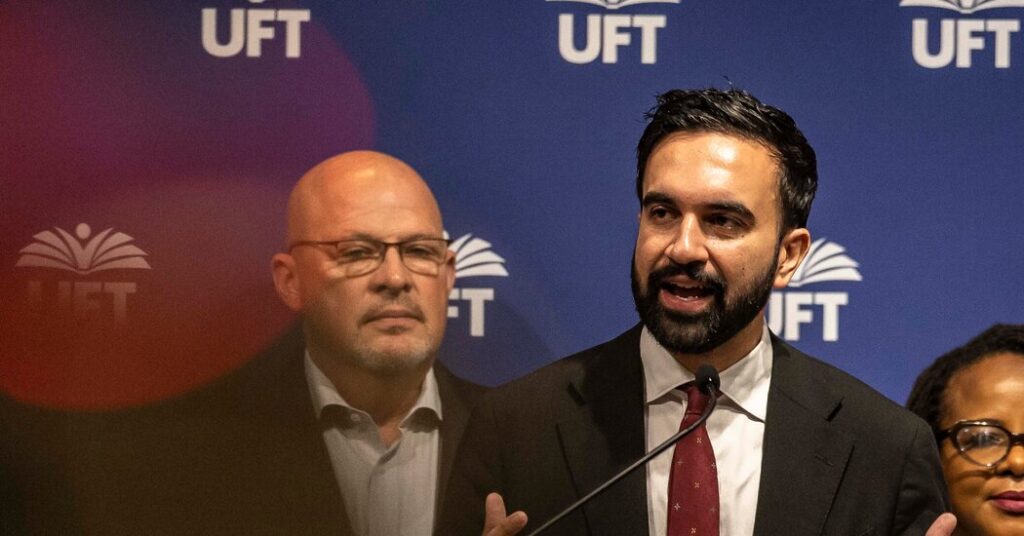
The head of the powerful teachers’ union in New York City has threatened “all-out war” against Mayor Zohran Mamdani if he does not support granting hefty bonuses to teaching assistants, setting up a potential rift between the democratic socialist mayor and the influential labor leader.
Mr. Mamdani had pledged on the campaign trail that, as mayor, he would back legislation providing one-time payments of $10,000 to the aides, known as paraprofessionals. They are among the lowest-paid employees in the city’s public schools, often working one-on-one with students with disabilities.
But after the City Council unanimously passed a bill last week giving bonuses to teaching assistants, Mr. Mamdani backpedaled, as administration officials have said that the payments would violate state labor law.
He has not indicated whether he intends to veto the measure, sue the City Council for passing it, or do nothing and let it lapse into law.
Michael Mulgrew, the president of the United Federation of Teachers, said that he had pressed the case with Mr. Mamdani, including in a meeting on Thursday. Mr. Mulgrew, who faces his own internal political pressures, said that he would be disappointed in the mayor if his administration opposes the bonuses or challenges them in court.
“If we have to go to all-out war with him over this, then we’re willing to do that,” Mr. Mulgrew said in an interview, adding that an escalation to that level would reveal that Mr. Mamdani “is not the person we thought he was.”
In a statement, Mr. Mamdani praised the work of paraprofessionals but said that “questions of compensation are best resolved through the collective bargaining process that respects workers and their unions.”
New York’s public school system, the largest in the United States, employs roughly 26,000 paraprofessionals, whose starting salary is about $32,000 a year. There are about 1,600 paraprofessional vacancies, the union said.
The legislation would cost New York City $325 million. The Citizens Budget Commission, a nonpartisan watchdog group that opposes the bill, warned that it would set a “dangerous precedent” by encouraging unions to bypass the bargaining table and appeal directly to lawmakers.
There are already signs of that happening. Joann Ariola, a councilwoman who chairs the Committee on Fire and Emergency Management, recently cited the potential paraprofessional bonuses in her request to raise the pay for Fire Department emergency medical technicians and paramedics.
Mr. Mamdani campaigned on promises of helping working-class New Yorkers and ultimately won the backing of major labor unions, including the United Federation of Teachers, which has about 190,000 members.
Like other New York mayors who have confronted the realities of running a complicated city in constrained fiscal times, Mr. Mamdani has backtracked on other campaign promises, too.
As a candidate, he called for expanding a housing voucher entitlement program for low-income New Yorkers, only to reverse course upon taking office. And he has not fulfilled a pledge to disband a contentious Police Department unit that responds to protests, called the Strategic Response Group.
Conversely, Julie Menin, the City Council speaker who has positioned herself as a more moderate counterbalance to the mayor, has repeatedly backed costly efforts that Mr. Mamdani has opposed. Ms. Menin backed the paraprofessional bill, earning praise from the teachers’ union.
In his meeting on Thursday with the mayor and City Hall representatives, Mr. Mulgrew said that the staff members reiterated their legal concerns. Still, Mr. Mulgrew said he remained “somewhat optimistic” that a compromise could be reached, pointing out that Mr. Mamdani had asked to schedule follow-up discussions.
Mr. Mulgrew suggested that the mayor had been given poor guidance from the city’s Office of Labor Relations and Office of Management and Budget.
“He’s new, and he’s being given a lot of information by a lot of people who have their own agendas,” Mr. Mulgrew said.
The legality of the paraprofessional bonuses comes down to the Taylor Law, which governs labor relations for public employees in New York. Mr. Mamdani said he believed that the bonuses would be in “direct violation” of that law.
The Office of Labor Relations had said that the statute prohibits authorizing such payments outside the collective bargaining process. Any compensation adjustments, the office said, would have to be negotiated jointly among the city, the Department of Education and the union.
Robert W. Linn, who served as the labor relations commissioner when Bill de Blasio was mayor and advises City Hall under Mr. Mamdani, said that he could not recall another instance of the City Council attempting to legislate bonuses for union workers.
“The bargaining structure for the city and state was enacted almost 60 years ago and has worked quite well,” Mr. Linn said.
The union maintains that the City Council measure was written specifically to avoid running afoul of the Taylor Law. The bonuses are described as “stabilization payments” that are necessary to address “emergency conditions” involving the retaining and hiring of paraprofessionals.
The bonuses would supplement base salaries and would not factor into workers’ pensions. The payments would be distributed throughout the upcoming school year but would be terminated if salaries increase by at least $10,000 through collective bargaining.
Paraprofessionals say that the $10,000 bonuses are desperately needed.
Jasminie Jones, 42, has worked as a paraprofessional for five years at P4 at Skillman, a school in Queens that serves students with disabilities. Last school year, she was assigned to assist a female student throughout the day, including during meals and bathroom visits.
Ms. Jones takes home roughly $1,200 every two weeks, which she said is not enough to live on in New York City. So three years ago, she started a second job working evenings and weekends as an in-home aide for students with disabilities. That job brings in an additional $1,500 per paycheck every two weeks.
“There’s no way a paraprofessional can survive on just the check that they’re getting,” Ms. Jones, 42, said. “I need that second check.”


2027: Abdulsalami tells INEC to remain impartial, do justice to all parties

”We’re in state capture”: Rep Obika says APC decides which motions can pass; if it affects them, they block it
”We’re in state capture”: Rep Obika says APC decides which motions can pass; if it affects them, they block it

NICASA condemns alleged killing of Nigerian in South Africa

Russian missile strike near Kyiv kills 10, wounds nearly 100

7-Month Pregnant Crystal Palace star Justine Vanhaevermaet joins Pre-Season Training (video)

I stayed at a hotel voted the best in Seattle. Now I’ll book the chain wherever I travel.

 Investigation2 days ago
Married woman humiliated after allegedly being caught cheating on her husband with another man in Kogi community
- Investigation3 days ago
âHe bargained the car from â¦15m to â¦13.5m and asked for a test driveâ â Car dealer recounts how suspected car thief allegedly stole vehicle before being caught
- Society3 days ago
Outgoing British High Commissioner praises Tinubu’s economic reforms
 Breaking1 day ago
âFailed nation, failed parenting and lack of home training’- Lawyer, Deji Adeyanju blasts podcast host for saying a poor man has no place in her heart’
- Investigation3 days ago
Tell my ex-wife to leave, I want to bring my sick mother home â Man begs court
- Investigation3 days ago
DJ Chicken regains his freedom (video)
- Society2 days ago
FULL TEXT: Trump’s letter to Tinubu
- Investigation3 days ago
Influencer Andrew Tateâs new charges include 19 for âIndecent Images of a Childâ and âExtremeâ p0*r^