World
What We Really Learned From the Fauci Hearing

This Video Is Trending Right Now
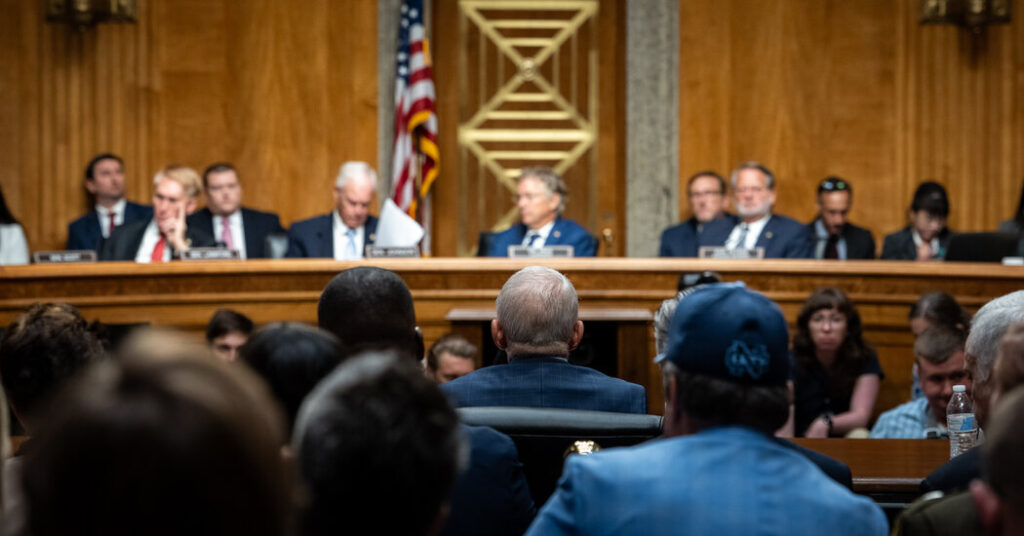
Senate hearings are always theatrical. Even still, Wednesday morning’s Senate committee hearing to interrogate Dr. Anthony Fauci on, among other things, the origins of Covid-19 was a shocking performance: Dr. Fauci barely spoke, while everyone else spent some three hours projecting their emotions onto him.
Senator Rand Paul of Kentucky, the committee chair, has cast himself as a contemporary Joe McCarthy intent on ferreting out the truth about one man’s supposed crimes against his country. The Covid lockdown “could never have been inflicted without you aiding and abetting the crime,” he said to Dr. Fauci during his opening statement. And “you have for years avoided responsibility.”
Just before leaving office, President Joe Biden took the remarkable step of providing Dr. Fauci with a blanket pardon covering all of his activities from 2014 to early 2025. This pardon would not protect against new accusations of perjury if Dr. Fauci were found to have lied during sworn testimony after Mr. Biden left office in 2025. On the advice of his lawyers, the 85-year-old Dr. Fauci made the extraordinary choice during Wednesday’s hearing to plead the Fifth Amendment. As Republican senators peppered him with often hostile questions, he repeated over and over again that he respectfully declined to answer.
By doing so, Dr. Fauci became the speechless cipher to whom committee Republicans and Democrats argued their irreconcilable stories — about the pandemic, but also more broadly about science and public health in America. The effect was a useless drama that offered zero insights to a public desperate for them.
Mr. Paul personally and directly accuses Dr. Fauci of: funding dangerous gain-of-function research in Wuhan, China, that may have resulted in a lab leak, releasing SARS-CoV-2 into the world (which Dr. Fauci denies); promoting mitigation policies that infringed on civil liberties; profiting off his pandemic-era fame; and hiding the truth about what he knew about the virus’s origins and when.
Dr. Fauci has faced congressional grilling numerous times, before both the House and the Senate. In the days before this event, Mr. Paul released more than 1,100 pages of Dr. Fauci’s diary entries. (Dr. Fauci apparently wrote them on computers associated with his government account; they were retrieved by Health Secretary Robert F. Kennedy Jr. and his staff, who provided them to Senator Paul.)
Excerpts from Dr. Fauci’s private writings, including his reflections on his conversations with celebrities and his growing award collection, seem to affirm the right’s portrayal of him as a self-regarding operator who was flattered rather than humbled by the attention he received during a national crisis.
But many of the entries being cited as evidence that Dr. Fauci lied to the public or deliberately withheld information are really reminders of how uncertain the context was for pandemic decision-making. Some of the entries, in fact, give a useful glimpse into how decisions were hashed out among experts with different perspectives and concerns, with Dr. Fauci often playing the role of convener or informal chair. On Jan. 26, 2020, he wrote that the virus may have originated in animals and jumped to humans; later, he dutifully noted conversations he was having with other scientists who were discussing alternative possibilities.
In an interview with The New York Times’s David Wallace-Wells in 2023, Mr. Wallace-Wells pushed Dr. Fauci on the lab leak hypothesis and his role in funding research in Wuhan. When Mr. Wallace-Wells suggested more thorough responses that Dr. Fauci could’ve offered when questioned on the subject, he became irritated. “David, have you ever testified before a congressional committee?” he snapped.
Dr. Fauci seems to have concluded years ago that the more he says, the more his character and actions become subject to debate. And so, on Wednesday, he took abuse — and some praise — and stayed silent. Another Republican senator, Josh Hawley of Missouri, in a particularly aggressive performance, accused him of wanting “to be the sun god of science.” Senator Bernie Moreno, an Ohio Republican, demanded to know, using an expletive, who Dr. Fauci thought he was for doing what he did.
Democratic senators, including Gary Peters from Michigan and Richard Blumenthal from Connecticut, commiserated with Dr. Fauci over his ordeal, and used much of their time to argue that the committee ought to be discussing all of the ways President Trump and Secretary Kennedy have ruined public health.
Only Senator Andy Kim, a Democrat from New Jersey, said anything insightful — and that was about what the hearing represented about the state of politics in America, and the implications for trust and a functioning democracy. “Right now, I feel the hyper-partisanship growing in this country in dangerous ways,” Mr. Kim said. “People calling our public servants criminals,” he lamented, is “undermining the very nature of the work of governance.”
He’s right, of course; show trials are bad for democracy and do nothing to get us closer to either truth or consensus. Hanging over every conversation about what happened during the pandemic of the recent past is anxiety about what might happen should we face a pandemic in the near future. In projecting all of a difficult era’s conflicts onto Dr. Fauci, Republicans evade the harder work of figuring out what we actually should learn from his, and our, mistakes.
Dr. Fauci is a complicated man who has been both elevated and reduced to a symbol. His legacy after a decades-long career at the intersection of science and politics is now defined by incompatible, contested accounts of his pandemic-era impact. There is little hope of resolving that contest any time soon.
Theater, at its most powerful, refracts truth through fiction so its force can be viscerally felt. This hearing was a performance that only entrenched the mistrust that increasingly defines Americans’ relationship to their institutions. Dr. Fauci, the ultimate institutionalist, has become that mistrust’s enduring target.
Rachael Bedard is a contributing Opinion writer, a geriatrician and a palliative care doctor.
The Times is committed to publishing a diversity of letters to the editor. We’d like to hear what you think about this or any of our articles. Here are some tips. And here’s our email: [email protected].
Follow the New York Times Opinion section on Facebook, Instagram, TikTok, Bluesky, WhatsApp and Threads.


He Made His Best Friend Nico Williams Chop Me And Later Blocked Me — Lamine Yamal’s Ex-Girlfriend Nicole Explains Reason Behind Her Breakup With The Barcelona Star

African Space Economy’s Funding Gap: Lomé Forum Highlights Need for Strategic Investment

Okonjo-Iweala stopped me from ‘Japa’, says ex-aviation minister

âWe are going to beat the f**king sh*t out of themâ – Trump issues sharp warning to Iran as diplomacy ends after surprise attack on US base

Southern Kaduna Killings: terrorists must not derail Kaduna’s peace — HURIWA

Chelsea’s former striker Radamel Falcao to land new managerial job

Woman fakes own kidnap, demands ransom from her mother in Benue

 Society2 days ago
“We Have Done Everything Possible for Peace, But Adwoa Safo Wants GH¢3.7 Million Before Releasing Our Father’s Body” — Nana Kwadwo Safo Akofena
- News2 days ago
Ìṣẹ-Ekiti Celebrates 25 Years of Purposeful Leadership as Arinjale Marks Coronation Anniversary
- Investigation2 days ago
Bandits abduct 13 passengers on JosâKano highway, police rescue 9
- Society3 days ago
Ogun 2027: Egba people must reject imposition, uphold democracy – Akinfiwatolu of Egbaland
- Society3 days ago
Ballon d’Or: Footballer can win award without winning single trophy – Organisers clarify
- Investigation2 days ago
Fugitive drug kingpin, ex-intâl footballer bag 24 years jail term for cocaine importation
- Investigation2 days ago
ââDo not shake hands”- UNILAG shares anti-r@pe advisories to female students
- Investigation2 days ago
âOne of my colleagues took the HIV prevention injection, Lenacapavir, and started experiencing this reaction shortly afterâ â Nigerian nurse