World
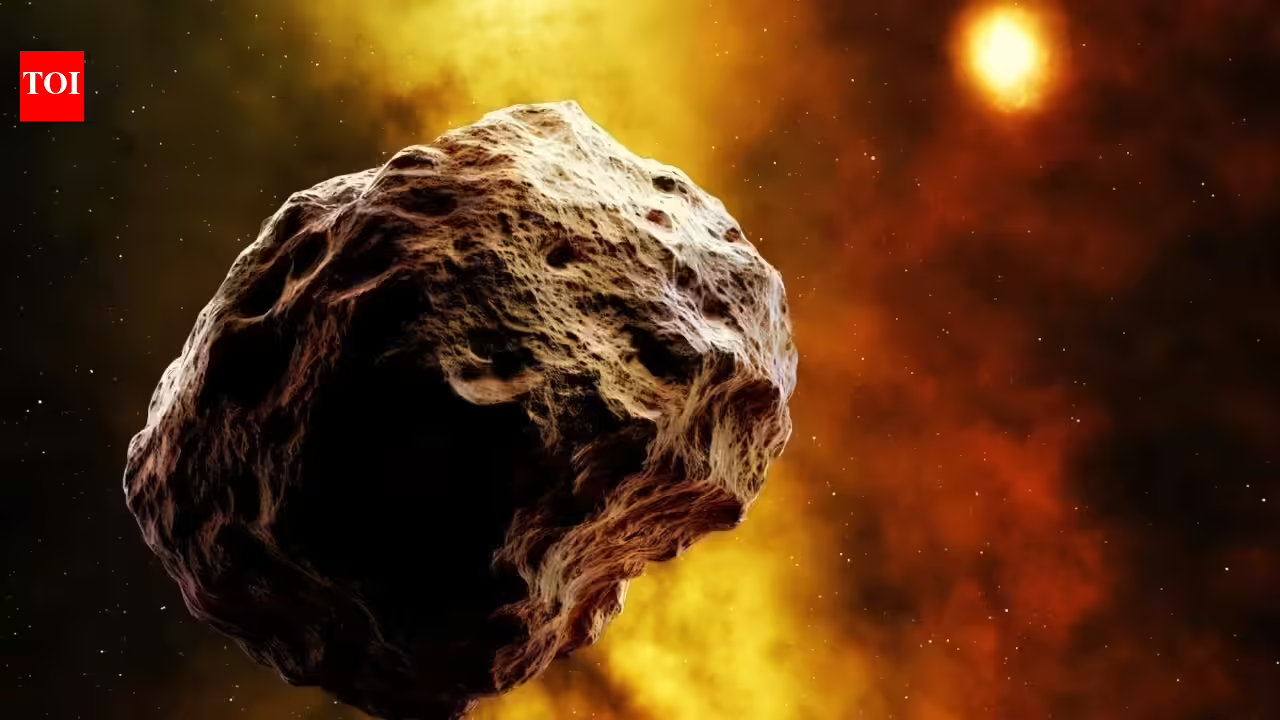
What will happen on 13 April 2029: A giant asteroid will pass closer than some satellites and be visible to billions

This Video Is Trending Right Now
For most people, asteroids are distant objects that remain hidden behind telescope lenses and scientific instruments. That will briefly change in April 2029, when one of the best-known near-Earth asteroids is expected to become visible without specialist equipment across large parts of the world. The object, called Apophis, has attracted scientific attention for more than two decades, first because of early concerns about a possible impact and later because those fears were ruled out through increasingly accurate observations. Its close approach has instead become an opportunity for research and public observation.Scientists are already mapping where people will have the best chance of seeing it, years before the event itself. If skies remain clear, billions could witness an astronomical sight that has no equivalent in recorded human history: a large asteroid passing close enough to be followed by the naked eye as it slowly crosses the night sky.
Asteroid Apophis 2029 : A remarkably close but safe flyby of Earth
On 13 April 2029, asteroid 99942 Apophis will pass around 31,600 kilometres above Earth, bringing it closer than the orbit occupied by geostationary satellites. Although that distance remains entirely safe, it is exceptionally close in astronomical terms.Rather than appearing as a blazing fireball or leaving a glowing trail, Apophis is expected to resemble a bright point of light moving steadily across the sky. Observers should notice its motion without telescopes because it will gradually shift position against the background stars over several hours. At its fastest apparent movement, it will cover roughly the width of the full Moon every minute.Astronomers describe the event as something that has never before been predicted with such certainty. While bright comets and meteor showers have long been visible to the public, forecasting a large asteroid passing this close to Earth during recorded human history is a different kind of event.
Who will be able to see asteroid Apophis in 2029
Visibility studies presented during a scientific workshop in Italy suggest that roughly 90% of the world’s population lives in areas where Apophis could potentially be seen without optical equipment.That does not mean everyone will witness it. Weather conditions, cloud cover and artificial light from towns and cities will all affect visibility on the day. Even so, the geographical reach of the event is unusually broad.The asteroid’s journey across Earth’s skies is expected to begin above Australia before continuing westward across Asia, Africa, Europe and the Atlantic, with the final stages visible from parts of the Americas and surrounding regions. The complete viewing window is expected to last about seven hours.
The best time to watch asteroid Apophis in April 2029
Astronomers have already calculated the periods when Apophis should appear brightest.During one of those peak moments, observers across Africa, much of Asia, eastern South America and sections of Europe are expected to have particularly favourable viewing conditions. Later, as the asteroid reaches its closest point to Earth above the North Atlantic, millions more people across South America, parts of North America, western Africa and Europe should also be able to follow its passage.Unlike satellites, which usually cross the sky within minutes, Apophis is expected to move slowly enough that people can watch it over an extended period before it disappears from view.
How asteroid Apophis went from a threat to a scientific opportunity
The story surrounding Apophis has changed dramatically since its discovery in 2004.Initial orbital calculations briefly suggested there was a small possibility that the asteroid could strike Earth during its 2029 encounter. Those early estimates attracted worldwide attention because the calculated probability was unusually high compared with previous asteroid discoveries.As astronomers gathered more observations over the following years, the asteroid’s orbit became much better understood. Each new measurement narrowed the uncertainties until any chance of a collision in 2029 was eliminated. Later calculations also ruled out any impact risk for at least the next hundred years.That certainty has allowed scientists to focus on what can instead be learned from such an exceptionally close flyby.
How the 2029 flyby could reshape asteroid Apophis
Although Apophis will remain safely distant, Earth’s gravity is still expected to influence the asteroid during its passage.The encounter will alter its path around the Sun, changing its future orbit without creating a danger for Earth. What remains uncertain is how the asteroid itself will respond internally.Researchers believe tidal forces generated by Earth’s gravity could disturb the asteroid’s surface. Loose rocks might shift, landslides could occur, or fresh material hidden beneath weathered layers may become exposed for the first time. There is also the possibility that little visible change will happen at all.That uncertainty is exactly what makes the event valuable. Scientists rarely get the chance to examine how a relatively large asteroid behaves during such a close gravitational encounter with our planet.
How astronomers will study asteroid Apophis during its 2029 flyby
Although the flyby is still several years away, planning has already begun.Astronomers hope to monitor Apophis using observatories positioned along its projected path, including facilities in Spain’s Canary Islands, where viewing conditions are expected to be particularly favourable during the closest stage of the encounter.Ground-based telescopes will be joined by radar observations and other instruments capable of measuring subtle changes in the asteroid’s shape, spin and surface. Those observations could answer questions that cannot be resolved through computer modelling alone.For planetary scientists, the event represents a rare natural experiment. Every measurement collected during those few hours will improve understanding of asteroid behaviour and help refine models used to study future near-Earth objects.


He collapsed and d!ed after arrest for drug possession – South African Police dismiss claims linking d3ath of Nigerian man in custody to anti-illegal immigrants protests

Cough syrup, 4 calls to 'girlfriend in India': Engineer husband charged with murder 8 months after wife found dead in US home

Female Monaco bombing suspect ‘shot de@d’ in Ukraine a week after attack on Ukrainian millionaire Vadym Yermolaiev

Court Voids ARCON’s N60bn Fine Slams On Facebook Nigeria

Three Nigerian kids win gold in international STEM Olympiad competition

NABTEB records 47.7% drop in enrolment as 75% candidates pass entrance examination

IPOB: Nnamdi Kanu notifies UN Security Council, 72 countries of transition in DOS

 Society1 day ago
H0rny Old Man Caught On Camera In Broad Daylight Trying To Chop Mad Woman At Roadside
 Society2 days ago
Sad Video emerges showing Kenyan Lady working in the Middle East crying in distress
- Society1 day ago
Chaos At Cemetery As Area Boys Hijack Dead Body In Coffin, Stops Family From Burial Over Unpaid Debt
- Politics2 days ago
Okpebholo seeks wider support as UNIBEN launches ₦100bn Trust Development Fund
- Investigation1 day ago
If this was AFCON the nonsense being said would be crazy â Former Congolese footballer Yannick Bolasie slams FIFA over Balogun red card reversal
- Society2 days ago
Armed Robbers Target Mobile Money Vendor, One Shot Dead as GH¢140,000 Is Recovered
- News2 days ago
Obi demands accountability over IMF’s ₦8.83tn off-budget spending report
- Investigation2 days ago
She brandished cutlass at me in church during Sunday service – Divorce-seeking pastor tells Oyo court as wife accuses him of 18-year-old girl