World
When Will the Wildfire Smoke Clear?

This Video Is Trending Right Now
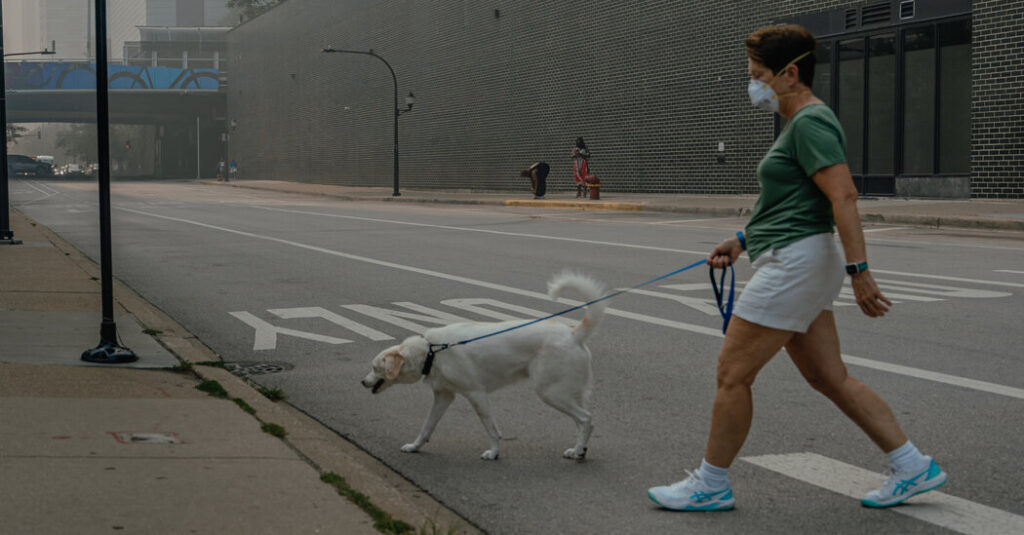
Acrid air from wildfires burning in the Canadian province of Ontario and in Minnesota continued to darken skies over parts of the Midwest on Sunday and stretched into the Northeast and Mid-Atlantic.
The smoke’s path was expected to shift by the hour, though forecasters said the worst conditions on Sunday were expected across the Great Lakes region. Air quality alerts were in effect across the region, including in parts of Minnesota and much of Wisconsin, Illinois, Indiana, Michigan and parts of Ohio.
The Northeast got a reprieve from the smoke on Saturday as thunderstorms and downpours washed out some of the smoke and winds pushed it offshore. But as conditions improved there, more sooty air spread into the upper Midwest.
On Sunday a new plume of smoke was spreading across Wisconsin and Northern Illinois and was moving toward the Ohio Valley. It could eventually reach the East Coast later in the day, but the concentrations of polluted air on Sunday in the Northeast were unlikely to be as high as they were before the weekend.
“We’re starting to tap into cleaner air from eastern Canada,” said Richard Bann, a meteorologist with the Weather Prediction Center, “and we’ll start to get some of that in the Northeast.”
Air quality alerts remained in effect on Sunday over parts of the Northeast and Mid-Atlantic, including in western and central New York and as well as western Maryland.
Conditions were expected to change little on Monday. Frank Pereira, a meteorologist at the Weather Prediction Center, said the highest concentrations of wildfire smoke were still expected across parts of the Great Lakes region, particularly in Michigan, Northern Illinois and Indiana, although some relief was likely later in the day.
“A pretty strong system is going to be coming through into the area by late Monday, bringing widespread rain across the Great Lakes,” he said. “So that will help improve conditions and start to clear things out.”
That improvement could be short-lived, however. Mr. Pereira said northwesterly winds coming out of central Canada could push another wave of smoke-filled air into parts of the Great Lakes and the Northeastern United States by the middle of the week.
Here’s what else to know about the wildfires and their smoke:
More than 900 wildfires are burning across Canada and some of the most active ones were in Ontario, with the smoke drifting south across the Great Lakes and into the United States. Read more about the Canada fires here. Wildfires in northern Minnesota were also contributing to the smoke, and more about those can be found here.
Scientists estimate that wildfire smoke is linked to tens of thousands of deaths a year, and that human-caused climate change is responsible for a growing share of them. Read more ›


Ondo community protests over deplorable road, seeks Aiyedatiwa’s intervention

Gavin Newsom’s diaper deal stinks

Power and water plant set ablaze as Iran attacks Bahrain and Kuwait

Spain earns $51 million for World Cup win and runner-up Argentina gets $34 million as total payout for all 48 teams hits record-high $871 million

NPFL: Plateau United snap up former home-Eagles midfielder

Badejo-Okusanya elected 33rd NBA president

Pete Hegseth inadvertently revealed MAGA’s secrets with masculinity initiative: analyst

 Society2 days ago
Heartbroken Girlfriend Storms Studio To Remove Portrait Tattoo Of Cheating Boyfriend From Her Back
- Breaking2 days ago
Ondo police arrest father for burning his 10-year-old daughter’s private part with hot iron over bedwetting
- Investigation2 days ago
Woman forced to dance as punishment after allegedly being caught sneaking into a compound in Awka
- Investigation3 days ago
âJurassic Parkâ actor Sam Neillâs cause of death revealed by agent
- Investigation3 days ago
‘Nigerians to pay â¦50,000 fine for hawking, preaching in buses’ – Senate
- Investigation3 days ago
Nigeria has no business being poor â VP Shettima
- Investigation3 days ago
How Mary Habila di£d â Colleague Anita Baaki recounts final moments at David Umahi’s House
- Investigation3 days ago
Tinubu afraid of my popularity in grassroots â Sowore