World
Why does Alaska go 65 days without sunrise: The science behind polar night

This Video Is Trending Right Now
Each year, as autumn turns to winter, the sun sets over Utqiagvik, Alaska, and does not rise again for roughly 65 days. Formerly known as Barrow, Utqiagvik sits at the very northern tip of Alaska, about 300 miles north of the Arctic Circle, making it the northernmost community in North America. This extended stretch of darkness, known as polar night, is not some rare anomaly but a predictable, recurring feature of life this far north, tied directly to the same basic astronomy that gives every part of the planet its seasons. Understanding why Utqiagvik disappears into darkness for more than two months each winter comes down to a simple geometric fact about how the Earth is tilted on its axis.
Why the Earth’s tilt is the real cause of polar night
The reason Utqiagvik loses the sun for so long has nothing to do with clouds, latitude tricks, or unusual weather, it comes down entirely to the roughly 23.5 degree tilt of Earth’s axis relative to its orbit around the sun. As the Northern Hemisphere leans away from the sun between the September and March equinoxes, daylight steadily retreats further and further north, and any location within about 23.5 degrees of the North Pole eventually finds itself pointed entirely away from the sun’s direct rays for an extended stretch. Since Utqiagvik sits well inside this Arctic Circle zone, the sun simply never climbs high enough above the horizon during the darkest months of the year to actually rise there at all.
Why the length of polar night depends on how far north you are
Not every location above the Arctic Circle experiences the exact same length of darkness, since how far a place sits from the North Pole directly determines how long its polar night lasts. Utqiagvik’s 65 days of darkness is actually on the longer end for inhabited settlements, considerably longer than the roughly 27 days experienced in Arctic Village further south, while the North Pole itself endures a far longer stretch of darkness lasting around 179 days each year. This relationship works in reverse as well, once winter finally passes, Utqiagvik swings to the opposite extreme, entering a period of continuous daylight known as the midnight sun that runs from mid May through early August, when the sun never dips below the horizon at all.
Why polar night is not the same as total darkness
Despite its name, polar night in Utqiagvik does not mean complete, unbroken blackness for two straight months. According to the National Weather Service’s official explanation of twilight, civil twilight, the period when the centre of the sun sits within six degrees of the horizon, still provides enough natural light that people can typically see outdoor objects clearly and often do not need artificial lighting at all. In Utqiagvik, this civil twilight period stretches for several hours even at the height of polar night, shrinking to its shortest window right around the winter solstice before gradually lengthening again as the weeks pass, meaning residents experience a dim, extended twilight rather than genuine round the clock night.
How light gradually fades and returns through different twilight stages
Beyond civil twilight, astronomers and meteorologists recognise further stages of darkness as the sun sinks lower below the horizon. According to the official rise, set and twilight definitions maintained by the United States Naval Observatory, nautical twilight begins when the sun’s centre reaches twelve degrees below the horizon, a point at which the horizon itself remains visible even under a moonless sky, historically useful for sailors taking navigational star readings, while astronomical twilight extends the boundary further to eighteen degrees below the horizon, beyond which scattered sunlight becomes fainter than starlight itself and the sky is considered genuinely dark. During the very darkest days of polar night, Utqiagvik briefly passes through all three of these twilight stages in sequence before the sky finally settles into true night for a few hours, only to begin the entire cycle again in reverse as the sun’s position slowly shifts back toward the horizon.
What life actually looks like during two months without sunrise
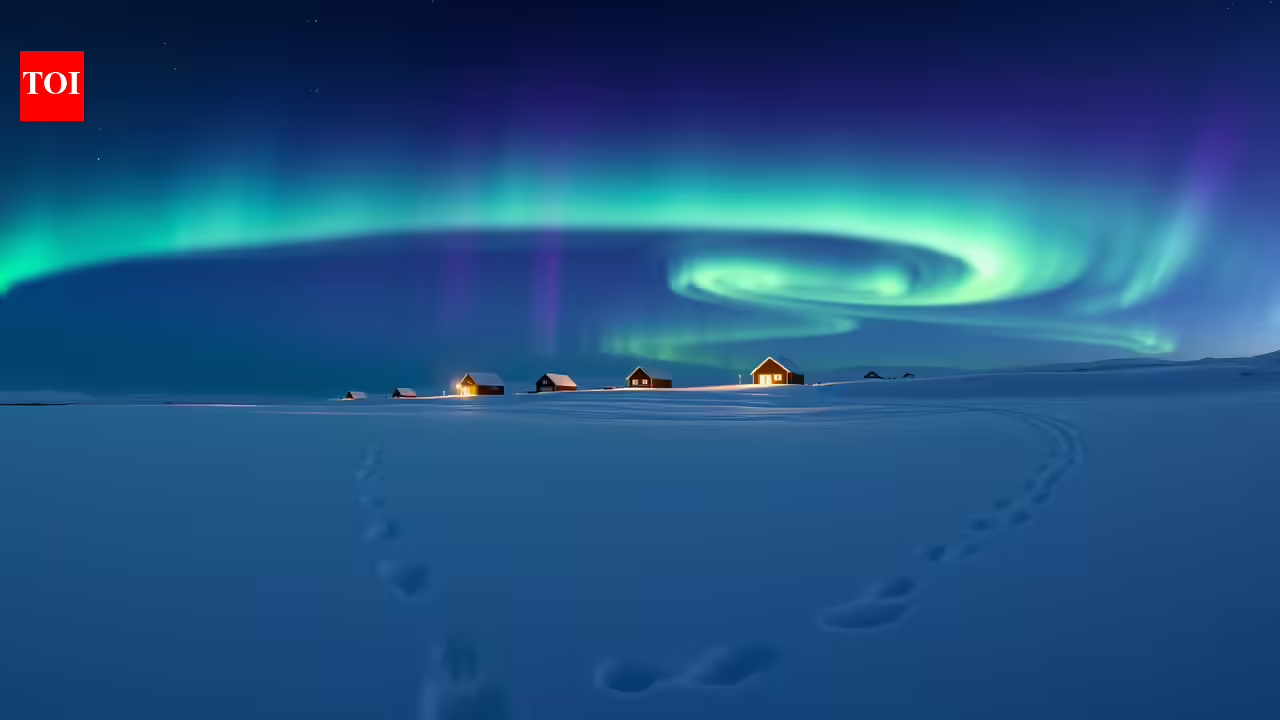
For residents of Utqiagvik, largely Inupiat Alaska Native families along with a small non native population, polar night is simply an established, expected part of the yearly calendar rather than a disruptive surprise. The faint twilight glow near the southern horizon provides some natural light through much of the day, and the Aurora Borealis frequently lights up the night sky overhead during the darkest stretches, offering its own striking, if unpredictable, source of illumination. When the sun does finally reappear on January 22, it initially offers only a brief glimpse above the horizon before setting again within an hour or two, and from there daylight steadily lengthens day by day until Utqiagvik eventually swings into its own opposite extreme of endless summer daylight, completing a yearly rhythm shaped entirely by the same tilted axis that gives the rest of the world its far gentler cycle of seasons.


Benue U.S. Exchange Alumni Leadership’s Summit Attracts 400 Participants

Wike Reveals Why Tinubu Removed FCT From TSA

Quote of the day by Saddam Hussein: 'A lion doesn't care if a monkey in a tree is laughing at him'

Trump issues chilling troops threat as he warns 'not going to have a Europe anymore'

We’ll replicate FCT’s infrastructure strides across Nigeria – Tinubu

Armed teen involved in NYPD cop shooting identified and charged

Davido Reveals Career Path He Would Have Chosen Without Music

 Society1 day ago
H0rny Old Man Caught On Camera In Broad Daylight Trying To Chop Mad Woman At Roadside
 Society2 days ago
Sad Video emerges showing Kenyan Lady working in the Middle East crying in distress
- Politics2 days ago
Okpebholo seeks wider support as UNIBEN launches ₦100bn Trust Development Fund
- Investigation1 day ago
If this was AFCON the nonsense being said would be crazy â Former Congolese footballer Yannick Bolasie slams FIFA over Balogun red card reversal
- Society22 hours ago
Chaos At Cemetery As Area Boys Hijack Dead Body In Coffin, Stops Family From Burial Over Unpaid Debt
- News3 days ago
Xenophobia: South Africa rejects Nigeria’s compensation demand
- News2 days ago
Obi demands accountability over IMF’s ₦8.83tn off-budget spending report
- Society23 hours ago
Watch Moment Husband Nearly Beats Pastor As Wife Donates Family Car To Him As Seed Offering