World
Aw, It’s Baby’s First A.I. Surveillance System

This Video Is Trending Right Now
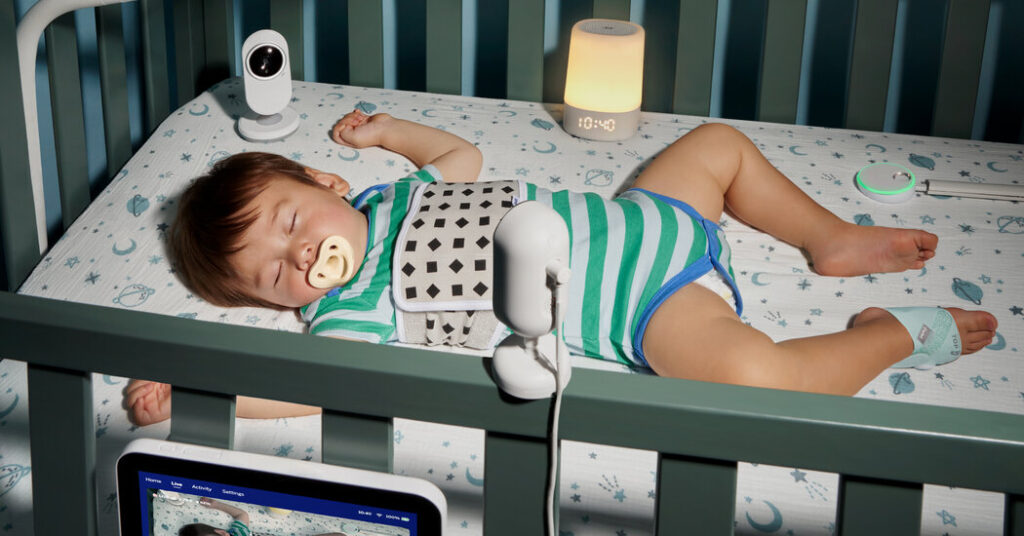
For all but a few nights of my first child’s life, her sleep has been recorded and analyzed by the Nanit Smart Baby Monitor System. A sleek white camera, bolted to the wall, points straight down at her body. High-definition footage is beamed to a server, where machine-learning algorithms log her movements and the precise moments her eyes open and close. The data are distilled into charts and insights that my husband and I review in the Nanit app: a daily “sleep efficiency” score, from zero to 100; minutes until sleep onset; the number of times we were needed over the course of a night.
Initially, we’d purchased the monitor simply for the ability to check on our daughter from anywhere using our phones. But we were quickly awed by everything else it could do, even as I recognized how unnecessary it was to have this much data about our baby, who was in fact a pretty decent sleeper. “SO MUCH INFORMATION,” I texted a friend. “it’s honestly TMI but i love it so much.” The Nanit straddles the line between creepy and delightful. It is the Eye of Sauron, but it also knows when we enter our daughter’s room in the morning and joy hits her face — and it sends us intelligently edited montages of these moments.
When I became pregnant with a second child in 2025, my husband and I did not even have a conversation about buying another Nanit camera. We had it waiting the day she came home from the hospital.
As a tool that crams together the sweetest thing on earth — a newborn — with relentless data collection by a for-profit tech company, the Nanit has always been a little disconcerting. A branding consultancy that helped create the product’s “visual identity” notes in a case study on its website: “The central challenge in this project was how to introduce this novel technology to the parenting market while transcending the negative connotations of ‘surveillance.’”
Millennial and Gen Z parents seem to have been persuaded. Nanit says it has one million daily users and annual revenue of more than $100 million. The most expensive version of its kit costs $474 and roughly $100 a year in subscription fees. And the market for babytech is only getting more crowded.
Owlet, Nanit’s biggest rival, offers a $300 pulse oximetry tracker that attaches to a baby’s foot through a sock. Huckleberry, a free app for tracking feedings and diaper changes, markets a $120 upgrade membership with “optimized nap predictions” and access to an artificial intelligence chatbot that, after logging your baby’s habits, can deliver personalized guidance and pep talks. CuboAi’s $359 Smart Baby Monitor 3 touts “A.I.-scheduled lullabies” and sends alerts when a baby’s face is covered.
As the products and their promises proliferate, I’ve gotten a little unnerved by how easy it’s become to outsource daily parenting decisions to technology. The downsides of this rush are manifest: sneakily high costs; the erosion of parents’ autonomy and self-confidence; giving sensitive data to corporations. But there may be no stopping the growth of babytech as a category. Parents my age and younger are increasingly willing to embrace tracking and analytics for their children — part of a broader cultural obsession with health data and optimization. Nearly half of Americans own a wearable device, and the companies that make smart rings and smart wristbands have valuations north of $10 billion.
Nanit and its rivals want to own 24/7 health tracking for the sub-four-foot set. And their already astonishing levels of baby data collection are just the beginning. Nanit recently raised $50 million from investors to expand its use of A.I. and use its camera to track speech and language development, motor skills and more, while extending its presence in children’s bedrooms into early adolescence.
My older daughter is now 4 and has become aware of “the Nanit,” which she refers to by name. I decided I wanted to know more about the company whose products stare at my kids all night — and which has designs to start tracking them far more.
When I visited Nanit’s office in downtown Manhattan recently, I was greeted by the sight of a lifelike baby doll lying in a $600 crib under one of the company’s cameras. The doll was clad in a onesie and a $20 Nanit Breathing Band, which was printed with a sequence of squares and diamonds. By analyzing the movement of pixels, the company’s software can quantify every rise and fall of a baby’s chest and send alerts to parents’ phones if it detects danger.
Nanit was founded in 2014 by Assaf Glazer, an Israeli who had just completed a Ph.D. in machine learning and computer vision at the Technion-Israel Institute of Technology. Dr. Glazer and his wife had welcomed their first child, and he was sleep-deprived. With a friend, Tor Ivry, who was expecting his third child, he began to dream up a device that could identify and analyze sleep beyond the rudimentary baby monitors then on the market.
“Nanit” was conjured with words like “nanny” and “nano” in mind, and was meant to evoke “cutting-edge technology for parents,” Dr. Glazer has said. (He is now the chief executive of Vinst, a food tech start-up in Israel.)
Since 2024, Nanit has been led by Anushka Salinas, 44, the former president of Rent the Runway. She oversees some 150 employees, most of whom are parents, who work under the tagline, “Turn second-guessing into: “I’ve got this.” When we met at Nanit’s office, Ms. Salinas was wearing an Oura ring and was also testing a Whoop band, and she spoke earnestly about how Nanit is “effectively the child answer” to such devices.
“What’s happening with adult tracking is beginning to trickle down now in a much more meaningful way to kids,” said Ms. Salinas, who has two of her own. “Kids aren’t really starting to wear Apple Watches and things like that until around age 10 for the most part, sometimes a little younger. So we really think of that zero-to-10 for Nanit as kind of the place that we live.”
Sleep tracking and optimization will remain the base of Nanit’s business, Ms. Salinas said. But already, the app offers some health features, such as automatically detecting and recording audio of coughs that can be shared with pediatricians. The company sees growth potential in giving its app the ability to weigh in on speech and motor development, which Nanit’s camera could track ambiently. Hypothetically, Ms. Salinas said, the app could flag a delay and offer parents tips for improvement, like reading more bedtime stories.
Children might one day grow up to resent this intrusion, with data on their formative years stored indefinitely on a corporation’s servers. (Nanit says that its data is secure and is never sold or used for marketing.) But Ms. Salinas argues that children, in the future, may want access to their earliest health analytics for a variety of reasons. “Maybe a kid wants to be a professional athlete later on and they want to be able to go back and understand how their sleep developed and what that means for their potential,” she said.
She also suggested that when our own Nanit-tracked children have children, they’ll value the ability to go back and look at their own bedtimes. Nanit does not store video footage forever, but her comment made me wonder if that function was inevitable. I shuddered to imagine a permanent record of every time I’ve testily denied a fourth book over vocal protest.
Nanit’s people are upfront about not being entirely sure about all the potential uses of their devices. “I’m not going to sit here and pretend that we know the answer to what all of this data is going to unlock in the future,” Ms. Salinas said. She pointed to recent breakthroughs from adult wearables, like detecting atrial fibrillation and the early signs of Parkinson’s disease, as proof that the possibilities could be significant.
Company executives seem to have absolute conviction in the benefits of their technology. Mr. Ivry, the chief technology officer, shared more ideas. What if a 4-year-old was diagnosed with a medical condition, and unique patterns from the Nanit could help explain it? “Maybe you have a super introverted kid and you want to understand if some of the motion patterns when they were babies kind of predicted that,” he said. “It doesn’t have to be a bad thing.”
For the Nanit-pilled, it’s almost silly to object to the idea of precisely tracking a baby. Victoria Vaynberg, the company’s marketing chief, pointed out how thoroughly surveillance-like behavior has infiltrated every part of our lives. “We care about where our food delivery is and we want to be able to track it to the exact block until it arrives,” she told me. “Yet there’s a hesitation about knowing exactly how long your baby slept?”
Baby monitors are a relatively small industry, with sales of just $316 million last year, according to Circana, a market research firm. Turning passive monitors into active health trackers is a way of accessing a far larger pot of money. Various estimates put the size of the wearables market as approaching $100 billion, and as more consumers use them to track their activity and get algorithmic advice, applying the promise of more data = better life to children can seem like an obvious next step.
To hear the companies tell it, the benefits of embracing babytech are life changing. Nanit has claimed that its users get 36 extra nights of sleep a year, because parents feel more confident shifting babies to their own rooms earlier, and that its monitoring can prevent a baby’s skull from getting flat. The company has paid for studies on new parents’ sex habits and suggested that buying a Nanit can lead to more intercourse. Owlet and Huckleberry claim that more than 90 percent of their customers enjoy better sleep.
Kurt Workman, the chief executive of Owlet, which he co-founded in 2012 in Utah, told me that he’s noticed parents are asking “way fewer questions on how the data can be useful, and what it could mean, and is it safe.” The company, which is public, had revenue of $106 million last year and says that more than 2.5 million people have used its products. “We have parents who are like, ‘I know I can put my baby to sleep when their heart rate goes below this level, and they’ll stay asleep,’” said Mr. Workman. “We’re already starting to hack that.”
In 2021, the Food and Drug Administration sent Mr. Workman a warning letter after finding that Owlet had violated a federal law with marketing that veered into the realm of medical devices: Ads for Owlet’s Smart Sock product had promised the device would alert parents about dangerous changes in their children’s pulse rates and blood oxygen levels. Now Owlet sells an F.D.A.-approved Dream Sock, touting “medical-grade monitoring” that “gives you real-time visibility into your baby’s wellness, so you know, not guess.”
Some pediatricians have criticized Owlet for marketing that makes use of fear — its website includes testimonials from families who say their babies could have faced “heart failure” had they not been wearing its device — and for causing unnecessary anxiety. When the Dream Sock malfunctions, parents think their baby has stopped breathing. Mr. Workman argues that the stories about Owlet catching life-threatening conditions are “incredible” proof points. “That’s a real-world, tangible impact to having access to health technology,” he said. “It’s not to scare people but to show that this is real.”
A different read of the babytech industry is that it’s all nonsense: Infants survived just fine before cameras with infrared night vision, humidity sensors and 256-bit encryption. My mother, who raised three of us, has made no secret that she thinks my generation is crazy. Recently, she got together with some of the Indian aunties whose children I grew up with. They bonded, laughing, over the protocols they were subject to when asked to handle their grandchildren’s bedtimes — the Nanits and Owlets, the sound machines and temperature controls, the precise sequencing that would make a nuclear reactor shutdown seem casual. The aunties were entertained and baffled by how different these routines were from their own experiences of early motherhood, which they recalled as more relaxed.
When I put the Nanit app on my mom’s phone for an evening of babysitting, she was bewildered by the phone notifications and mystified by why I would even want the analytics. And she plainly doesn’t like it when I use the app to check, a little compulsively, if my sleeping kids are, in fact, sleeping. In her view, it’s all anxiety inducing. She was weirded out by the idea that my kids’ data would live on a server and that they would perhaps be able to retrieve it someday. “Too much,” she said.
Plus, for all of Nanit’s claims and ambitions, parents often take to social media to complain that its most basic data can be wrong. The camera will flag visits or cries that didn’t actually happen.
Rebekah Diamond, a pediatrician and assistant professor at Columbia University, worries that parents who rely on these devices are numbing their natural instincts and allowing technology to interfere with one of the most universal and meaningful of human experiences. “I’m very cautious and wary of the big picture of kid-tracking and health-tracking and health monitoring, when it comes to this hyper-detailed, hyper-obsessive way it seems to be unrolling,” she told me. “Parents are losing a little bit of the muscle of their own confidence and decision-making.”
In other words, baby-tracking devices can be infantilizing. “What would you do if you didn’t have this app that said your baby needs a nap?” Dr. Diamond said. “You’d look at your baby. And see that they look tired.”
Baby monitors have their roots in fear. In 1932, American parents were horrified to learn that Charles A. Lindbergh’s toddler son had been taken from his second-floor nursery, and eventually killed, while five adults were in the home. A few years later, Zenith Radio Corporation introduced the first commercial baby monitor. The “Radio Nurse” was designed to be “on guard” for babies and the sick and elderly. An instruction manual read: “If the baby cries — if the invalid wants a glass of water — if there is a fire — if an intruder enters — YOU KNOW IT INSTANTLY!”
Nanit, Owlet and their competitors still operate in this space. The comedian John Mulaney recently riffed on his toddler son’s sleep setup, saying his bedroom looked like a “C.I.A. black site,” with a blackout tent over his crib. “I don’t know why we have 24-hour CCTV footage of my son’s crib, he’s not going anywhere — he sleeps in a bag,” he said. “We then have three sound machines going at full blast. And because we read it once on Instagram, we keep his nursery at 68 degrees. Any warmer and your infant will die automatically.”
One person who remains oblivious to all this parental anxiety is my older daughter. The Nanit is just a feature in her room. She understands that she can speak to my husband and me through the device, whose four red lights blink to power its night vision, and that we can see her at night through our phones. I imagine that she would develop sharper feelings about the camera if it started to play an extended role in her life, for years to come.
Nanit believes that one solution for that, as it looks to extend its presence in children’s bedrooms beyond toddlerhood, are new covers, known as “Cammies,” that can make the monitor look like a bunny, a bear or an elephant. Ms. Salinas said that making the camera look like a little friend or toy can “generate a lot more love” for it. But she added, “Each family is going to have to decide on their own if their child is OK with having the camera in the room as they get to the age that they’re making their own decisions.”
In her view, this is the start of a new future, a library of health data from cradle to grave. “The adoption curve accelerated significantly over the last few years,” Ms. Salinas said, “and I expect that to continue — such that it’ll be almost every parent that will have some product like Nanit that will help them have much richer insights on their child and who they’re becoming.”
Even before I first met Ms. Salinas, I had been wondering when to remove the Nanit from its perch above my older daughter’s bed. She may simply outgrow it before my husband and I come to a formal opinion on privacy versus convenience. These days, she no longer naps, and in the mornings she is as likely to greet us in our own bed than the other way around. There’s still joy on her face, and I make sure to see it there, rather than on a screen.


BREAKING: Abducted Benue State Seminarian Escapes From Kidnappers

My three days at a motel as a human biohazard

Iran denies asking US to halt strikes, calls Trump’s claim ‘new lie’

God has answered our prayers. We have found them- lady who sought public help in finding her mumâs missing three children gives heartwarming update

Female driver dies after speeding vehicle crashes into building in Lagos

Father of slain Marine speaks out after illegal immigrant who killed son faces third deportation

Government to chair EU meeting on Ceuta crisis as death toll reaches 86

 Investigation2 days ago
âSome of us are âpick meâ and we wouldnât know. I used to do things for men I liked when it was supposed to be the other way aroundâ â Lady reveals
- Investigation2 days ago
âMy ex just logged me out of his Netflix and Prime because I said he is weird and I regret meeting him. That doesnât mean he should remove meâ â Nigerian lady reacts as ex revokes her access
- Breaking2 days ago
âWe are going to beat the f**king sh*t out of themâ – Trump issues sharp warning to Iran as diplomacy ends after surprise attack on US base
- Investigation2 days ago
âTinubuâs comment on hunger insensitiveâ- Peter Obi
- Investigation2 days ago
Before you go about snatching someone else’s husband, please check the quality of what your’re snatching first- actress Rita Edochie shades an unnamed âhusband snatcherâ
- Investigation3 days ago
âWeâre committed to increasing finance for Africaâ- CAF urges members to review FIFA’s private investor plan
- Investigation3 days ago
âNigeria is the Republic of docile peopleâ- OAP Dotun slams critics of Tyla concert boycott as he recalls South Africa’s treatment of Burna Boy
- Breaking2 days ago
âNigeria is the Republic of docile peopleâ- OAP Dotun slams critics of Tyla concert boycott as he recalls South Africa’s treatment of Burna Boy