World
Carmakers Go Back to the ’80s With Turbo Engines

This Video Is Trending Right Now
Does hearing a “1980s rewind” on the radio give you a nostalgic kick while driving? Your modern car might be getting a power kick from another 1980s reprise, and you may not even realize it.
Forty-five percent of the 16.3 million new passenger vehicles sold in the United States in 2025 had a turbocharged engine. To make that happen, carmakers had to eliminate a slew of 1980s turbo problems.
Driven by the hot, expanding exhaust stream exiting an engine, a turbocharger is a small compressor that forces more air into the engine’s cylinders, allowing it to burn more fuel to produce greater power. Except for electric vehicles, a turbo engine is your only choice from many luxury brands, including Audi, BMW and Mercedes-Benz. In Porsche’s lineup, the only naturally aspirated (nonturbo) holdouts are four 911 GT3 variants; all other models have turbocharged gas engines.
Turbos are prevalent among mainstream brands, too. All of Ford’s S.U.V.s have them, as do many of its pickups. Turbo engines propel many Chevrolet vehicles, including the automaker’s three sub-$30,000 crossovers and its 1,064-horsepower Corvette ZR1. Hyundai has nearly 30 percent turbos in its sales mix, including some hybrids. (Kia vehicles share powertrains with Hyundai.) The Honda CR-V, one of the most popular vehicles in America, has a 1.5-liter turbo four-cylinder engine standard.
“Customers don’t necessarily wake up wanting a turbocharger — they just want a vehicle that feels effortless to drive and affordable to own,” said Olabisi Boyle, a senior vice president at Hyundai. “The modern turbocharger quietly stopped being a novelty and became invisible. Drivers simply experience better acceleration, better drivability and better efficiency.”
Among turbo engines today, powerful four-cylinders are the most common, per federal data. They not only are used in small and midsize vehicles but have also replaced larger V6 and V8 engines in bigger models, too, like the Traverse S.U.V. and the Colorado and Silverado pickups, all from Chevy.
Unlike 1980s turbo cars, today’s models don’t broadcast their engine tech with big TURBO badges or decals on the fenders or doors. You probably can’t tell a turbo engine from driving, either, because modern versions eliminate so-called turbo lag, the slight delay between pressing the accelerator pedal and the turbo boost kicking in, which affected many older models. Most important, carmakers employ numerous measures to prevent the terminal mechanical failures that dogged turbo engines four decades ago.
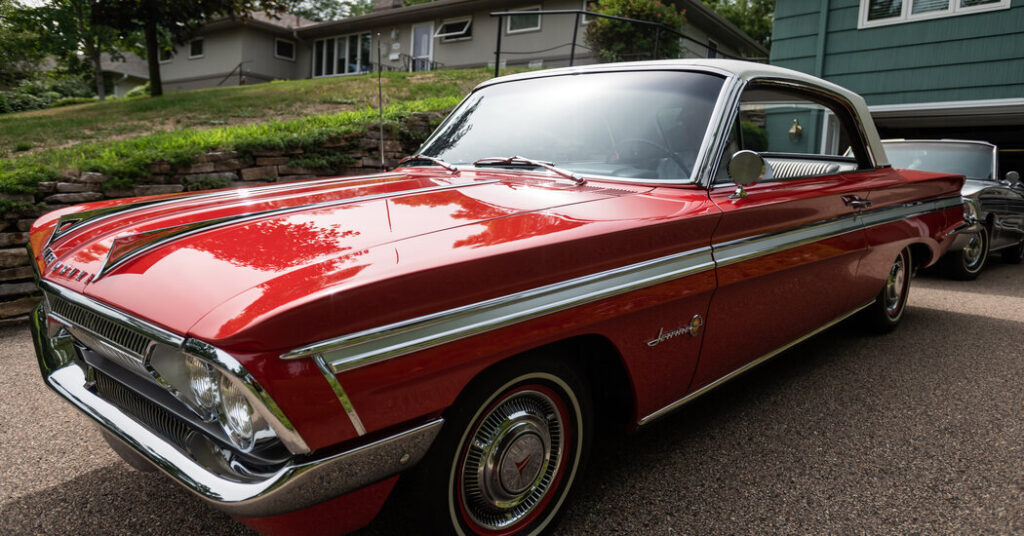
A common thread connecting yesterday’s turbos with today’s is the prime driver behind them: fuel-economy regulations that have forced carmakers to downsize engines. The results back then left buyers wanting better performance, not just for sporty cars but for everyday sedans, too. Turbocharging was not new, even in the ’80s. General Motors offered the first production cars with the power-booster in the early 1960s, the Chevy Corvair Monza Spyder and Oldsmobile Jetfire. Results were mixed and especially bad for the Olds. A turbo revival in the 1970s promised better results.
The Porsche 911 Turbo Carrera (a.k.a. 930) rocked the sports car world in 1975 (1976 in the United States), but it was the Buick division of G.M. that pushed turbocharging into the American mainstream in 1978 with midsize and full-size models. An optional turbo V6 increased horsepower by about 60 percent, and power would escalate from there.
While some may feel wistful for classic turbo cars, nobody would accept their mechanical demons in 2026. Exorcising those was a prerequisite for widespread adoption, explained Michael Schmidt, a top turbocharger executive at Stellantis.
“We cured turbo lag by regulating turbo boost electronically, rather than mechanically, as was done back then,” he said. “The instant you step on the accelerator, you get boost. There’s no waiting for the turbos to spool up.”
Improved airflow, along with tighter tolerances and lighter parts, also helped. In its road test of the 550-horsepower, twin-turbo six-cylinder Dodge Charger Scat Pack, Motor Trend said, “power delivery feels immediate and linear.” The Jeep Grand Wagoneer and some Ram pickups use a version of that engine.
Mr. Schmidt knew the old turbo engines’ troubles to be conquered. “Chrysler’s highest warranty item in the ’80s was turbo coking,” he said. He was referring to a condition in which a turbo’s heat bakes an engine’s lubricating oil, producing carbonized chunks that can wreck the turbo and other engine components. To help cool the oil, some drivers would idle their cars for a few minutes before shutting off the engine.
Stellantis turbo engines, and those from other carmakers, use an electrically operated “after-run” system to cool the oil after shutdown. In other turbo cars, a “thermal-siphon” system passively pulls coolant through the turbo-bearing housing.
Mr. Schmidt also credits today’s motor oils, both synthetic and mineral, with helping to resist heat damage better than 1980s oils.
Even with many brands offering turbocharged cars decades ago, these accounted for only an estimated 6 to 7 percent of sales. Aside from car buffs, few probably remember them today. Some models have become valuable in the collector-car market, a reward, perhaps, for helping to pull cars out of the “malaise era.”
“One of the things that drives values in classic cars is performance, even when that performance has been superseded by cars that came afterwards,” said Dave Kinney, the publisher of Hagerty Price Guide. “If one of your collecting requirements is that something be exotic for its time, for ’80s and ’90s cars, that would be turbocharging.”
Values cover a wide range. Several 1976-89 Porsche 911 Turbos recently sold on the Bring a Trailer auction site for up to $250,000. On the same site, numerous super-low-mile Buick GNXs that buyers preserved instead of driving sold in the same range. Enthusiasts looking for something far more accessible have bought low-mile 1987-88 Ford Thunderbird Turbo Coupes for $13,000 to $23,000, a range in line with Hagerty.
“It’s not a very collectible car, but the people who own them absolutely love them,” Mr. Kinney said.
More than collectors are giving first-wave turbo cars their due. In June, the Cincinnati Concours d’Elegance most likely became the first such American event to curate a display class just for turbocharged cars from 1974 to 1993. It included a 1986 Dodge Daytona Turbo Z and a 1988 Ferrari 288 GTO.
The impetus for the display came from the event’s chairman, Dave Sheehy. Seeing Saab 900 Turbos used as police patrol cars in Vail, Colo., in the 1980s inspired him to buy one. Since then, he has owned almost exclusively turbocharged cars, including his current Alfa Romeo Giulia.
“It was a special era for cars,” he said.


New Zone 13 AIG unveils vision, prioritises professionalism, accountability

Atiku reveals why former President Obasanjo is unforgiving, vindictive

FIFA president, Gianni Infantino accepts defeat as he scraps controversial plot to sell stakes in the World Cup

Inside Miami’s ‘Billionaire Bunker,’ a man-made island for the .01% where billionaires like Jeff Bezos and Mark Zuckerberg shell out for total privacy

Breaking: Veteran journalist, Chief Lekan Alabi dies at 76

Middle East war: NCPC lifts ban on Christian pilgrimage to Israel
Middle East war: NCPC lifts ban on Christian pilgrimage to Israel

 World3 days ago
My daughter’s squishy toy burst on her legs. We ended up in the emergency room.
- Investigation3 days ago
P0rn star Emily Willisâ family reaches $3m settlement over rehab brain injury that left her permanently disabled
- Investigation1 day ago
âSome of us are âpick meâ and we wouldnât know. I used to do things for men I liked when it was supposed to be the other way aroundâ â Lady reveals
- Investigation3 days ago
âItâs is an opportunity but not an obligationâ â FIFA president Infantino defends new proposal to sell FIFA World Cup rights to private company after facing backlash
- Investigation3 days ago
âWe are going to beat the f**king sh*t out of themâ – Trump issues sharp warning to Iran as diplomacy ends after surprise attack on US base
- Breaking1 day ago
âWe are going to beat the f**king sh*t out of themâ – Trump issues sharp warning to Iran as diplomacy ends after surprise attack on US base
- Investigation1 day ago
Before you go about snatching someone else’s husband, please check the quality of what your’re snatching first- actress Rita Edochie shades an unnamed âhusband snatcherâ
- Investigation16 hours ago
âMy ex just logged me out of his Netflix and Prime because I said he is weird and I regret meeting him. That doesnât mean he should remove meâ â Nigerian lady reacts as ex revokes her access