World
The last day of a factory in Trump country, as its work moves to China

This Video Is Trending Right Now
EASTLAKE, Ohio — For 40 years, six days a week, Joe Klima rose before dawn in the same house on Barbara Drive and drove about a mile to the same factory, which produced some of the world’s finest tubas, French horns and sousaphones in a small city northeast of Cleveland.
His routine stayed more or less the same through seven presidents, four recessions and several American wars in the Middle East. The plant’s workforce halved; pay dropped; China flooded the world with cheap goods; politicians came and went, offering unfulfilled promises to reverse the long slide of American industry; and Klima kept going to work. It was a hard job, buffing heavy brass instruments on a lethally swift industrial lathe, and most nights he slept soundly.
But in the small hours of June 30, he lay awake in bed. A little before 5 a.m., he rose and packed his lunch. Ahead of Klima was his last shift at the Conn Selmer plant in Eastlake, Ohio — everyone’s last shift, because the factory was closing. At a time when the president of the United States said the country was in the midst of a manufacturing renaissance, the 150 people who still worked at the plant were losing their jobs, and seeing many of them offshored to China.
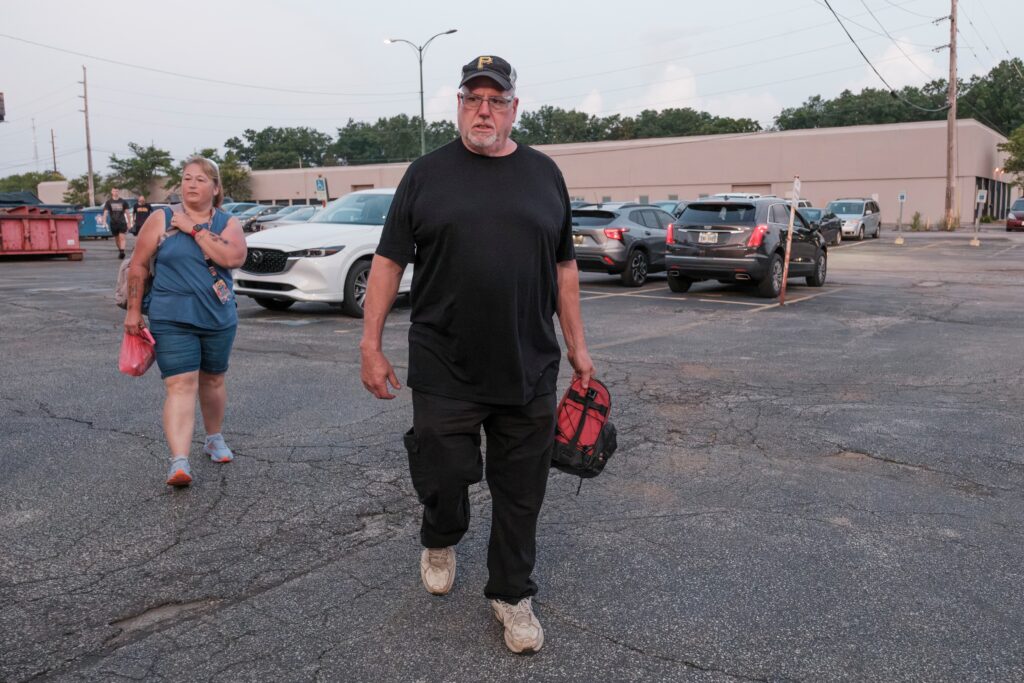
Careful not to wake his girlfriend, Klima put on his Pittsburgh Pirates ball cap and walked into the warm, dark morning. A Creamsicle-orange moon hung low in the sky as he stepped into his charcoal Dodge Ram and slowly backed down the driveway.
At 64, Klima was tall and broad, with strong arms and hands. When people at the plant called him “Grandpa” or “Papa,” it was out of reverence for the energy he still brought to one of the factory’s most dangerous jobs and to the bargaining table.
Managers had informed Klima and other union leaders in January that Conn Selmer was closing its Eastlake plant. Some production would move to a nonunion factory in Elkhart, Indiana. The rest was going to China, where the company had begun building a $21 million manufacturing facility in 2024 in Jiangsu province, union leaders said they were told.
Klima and some of the other old-timers at Conn Selmer could remember a time when politicians assured manufacturing workers in the Midwest that free trade with China or Mexico would on balance improve their lives. But that era was over. On the left — and, more noticeably, on the right — it seemed like everyone now talked about reviving the nation’s industrial base.
“Together we will reclaim our nation’s destiny as the number one manufacturing superpower in the world,” Donald Trump said on the campaign trail in August 2024. “We will do it, and China won’t even be close. Nobody will be.”
Many of Klima’s friends and co-workers welcomed that message. The neighborhood through which his truck rumbled in the predawn darkness — streets without sidewalks, lined with tidy postwar tract houses fronted by green and mostly unfenced lawns — was in a precinct Trump had won in each of the last three elections. Eastlake is emblematic of the White and working-class communities that were once overwhelmingly loyal to the Democratic Party but have shifted rightward in recent decades.
Klima grew up in a union household where political allegiances weren’t up for debate. He still considered himself a Democrat, and he disliked Trump, whose bluster and tawdry sex scandals rubbed him the wrong way. But he didn’t consider himself a partisan. He thinks he probably voted for Ronald Reagan in the 1980s, though he says he wasn’t paying close enough attention to remember.
“My opinion is, whoever the president is, it doesn’t affect a middle-class person,” Klima said. “Maybe I’m bitter or something.”
Many of Klima’s co-workers were certainly bitter. A lot of them had voted for Trump, impressed by his vows, and those of his supporters, to defend and restore American factory jobs.
In September 2024, billionaire hedge-fund owner John Paulson — an adviser to the president and one of his biggest fundraisers — gave an interview supporting Trump’s tariff proposals on CNBC. “What you see is a hollowed-out American manufacturing base. And we need to protect American jobs and protect American manufacturing,” Paulson said. “We can’t have Americans — American producers closing American factories and offshoring.”
Paulson is a legendary figure in the world of New York finance. He made much of his money through a prescient bet against the U.S. housing market before its collapse in 2007, personally netting $4 billion. But through his investment firm, Paulson had other holdings that extended beyond the credit default swaps that so enriched him at the onset of the Great Recession. Over the years they included stakes in a mining company, a commercial forest interest and a media conglomerate.
And they included Conn Selmer, whose parent company, Steinway Musical Instruments, had been acquired in 2013 by Paulson’s investment business. Conn Selmer’s 61-year-old Eastlake factory, a low-slung building between a frontage road and a field overgrown with wild grass and goldenrod, was now opening for its last shift making instruments in the United States.
Klima pulled into the parking lot and joined his co-workers, who were streaming in through the plant’s rear entrance beneath a rising sun. Some paused on the threshold before entering.
“This is it,” one said, shaking his head.
Klima swiped his security badge at the door and stepped briskly inside with his head down.
A few minutes after Klima went in, he was followed by the current union president, Rob Hines.
Hines, 40, had arrived at Conn Selmer through a temp agency in 2016. Almost immediately, he realized he never wanted to work anyplace else. Hines marveled at what he discovered on the hot factory floor, which resounded with the clinking of mallets, the whine of buzzsaws and the roar of industrial fans.
Automated rolling mills had transformed the steel industry, and robotic spot welding had put people out of work in Detroit’s great car factories. But the process of shaping sheets of brass into gleaming musical tools had so far been largely impervious to technological shortcuts.
Hines started in the tar room, where the metal was made pliant with hot pitch and then shaped laboriously by hand. As others showed him what he was doing wrong, and how to do it right, he began to absorb the trade into his mind and hands.
Once an instrument’s bell was symmetrical, its tail curved as perfectly as the shell of a nautilus, it was sent to the buffing room. This was where Klima had worked for most of his career, and where Hines — like Klima, a tall and powerful-looking man — wound up as well. The buffers brought Conn Selmer’s products to a high sheen by applying the instruments to an industrial lathe spinning, on average, 2,600 times per minute.
Accidental contact with the lathe meant a lost finger, or worse. The work was physical. The sousaphone, for instance, is a large, wearable tuba used in marching bands. Buffers had to wrap themselves within it, manipulating the instrument and their bodies in a strange dance to ensure every surface was properly finished.
Klima had gotten his job decades earlier through his father-in-law, who also worked at Conn Selmer. Now that man was dead, as was Klima’s wife, who passed away in 2021 after they raised three children together.
On the morning of June 30, Klima and Hines donned their blue aprons and gloves and steel-toed boots. But there wasn’t much to do. Production had been winding down ahead of the factory’s closure. Few new instruments were going out the door; what little work remained was mostly small repairs to products under warranty.
Klima had spent the last few days helping craft the special lamps, made from engraved instruments, that workers traditionally received upon retirement. They would go to older, longtime employees who, like Klima, did not plan to look for new jobs.
Klima’s was a trumpet, model 52B, with a beautiful platinum sheen. The words “Forty Years of Service” were etched along the bell. He had been planning to retire next year, at 65. In the grand scheme of things, it wasn’t much of a difference. So why did it feel like such a blow?
“You work there 40 years — all your life,” he said. “You want to retire, you want to walk out and say goodbye to everybody. Now this is goodbye, you know?”
Hines had also hoped to retire from Conn Selmer, leaving the plant one day with his own lamp. He had previously held jobs in shipping bays and hospital cafeterias. “I would start jobs, quit jobs,” he said. “I felt like I truly found a home when I came here.”
The factory was not some kind of workers’ paradise. The work was tough, and management could be unforgiving. Especially in the last few years, Hines said, supervisors had been trying to speed up production in a way that some employees saw as prizing quantity over quality. The company had started using some instrument parts from China, a cost-saving measure that dismayed workers who were unhappy with the imports’ flimsiness and poor design.
Despite these frustrations — despite the early mornings, aching limbs and sometimes grueling pace — there was something inside the plant that Hines had not experienced elsewhere. In a word, it was pride.
He saw it in his co-workers, who would stop and stare in appreciation at a finished French horn or sousaphone. He saw it in the schoolchildren who sometimes toured the factory, where instruments used in the Cleveland Orchestra and the Ohio State University Marching Band were made. “It’s truly amazing, what we do here,” Hines said.
And so on his last shift, as many others talked, and laughed, and cried, Hines put on his headphones and buffed the bells of a few last sousaphones. The manufacturing of this particular model, Hines had been told, was being offshored wholly to China. He turned the instruments at the lathe deliberately, reflecting that they might be the last of their kind Conn Selmer made in the United States.
People said the Eastlake plant’s workforce was like a family. Figuratively, whether this was true depended on whom you spoke to, but literally, it was frequently the case.
Toward lunchtime Adam Rosciszewski, 63, set up a grill and a tent in the parking lot with his two brothers, Scott and Jimmy. All had worked at Conn Selmer. Adam and Scott were retired, and Jimmy now worked at the Cleveland Cliffs steel company. Their father had been the factory’s union steward, and each of them had been union leaders in turn. Jimmy’s wife had worked at Conn Selmer, and his son still did.
The brothers fired up the grill and cracked dewy cans of Bud Light. Jack Swanson, who worked in the plant for 45 years before retiring in 2019, reminisced with Adam Rosciszewski about the time they snuck a stripper into the men’s bathroom for Swanson’s birthday.
“We worked hard,” Swanson said. “But we had fun.”
Rosciszewski shook his head. “We had so much fun.”
By early afternoon the summer sun was beating down. Workers on break from doing nothing inside, joined by retirees who had come to honor them, crowded under the small pavilion the Rosciszewski brothers had set up for shade.
Hines was moved to see so many people who no longer worked at the plant show up on a miserably hot day.
“It’s good to see y’all,” he said, shaking hands with Dave Knuchel, who had retired after more than four decades at Conn Selmer. “Thank you for coming out.”
Knuchel held onto Hines’s hand and looked him in the eye.
“You know how important this place was,” he said.
Hines knew. He had run for president of United Auto Workers Local 2359, which represented Conn Selmer workers in Eastlake, promising to find a way to work with management to keep the plant productive and profitable for years to come. Theirs was the only one of Conn Selmer’s three U.S. factories that was still unionized.
But when Hines sat down with Conn Selmer executives to lead his first contract negotiation, he was told there was nothing he could do to stop the plant’s closure.
A spokesman for Paulson referred questions to Conn Selmer. Company officials did not respond to repeated requests for comment. Conn Selmer Vice President Nicole Ebersole wrote to state and local officials in April that the factory closure was unavoidable because of “repeated annual financial losses caused by an inability to be cost competitive with competitors based in Asia.”
UAW’s national staff launched a pressure campaign to shame Paulson into keeping the plant open. Trump had often boasted about his power to stop companies from offshoring jobs. “All of those bad things that you had to suffer with, you’re not suffering anymore, because now people and companies have an incentive to stay,” he told workers at an Ohio appliance factory in 2020. “They’re not going to be leaving so fast. I want to make sure these companies aren’t leaving.”
Perhaps, workers and union leaders thought, the president might call Paulson and tell him to change course. Paulson had, after all, supported Trump since his first campaign, and the men’s relationship went back at least to 2012, when Paulson and others had sold Trump the Doral Resort & Spa in Miami. Or maybe Vice President JD Vance — an Ohio native who spoke often about the importance of manufacturing, and who had hung out with Paulson at fundraisers in the Hamptons and Palm Beach — might intervene.
Sen. Bernie Moreno, an Ohio Republican, called the chief executive of Conn Selmer to try to keep the factory open and its jobs in the U.S., according to Moreno’s office. The company did not change course.
Through the last week of June, Hines said, he still hoped someone in a high place might pull some strings. “We just wanted John Paulson to come to the table,” he said.
Now, with just a few hours left in the workday, the Eastlake workers were starting to accept that help wasn’t coming.
“It’s all a farce,” Adam Rosciszewski said of Trump’s promises to protect American factory workers. Like Klima, he had never liked the president.
“I’m not a Trump fan. I can’t stand him,” said another Conn Selmer retiree, Bob Almas. “But I like what he does.”
Fetching another beer from the cooler, Adam Rosciszewski turned and squinted at him.
“What the hell are you talking about?”
“Have you seen the other guys?” Almas said. “They’re socialist communists.” He shook his head. “I used to be a Democrat. Then I seen how they went.”
“And the Republicans?” Rosciszewski asked. “How did they go?”
“It’s all false promises,” said Annette Dombrowski, a 64-year-old janitor at the factory who also voted for Trump. “I’m done. I’m not voting ever again.”
These were the kind of political discussions Klima tried to avoid. You could argue till you were blue in the face about what Trump had done and not done, and whether he was better or worse than Joe Biden.
Experts could debate whether his tariffs had hurt the American companies they were meant to help, or point to federal data, which showed that America had lost about 75,000 manufacturing jobs since Trump took office in 2025, continuing a larger trend underway since the late 1970s.
What Klima knew was that the plant that ran three shifts employing 300 people when he first walked through its doors at age 23 was sputtering to a final halt. He was angry for himself, but worried for others: all the young men and women who would not have what he did.
“A lot of people working here — people in their 30s, 40s — they wanted to retire from here. They were going to get family members in here once they left,” he said. “It did it for me all these years, and now it just, how do you say it? Took the rug right out from under you.”
Midafternoon, after managers gathered everyone for a group photo, they let them off early. Klima wandered over to the cookout.
Amber Bluhm, a tall woman with purple-dyed hair who worked in shipping and receiving at a neighboring business, had printed out stickers that she handed around to the now-unemployed instrument makers. They read: “F— John Paulson.”
The last day of work at Conn Selmer ended at the Bogside Pub, a bar in a strip mall about three miles from the factory. It was loud, and crowded, and warm. There was a problem with the AC, luckily fixed soon after the workers began to pour in.
They embraced, and took photos, and had the occasional shouting match or standoff, quickly defused. None of this was unusual, said Travis Sarka, 32, who had worked at the factory for 11 years. “We’re in there six days a week — working, sweating, fighting and loving each other the whole time,” he said. “It really hurts that we’re not leaving on our own terms.”
The barmaids, harried-looking but friendly in their stretchy black workwear, knew almost everybody. Klima stood along the wall, sipping a pint of Budweiser. He wore one of the “F— John Paulson” stickers on the back of his shirt, just beneath the collar.
Some of his co-workers would spend the next day filling out unemployment paperwork. A few already had new jobs lined up. Klima’s girlfriend had begun to draw up a schedule for his first days of retirement: yard work, trips to see her parents, walleye fishing with his buddies. There would be his grandkids’ little league games through the summer, and deer hunting in the fall.
None of this abated the feeling of giddy dread that hung over the Bogside. Klima might not be interested in politics, but he knew that what was ending in Eastlake wasn’t just about him.
“We worry about a lot of these younger guys,” said his girlfriend, Bridget McBride, who had joined the Conn Selmer workers at the bar.
Klima bellied up next to McBride and ordered another beer. “I don’t have to go to work tomorrow,” he said.
Hines appeared at his shoulder. “I came over here to say hi to her,” the younger union leader said, laughing and nodding at McBride, who was scrolling her phone looking for dinner delivery.
This was not strictly true. Hines respected Klima as much as anyone else in the plant. The older man had helped teach him the unwieldy ritual of large-instrument buffing. Hines sometimes called him Uncle.
One of their co-workers, a young guy with kids whom Klima thought was a hard worker, walked up and held out his hand. He was calling it a night. Klima stared at him for a moment and cleared his throat. When he spoke, his voice was hoarse, halting.
“I hope everything works out for you,” Klima said, squeezing the younger man’s hand and clapping him hard on the back. “We got this.”
Others were also saying goodbyes, and the crowd in the Bogside Pub began to thin out. Hines perched on a stool and did some shots with the stragglers. Outside it was finally cooling off. A hazy orange sun dipped toward the horizon.
Soon afterward, Hines caught an Uber back to his apartment in the nearby city of Mayfield Heights and went to bed. He drifted off but woke up a little before 2 a.m. His mind whirred as he thought about the months and years ahead.
Hines sat on his couch in the dark and looked at his phone, pulling up the group photo taken in the afternoon outside the factory.
Staring at that image in the small hours, it occurred to him that he might never again know virtually everyone he worked with. Nor would he share with another group of co-workers what had existed inside the old factory off the frontage road in Eastlake.
Hines and some of his younger co-workers had talked of getting commercial driver’s licenses. Now, as he lay awake early in the morning on the first day of a very different life, he decided on a solitary career path.
Hines wanted what an older generation had — what Klima had — and what he had briefly been a part of. But he didn’t think he would easily find it again, and he wasn’t sure others would, either. For workers like him, the world was changing. At least in the near term, Hines liked the idea of sitting in a truck by himself.
David J. Lynch and Aaron Schaffer contributed to this report.


97% of Tinubu’s ambassador-designates cleared by host countries — FG

Convicted murderer hosts TikTok live sessions and runs businesses from Nigerian prison

Meet twin brothers who are both catholic priests

Trump turns on Jeanine Pirro with furious outburst: ‘What she was thinking?’

Russia hits Ukrainian capital with ballistic missiles and drones, killing at least 9

Jang is my role model — Mutfwang

IS fighters overrun two Niger military bases, 38 soldiers confirmed dead

 World3 days ago
My daughter’s squishy toy burst on her legs. We ended up in the emergency room.
- Investigation1 day ago
âSome of us are âpick meâ and we wouldnât know. I used to do things for men I liked when it was supposed to be the other way aroundâ â Lady reveals
- Investigation3 days ago
âItâs is an opportunity but not an obligationâ â FIFA president Infantino defends new proposal to sell FIFA World Cup rights to private company after facing backlash
- Investigation3 days ago
âWe are going to beat the f**king sh*t out of themâ – Trump issues sharp warning to Iran as diplomacy ends after surprise attack on US base
- Breaking1 day ago
âWe are going to beat the f**king sh*t out of themâ – Trump issues sharp warning to Iran as diplomacy ends after surprise attack on US base
- Investigation1 day ago
âTinubuâs comment on hunger insensitiveâ- Peter Obi
- Investigation1 day ago
Before you go about snatching someone else’s husband, please check the quality of what your’re snatching first- actress Rita Edochie shades an unnamed âhusband snatcherâ
- Investigation19 hours ago
âMy ex just logged me out of his Netflix and Prime because I said he is weird and I regret meeting him. That doesnât mean he should remove meâ â Nigerian lady reacts as ex revokes her access