Business
Iran war slashes global oil demand outlook — IEA


The International Energy Agency has warned that the Iran war has destabilised global oil markets, cutting demand expectations and triggering what it described as the most severe supply shock in history, driven by disruptions across the Middle East energy corridor.
In its latest Oil Market Report, the agency said global oil demand is now projected to contract by 80,000 barrels per day in 2026, a sharp reversal from last month’s forecast growth of 730,000 bpd. It added that a projected 1.5 million barrels per day drop in Q2 2026 would mark the steepest quarterly decline since the COVID-19 pandemic.
The IEA said early demand destruction is already visible in the Middle East and Asia-Pacific, where consumption of naphtha, LPG and jet fuel has fallen sharply. It attributed this to rising prices, scarcity of supplies, and weakening industrial and aviation activity.
On the supply side, global oil output plunged by 10.1 mbpd in March to 97 mbpd, as continued attacks on energy infrastructure and restrictions in the Strait of Hormuz disrupted exports. OPEC+ production reportedly fell by 9.4 mbpd, while non-OPEC supply also weakened despite gains in the United States and Brazil.
The crisis, it was learnt, has also hit refining operations, with global crude throughputs constrained by feedstock shortages and damaged infrastructure. The IEA said refineries in the Middle East and Asia reportedly cut runs by around six mbpd, while global crude processing is now expected to decline by one mbpd on average in 2026.
Prices have also surged to historic levels, with Brent crude trading around $100 per barrel and physical crude briefly touching $150 per barrel, as refiners scramble for alternative supplies. Middle distillates in Asia reached record highs above $290 per barrel, reflecting extreme tightness in product markets, according to the report.
Inventories were said to have fallen sharply, with global observed stocks dropping by 85 million barrels in March. The IEA said supply routes through the Strait of Hormuz have been severely disrupted, cutting flows from over 20 mbpd before the conflict to about 3.8 mbpd.
While some exports have been rerouted through Saudi Arabia, the UAE, and Iraq–Türkiye pipelines, these alternatives have not offset losses exceeding 13 mbpd, the agency said, adding that floating storage has increased in the Middle East as stranded cargoes build up offshore.
The IEA stressed that restoring full flows through the Strait of Hormuz remains the most critical factor in stabilising global energy markets, warning that prolonged disruption could deepen the supply shock, worsen inflationary pressures, and further weaken global oil demand.

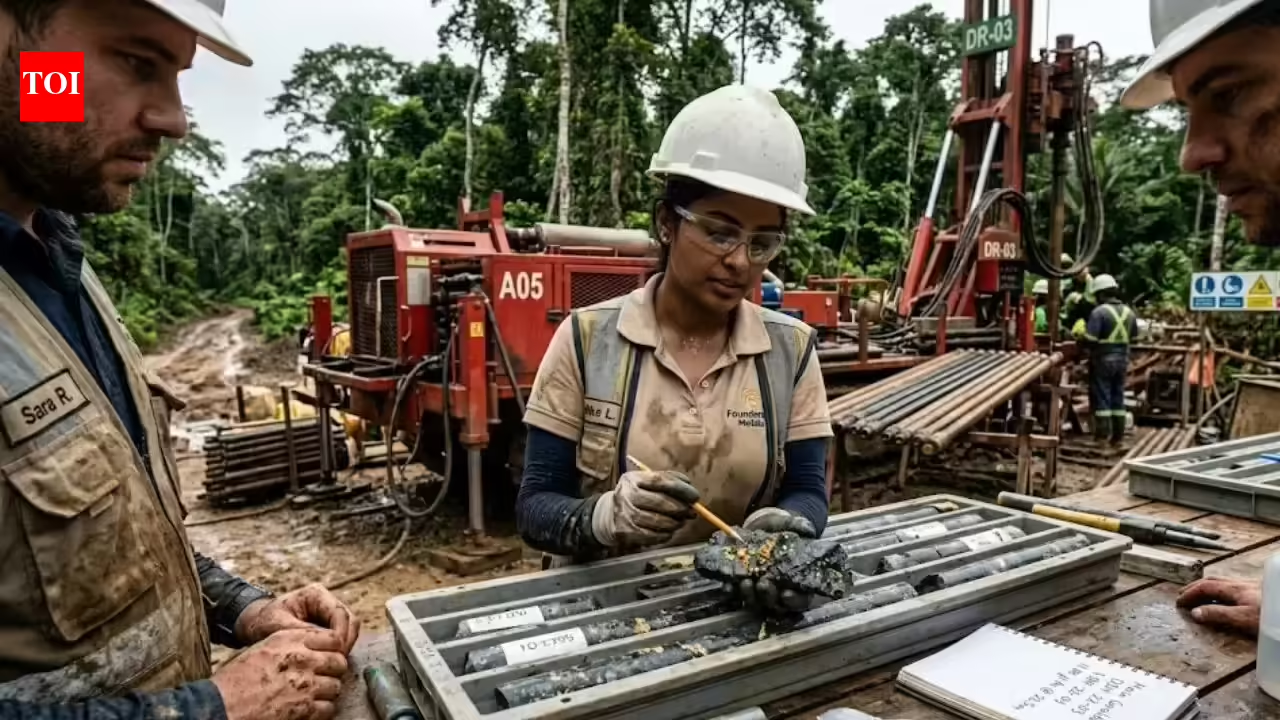
Massive gold discovery at Maria Geralda in Suriname shocks geologists with unusually high grades

MXT Capital pushes ESG goals with Green Vault launch

Dollar to Naira exchange rate today, April 23, 2026

6 US cities powered entirely by renewable energy sources like wind, solar and hydro

Refiners decry crude diversion, warn of underutilised capacity

Ogbue: Former UBA Chairman remembered for leadership, institutional reforms

Millions of workers at risk as global shocks intensify, ILO warns

 Breaking3 weeks ago
Outrage as video of secondary school students in Benue state str!ping their classmate surfaces online
 News3 weeks ago
I Joined A Cult, Worked So Hard For Demons – Tonto Dikeh Confesses While Ministering (Video)
- News4 weeks ago
Heartbreaking Story Of 300-Level Ekiti University Student Who Was K!lled After Truck Crashed Into His Building (Video)
- Breaking3 weeks ago
Singer Flavour shows off Italian woman and vows to shower her with so much love that she’ll have no choice but fall in love (video)
- News3 weeks ago
WAEC Releases 2026 WASSCE Timetable (Full List)
- National3 weeks ago
Environmental Sanitation: Lagos meets with LG, LCDA bosses
- Breaking2 weeks ago
Mother Abandons 4 Children with Neighbor and Disappears for Months — Shocking Case Raises Questions
- World18 hours ago
Millionaire's son beheaded and disemboweled on trip with girlfriend to holiday hotspot