World
Maps show how Texas, California, Missouri, North Carolina and Utah redistricting could affect congressional seats

Several states undertook mid-decade redistricting efforts to try to alter the makeup of their congressional delegations this year, after President Trump began last summer to press Republican-led states to increase the number of GOP-friendly districts to help his party hold the House in next year’s midterm elections.
Indiana became the first of these to reject a new map proposed by GOP legislators to redraw the state’s congressional districts so that all nine congressional districts would be favorable to Republicans. In Maryland, Democratic Gov. Wes Moore’s plan to redraw the state’s map to edge out Maryland’s lone GOP member of Congress failed when the legislative session ended on April 14 with the Democratic-led state state Senate leaving the redistricting bill in a committee.
Texas was the first to kick off the gerrymandering push, when Gov. Greg Abbott signed legislation in August to redraw the districts and create five GOP-friendly seats. In California, Gov. Gavin Newsom, in turn, launched an effort to redraw his state’s map to help Democrats. In November, the plan was approved by voters by a 29-point margin.
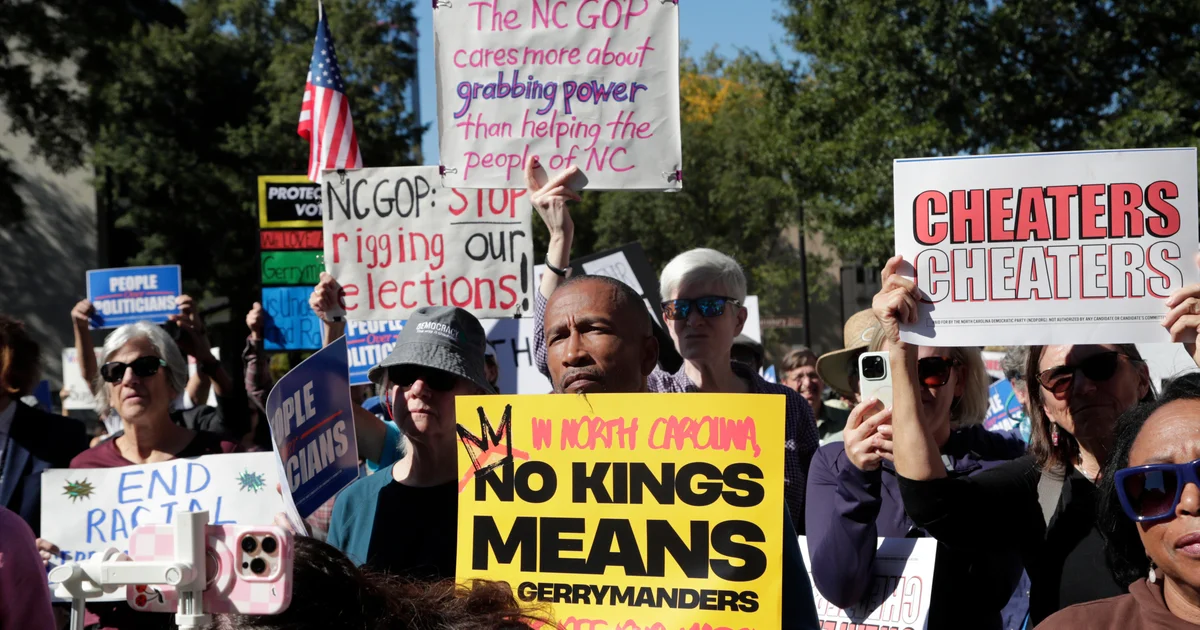
In Missouri, state lawmakers redrew their map in September to squeeze Democratic Rep. Emanuel Cleaver from his Kansas City district. Then in October, North Carolina state Republicans redrew the 1st Congressional District, held by a Democrat, to make it more favorable to conservatives.
But Republicans in Indiana’s state Senate rejected the redistricting measure in a 31-19 vote on Dec. 11, despite the GOP’s 40-10 advantage in the chamber. Ahead of the vote, as the lawmakers faced intense pressure from Mr. Trump and other members of his administration, Indiana state police said they had received “numerous” bomb threats and swatting hoaxes against state senators.
Utah lawmakers also reworked their state’s map after a judge ruled the current districts violated restrictions on gerrymandering. All four of the state’s House districts are represented by Republicans, but a judge in November threw out the GOP-controlled legislature’s map and ordered one that will create a Democratic-leaning district in Salt Lake City.
Congressional maps are normally redrawn every 10 years after the U.S. Census reveals population shifts. But this rare mid-decade redistricting push was kicked off as Republicans seek to maintain — or even expand — their razor-thin majority in Congress in the 2026 midterm elections. Historically speaking, midterms are often a rebuke of the party in the White House.
Although both parties are trying to rig their states’ congressional districts to be favorable to themselves, the outcome is far from guaranteed.
“Computers and technology do give us a lot more ability to to make predictive statements about outcomes, but we’re doing it — I think it’s fair to say — in a very volatile environment politically, where things that we have seen as trends are sort of being turned on their heads,” said Kareem Crayton, vice president of the Washington, D.C.-based the Brennan Center for Justice.
Crayton noted several current issues that could factor heavily into voters’ decisions, and called it “folly to assume that just because people showed up and voted for the current president of the United States, that people want to show up for a member of Congress, particularly … a new candidate in a district that hasn’t been created before.”
Texas has 38 congressional seats, with 25 held by Republicans and 13 by Democrats.
Republicans have invested heavily in the Rio Grande Valley, once a Democratic stronghold, but they’ve made inroads. In 2024, two of the three Rio Grande Valley House seats voted for Mr. Trump, though they reelected their Democratic congressional representatives. The maps were designed to increase those gains and box out the two Democrats.
Texas Democrats have recently made gains in the Dallas-Fort Worth area and Houston’s Harris County. The new maps reshape Democratic Rep. Al Green’s Houston district in the rural areas, making a district that was 72% Democratic into one that is 40% Democratic. The proposed map also changes Rep. Julie Johnson’s Dallas-area district from 62% to 41% Democratic. Rep. Marc Veasey’s district in Dallas-Fort Worth remains a Democratic stronghold, but he would no longer live in the district.
Liberal Austin is further dissolved into neighboring districts. Rep. Lloyd Doggett, who was first elected in 1994 and whose district gave former Vice President Kamala Harris her largest margin of victory in all of Texas, announced in August that he would not seek reelection if the proposed maps are upheld by the courts, avoiding a primary with Rep. Greg Casar, also of Austin.
On Nov. 18, a three-judge panel in the U.S. District Court in El Paso blocked Texas from using the maps approved by the legislature in August. The court said that the plaintiffs will likely succeed in showing that race predominated over partisanship in the map-making process, and said the legislature appears to have set and followed a racial target.
Abbott appealed the decision to the U.S. Supreme Court, which ultimately restored the map passed this summer.
California has 52 House representatives, with nine Republicans and 43 Democrats.
In 2020, Republicans flipped three seats held by Democrats for the first time since 1994. They’ve hung onto two of them, including GOP Rep. David Valadao’s 22nd District in the Central Valley.
Under the proposed map, Valadao’s district would go from being 47% Democratic in 2024 to 49% Democratic, making him slightly more vulnerable. And GOP Rep. Darrell Issa’s 48th District near San Diego would change from 42% to 52% Democratic.
Crayton noted several current issues that could factor heavily into voters’ decisions, and called it “folly to assume that just because people showed up and voted for the current president of the United States, that people want to show up for a member of Congress, particularly … a new candidate in a district that hasn’t been created before.”
In Southern California, Rep. Ken Calvert’s 41st District in Riverside would be redrawn further toward Los Angeles, shifting it from a district that was 47% Democratic in 2024 to one that is 57% Democratic under the proposed maps.
In Northern California, GOP Rep. Doug LaMalfa’s District 1, which includes the northeastern-most part of the state, would shift further south toward Marin County and the northern part would be absorbed in the 2nd District, home to heavily Democratic Eureka and the northern Pacific coast. Rep. Kevin Kiley’s district, which snakes along the California-Nevada border through Death Valley, would instead move further toward heavily Democratic Sacramento. Republican Rep. Tom McClintock’s 5th District would be shifted to include the southern portions of what was Kiley’s district.
Kiley, whose district would go from one that was 48% Democratic in 2024 to one that is 55% Democratic, has been an outspoken critic of redistricting, even introducing legislation in the House to ban mid-decade redistricting.
After Texas and California’s redistricting efforts, Gov. Kehoe called a special session of Missouri’s legislature to take up redistricting. Missouri currently has two Democratic representatives in Congress: Rep. Wesley Bell, who represents St. Louis and was first elected in 2025, and Cleaver, who has represented the Kansas City area since 2005.
As Missouri has trended toward Republicans over the past 20 years, Cleaver’s district has been a target of the GOP, especially in the 2021 redistricting when several lawmakers pushed for what was called the “7 to 1 map” that would have redrawn the 5th Congressional District to be more Republican. Lawmakers ultimately decided against that plan. St. Louis’ NPR station reported that Republicans worried that the short-term gains from carving up the district could lead to long-term problems in the neighboring suburban districts.
Nonetheless, the Missouri GOP joined the redistricting effort in 2025. Under the new map, Cleaver’s district transforms from one that is 62% Democratic to one that is 41% Democratic. Cleaver says he still plans to run for reelection.


Nigerian doctor raises alarm over viral video of young lady using her mouth to extract liquid from her dog and swallowing it

Quote of the day by Rosalind Franklin: “Your faith rests on the future of yourself and others as individuals, mine in the future and fate of our successors. It seems to me that yours is the more selfish.”
Quote of the day by Rosalind Franklin: “Your faith rests on the future of yourself and others as individuals, mine in the future and fate of our successors. It seems to me that yours is the more selfish.”

African professionals urged to view volunteering as investment

Man caught after alleged daylight car theft attempt in Ghana claims he was only "testing the vehicle" (videos)

Eko, Kano lead as power sector records 26 deaths – NERC

Family demands answers after N.J. influencer died on trip with fiance in Zanzibar

 Breaking2 weeks ago
Outrage as video of secondary school students in Benue state str!ping their classmate surfaces online
 News2 weeks ago
I Joined A Cult, Worked So Hard For Demons – Tonto Dikeh Confesses While Ministering (Video)
- News2 weeks ago
Heartbreaking Story Of 300-Level Ekiti University Student Who Was K!lled After Truck Crashed Into His Building (Video)
- National2 weeks ago
Environmental Sanitation: Lagos meets with LG, LCDA bosses
- Breaking1 week ago
Mother Abandons 4 Children with Neighbor and Disappears for Months — Shocking Case Raises Questions
- News2 weeks ago
WAEC Releases 2026 WASSCE Timetable (Full List)
- Breaking2 weeks ago
Singer Flavour shows off Italian woman and vows to shower her with so much love that she’ll have no choice but fall in love (video)
- World6 days ago
Trump LIVE: Iran war bombshell as Trump could be 'removed from Presidency'