National
Nigeria, Morocco To Sign $25bn Transcontinental Gas Pipeline Deal

… $2.8bn AKK pipeline begins gas supply to Abuja
By Charles Ebi
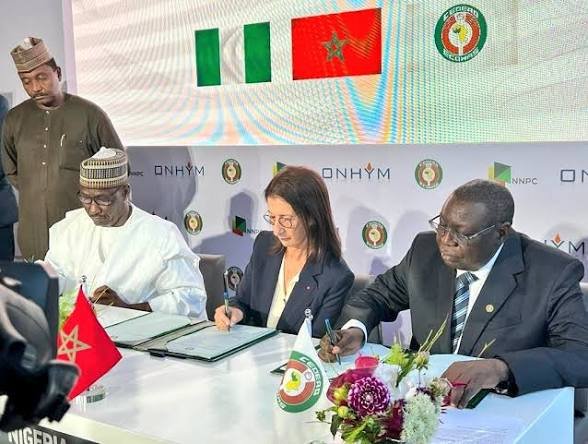
Nigeria and Morocco are set to sign an intergovernmental agreement this year for the $25 billion Nigeria-Morocco gas pipeline project, marking a major step toward advancing one of Africa’s most ambitious energy infrastructure plans.
This was disclosed by Amina Benkhadra, Director-General of Morocco’s Office National des Hydrocarbures et des Mines, in a report by Reuters on Monday, based on comments she provided to the news agency.
Known as the African Atlantic Gas Pipeline, the project will span about 6,900 kilometres across a mix of offshore and onshore routes, with the capacity to transport up to 30 billion cubic metres of gas annually, including volumes earmarked for Morocco and exports to Europe.
In an email to Reuters, Benkhadra said the upcoming agreement would strengthen coordination among participating countries and ensure smoother implementation of the project.
“Following the intergovernmental agreement, a high authority for the pipeline will be established in Nigeria, bringing together ministerial representatives from each of the 13 participating countries to provide political and regulatory coordination”, she said.
She added that the pipeline is designed to serve both regional and international markets, positioning Morocco as a key energy link between Africa and Europe.
“The African Atlantic Gas Pipeline will run along a hybrid offshore-onshore route covering approximately 6,900 kilometres. It will not only supply Morocco but also support exports to Europe, positioning Morocco as a key energy bridge between Africa and Europe”, she said.
Benkhadra also noted that the project would be executed in phases, allowing different segments to be developed independently to enable early economic returns rather than waiting for a single final investment decision.
The Nigeria-Morocco pipeline is expected to have a maximum capacity of 30 billion cubic metres annually, with about half of this volume allocated for Morocco’s domestic use and exports to Europe.
Backed by the Economic Community of West African States ,ECOWAS, the project will connect 13 countries along the West African coast, making it one of the largest cross-border energy projects on the continent.
To drive execution, a dedicated project company will be established as a joint venture between Morocco’s hydrocarbons agency and the Nigerian National Petroleum Company Limited ,NNPC Ltd, with responsibility for financing, construction, and overall delivery.
The pipeline is expected to boost electricity generation, support industrialisation, and deepen economic integration across West Africa, while also positioning the region as a strategic gas supplier to global markets.
The Nigeria-Morocco gas pipeline has evolved over several years through multiple agreements and stages of development.
Initial memoranda of understanding were signed between both countries in 2016 and 2018, laying the groundwork for the project before broader regional participation gained traction in 2022.
In June 2022, the Federal Executive Council ,FEC, approved NNPC to execute an MoU with the Economic Committee of West African States, ECOWAS, for the construction of the gas pipeline to take gas from West African countries through Morocco to Spain and Europe.
In December of that year, NNPC signed a memorandum of understanding ,MoU, with five additional African countries for the Nigeria-Morocco gas pipeline project.
In March of 2024, Mele Kyari, the then Group CEO of NNPC, disclosed that the Final Investment Decision ,FID, on the $25 billion Nigeria-Morocco gas pipeline would be made in December 2024.
Despite progress, the project has faced delays linked to financing complexities and cross-border coordination challenges, making the planned agreement a crucial milestone in moving it toward execution.
Meanwhile, Nigeria is expected to begin gas delivery to the Federal Capital Territory, Abuja, through the Ajaokuta–Kaduna–Kano ,AKK, pipeline by July, marking a major step in the country’s gas development drive.
This was disclosed recently by the Nigerian Upstream Petroleum Regulatory Commission through its in-house publication, where a spokesperson provided an update on the project’s progress.
First conceived in 2008, the $2.8 billion project has missed several delivery targets, including earlier deadlines of 2023 and the final quarter of 2025.
Now, with the pipeline more than 90% complete, according to Reuters, citing an energy lawyer involved in the project, July has been set for it to begin delivering gas to the nation’s capital.
“We’re hoping that by July, gas will be delivered to Abuja through the AKK gas pipeline”, a spokesperson for the NUPRC said.
The 614-kilometre pipeline is expected to transport over 2.2 billion cubic feet of gas per day and forms a critical part of Nigeria’s strategy to transition towards gas, power industries in the northern region, and reduce dependence on diesel and fuel oil.
The AKK pipeline is a key segment of Nigeria’s broader gas infrastructure expansion, designed to connect gas-rich southern regions to demand centres in the north. The pipeline runs through Kogi State, Niger State, and Kaduna State before terminating in Kano, enabling supply to industries and power plants across Northern Nigeria.
Construction of the pipeline began in 2020 but faced delays due to funding constraints and technical challenges, particularly the complex crossing of the River Niger using advanced horizontal directional drilling techniques.
The project is being financed through a mix of debt and equity. The China Export and Credit Insurance Corporation is providing insurance cover for 85% of the total project cost—approximately $2.59 billion, sourced from Chinese lenders. The Nigerian Gas Company is contributing the remaining 15% equity, valued at about $434 million.
Gas transported through the pipeline will largely originate from southern producing areas, linked through the Obiafu-Obrikom-Oben ,OB3, gas pipeline, strengthening supply across the national grid.
The project is also expected to unlock industrial growth, improve electricity generation, and support Nigeria’s transition to a gas-based economy.
This is not the first time a completion or delivery timeline has been set for the AKK pipeline.
In April 2022, the Nigerian National Petroleum Company Limited projected that the project would be completed by the first quarter of 2023.
By April 2023, NNPC said that progress had reached about 70%, with expectations that welding would be completed by the third quarter and delivery achieved before year-end.
However, in November 2023, the company again shifted the timeline, stating that the project would be inaugurated in December of that year, a deadline that was not met.
In June 2024, then Group Chief Executive Officer of NNPC Ltd, Mele Kyari, announced a new completion target of the first quarter of 2025, which was also missed.
The repeated delays have made the July target another critical test of Nigeria’s ability to deliver large-scale energy infrastructure projects on schedule.


Former Chelsea star Jorginho apologises for false accusation against pop singer Chappell Roan

Data centers could spur a utility spending spree. Here's the impact.

FCC Strengthens Data Protection Drive, Deepens Partnership with NDPC

Swalwell, Gonzales officially resign from Congress, avoiding expulsion votes
FRESH: Tinubu-Led Government Defends Price Of Petrol In Nigeria

Corps member’s body found two days after he d!ed in his sleep

Insecurity: Alia orders dislodge of terrorists herdsmen camps in Benue forests

 Breaking2 weeks ago
Outrage as video of secondary school students in Benue state str!ping their classmate surfaces online
 News2 weeks ago
I Joined A Cult, Worked So Hard For Demons – Tonto Dikeh Confesses While Ministering (Video)
- News2 weeks ago
Heartbreaking Story Of 300-Level Ekiti University Student Who Was K!lled After Truck Crashed Into His Building (Video)
- National2 weeks ago
Environmental Sanitation: Lagos meets with LG, LCDA bosses
- Breaking1 week ago
Mother Abandons 4 Children with Neighbor and Disappears for Months — Shocking Case Raises Questions
- News2 weeks ago
WAEC Releases 2026 WASSCE Timetable (Full List)
- Breaking2 weeks ago
Singer Flavour shows off Italian woman and vows to shower her with so much love that she’ll have no choice but fall in love (video)
- World6 days ago
Trump LIVE: Iran war bombshell as Trump could be 'removed from Presidency'