Breaking
Atiku faults El-Rufai’s continued detention, says bail must not become pre-conviction punishment

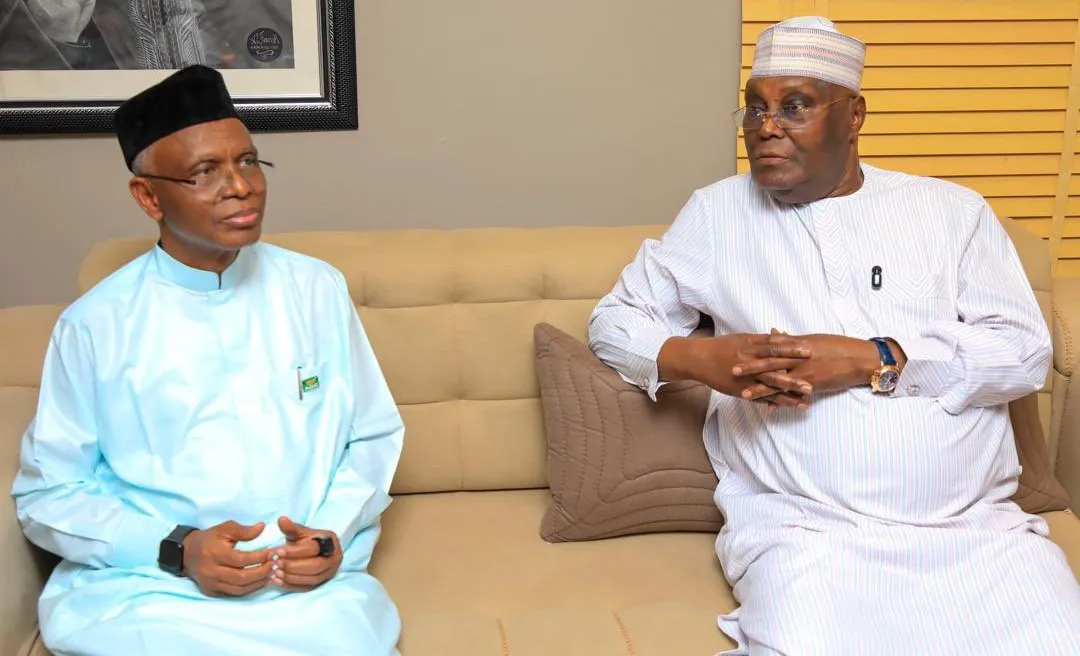
Former Vice President Atiku Abubakar has expressed concern over the continued detention of former Kaduna State Governor Nasir El-Rufai, arguing that bail conditions imposed by the court have become practically impossible to meet and amount to a denial of constitutional rights.
Mr Atiku, in a statement issued on Wednesday by his Senior Special Assistant on Public Communication, Phrank Shaibu, said the refusal of the Federal High Court to review the bail terms raises serious questions about the administration of justice, constitutional liberties and the treatment of political opponents in the country.
The former vice president stressed that although courts have the discretionary power to impose bail conditions, such powers must be exercised fairly and reasonably.
According to him, bail conditions that are excessive or unattainable undermine the fundamental principle that an accused person remains innocent until proven guilty.
“The law is settled that an accused person remains innocent until proven guilty. Bail exists to preserve that constitutional protection. It was never designed to become a sophisticated instrument for punishment before conviction,” Atiku said.
He questioned the rationale behind conditions requiring El-Rufai to produce a serving Grade Level 17 federal civil servant who owns verifiable property in high-profile districts such as Maitama or Asokoro, alongside other requirements.
“When a court insists on conditions that require a defendant to produce a serving Grade Level 17 federal civil servant who must also own verifiable property in Maitama or Asokoro and satisfy a maze of additional requirements, Nigerians are entitled to ask a simple question: is the objective to grant bail or to ensure that bail remains unattainable?” he asked.
Atiku warned that the implications of such judicial decisions extend beyond the former governor, noting that any Nigerian could face a similar situation if constitutional safeguards are weakened.
“This is not merely about one individual. It is about the principles that underpin a democratic society governed by the rule of law. Today it is El-Rufai. Tomorrow it could be any citizen whose liberty depends not on the law but on whether he can satisfy conditions that few Nigerians can ever meet,” he stated.
The former vice president described the judiciary as the last refuge of citizens against abuses of power and urged judicial authorities to ensure that their decisions inspire confidence in the fairness and accessibility of justice.
He cautioned that at a time when public confidence in institutions is under pressure, the courts must avoid creating the impression that justice is available in theory but unattainable in practice.
“Bail conditions should secure attendance in court, not guarantee continued incarceration,” he said.
Atiku also expressed concern over what he described as a growing pattern in which opposition politicians and government critics increasingly find themselves facing legal and administrative challenges, creating a perception that state institutions are being selectively deployed.
“No democracy can thrive where citizens begin to suspect that legal processes are being used not merely to prosecute offences but to punish dissent. The strength of a democracy is measured not by how it treats those in power but by how it treats those who challenge power,” he said.
The former vice president, however, clarified that his comments were not intended to interfere with the substantive case before the court or prejudge the allegations against El-Rufai.
He maintained that issues of guilt or innocence remain the exclusive responsibility of the judiciary, but insisted that constitutional guarantees such as the right to liberty, presumption of innocence and fair hearing must be protected at all times.
According to him, when bail conditions become virtually impossible to fulfil, detention effectively becomes punishment before trial.
“There is a name for a situation where a citizen is told he has been granted bail but is simultaneously subjected to conditions that make his release virtually impossible. It is called a constructive denial of bail. Courts must guard against such outcomes because they undermine the spirit of the Constitution,” he said.
Atiku called on all institutions involved in the administration of justice to uphold fairness, proportionality and respect for fundamental rights, warning that democracy is weakened whenever constitutional protections are compromised.
He added that Nigeria’s democratic system can only thrive when justice remains impartial, free from political influence and accessible to all citizens.


Fela wouldn’t have been great if he wasn’t from privileged background – Seun Kuti

Woman shares what her first love did that led to her being hospitalised

ECOWAS Court Dismisses Former Chief Justice Gertrude Torkornoo’s Claims Against Ghana

LaLiga: I can’t deny it – Mourinho reveals why he is returning to Real Madrid

Horror as woman catches fire in UK street as passers by try to help

Woman Reveals How First Love Landed Her in Hospital

Oyo slams curfew on 10 LGAs around National Park

 Investigation2 days ago
He said he wanted to sleep with me, but I told him I am a married woman – Lady in viral video being ass@ulted by a man in Abia speaks
- World3 days ago
Russia burning as Ukraine launches massive attack on key waterway 160 miles from frontline
- World1 day ago
Russia launches nuclear drill in UK's backyard as Kremlin 'advocates use of atomic bomb'
- Breaking2 days ago
He said he wanted to sleep with me, but I told him I am a married woman – Lady in viral video being ass@ulted by a man in Abia speaks
- Investigation2 days ago
âSeek help from usâ â NDLEA tells Nigerians battling Drug addiction
- Investigation2 days ago
Actress, Angela Okorie responds after facing backlash for burning outfit she wore to late colleague, Alexx Ekuboâs funeral
- Investigation2 days ago
"Please. It will look as if it’s my fault. His family doesnât like me" Young wife, 18, assaulted by husband begs for him not to be arrested and reveals she regrets marriage (videos)
- Investigation1 day ago
Those who called Jonathan clueless are now in Power â Pastor Ayo Oritsejafor