World
Iran fires missiles and US strikes Iran facility after reports of faltering peace talks

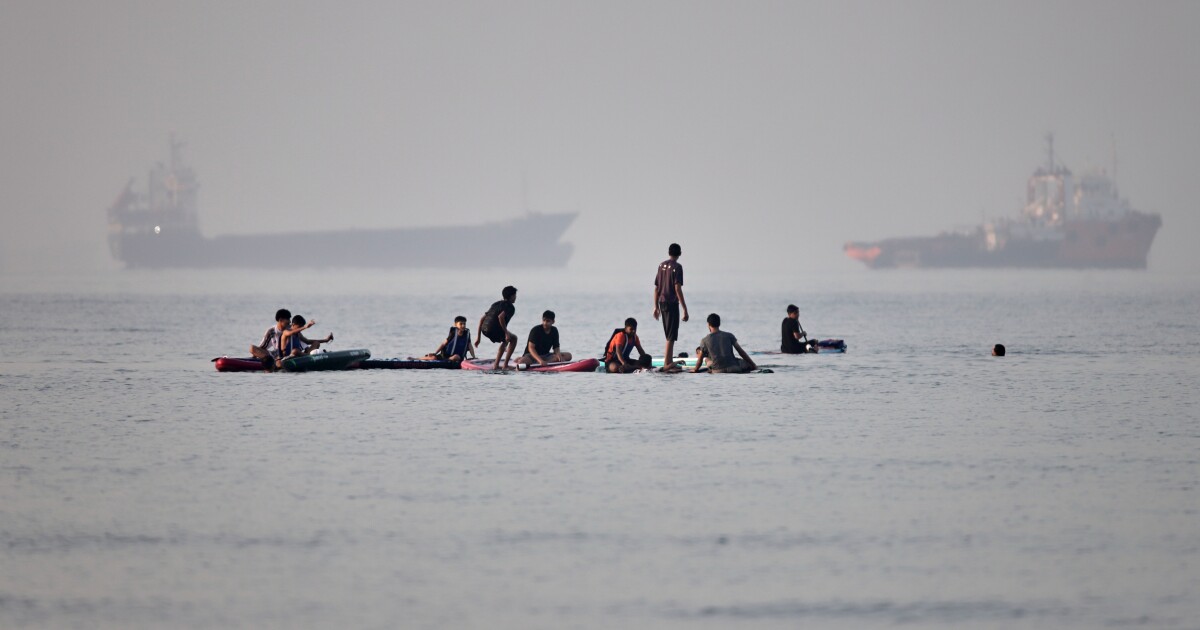
The U.S. military said Tuesday that Iranian fired missiles at Kuwait and Bahrain that failed or were shot down, and that the U.S. launched strikes on an Iranian facility in response.
Iran fired missiles toward Kuwait and Bahrain, but failed to hit their targets, the U.S. said. The two fired at Kuwait fell apart en route, while U.S. and Bahraini forces intercepted the missiles aimed at Bahrain.
U.S. Central Command said it responded with strikes on an Iranian military ground control station on Qeshm Island in the Strait of Hormuz.
Iran’s paramilitary Revolutionary Guard said it had targeted the headquarters of the U.S. Navy’s 5th Fleet in Bahrain and another country in its attack, without naming Kuwait. It said it launched its attack in response to the U.S. firing a missile into the engine room of another oil tanker trying to reach Iran despite the U.S. blockade.
“We had previously warned that in case of aggression, the response would be different and more severe, and we acted accordingly,” the Guard said in its statement.
The attacks happened after Iran stopped communicating with mediators about extending a ceasefire in the war with the U.S. and Israel, according to reports Tuesday from two semiofficial Iranian news agencies. President Donald Trump disputed the claim and said talks were continuing.
RELATED STORY | Rubio is optimistic on eventual Iran nuclear talks despite congressional skepticism
The reports by the Fars and Tasnim news agencies, both believed to be close to the Guard, came as tensions flared in Israel’s separate-but-related fight against the Iranian-backed militia Hezbollah in Lebanon.
A regional official involved in the mediation, speaking on condition of anonymity to discuss the talks, told The Associated Press that Iran had not communicated at all on Tuesday after saying that a ceasefire needed to be enforced in Lebanon for negotiations to continue.
Trump says talks ‘going on continuously’
Trump called reports of a cessation in talks “false and erroneous.”
“The conversations between us have been going on continuously, including four days ago, three days ago, two days ago, one day ago and today,” Trump said in a social media post. “Where they lead, one never knows, but as I told Iran, ‘It’s time, one way or another, for you to make a Deal.”
U.S. Secretary of State Marco Rubio did not address the reported cutoff in communications as he testified at a congressional hearing in Washington. Instead, he sounded an optimistic note about the nuclear dimension of the negotiations, while cautioning that there’s no guarantee of reaching “a deal that’s acceptable.”
Iran has been trying to increase pressure on Trump over negotiations on the Iran war ceasefire and loosening the Islamic Republic’s chokehold on the Strait of Hormuz and the oil, gas and other commodities that normally pass through it. Trump then could potentially push Israeli Prime Minister Benjamin Netanyahu to halt or slow the advance of his forces, which have moved deeper into Lebanon than at any time in over a quarter of a century.
IN CASE YOU MISSED IT | Trump administration cautions businesses on payments to Iran in Strait of Hormuz
The conflicts have increasingly become conjoined, as Iran insists that any potential truce in the war there must also quell the fighting in Lebanon.
Israel and the U.S. maintain the fighting in Lebanon is separate from the Iran war talks.
Inflation takes an economic toll on Iran
Meanwhile, year-on-year inflation in Iran reached a level in May unseen since World War II, underlining the economic pain average Iranians are facing. While the U.S. is eager to ease the Islamic Republic’s grip on the strait — through which a fifth of all traded oil and natural gas passed in peacetime — Iran faces economic challenges as its oil-backed economy remains under a U.S. naval blockade.
Economic pressure touched off nationwide protests in Iran in 2017 into 2018, when rising food prices sparked demonstrations that killed over 20 people and saw hundreds arrested. The next year, an increase in government-subsidized gasoline prices caused protests that saw over 300 people reportedly killed.
Then came the protests over the collapsing value of Iran’s currency, the rial, at the start of this year. They were the most intense demonstrations to shake the Islamic Republic since its 1979 revolution and the chaotic years that followed. Iran’s theocracy met January’s protests with a crackdown on demonstrators in January that killed over 7,000 people, according to activists’ estimates.
Now, even as hard-liners hold gun-handling workshops and organize marriages under the shadow of a ballistic missile to bolster spirits, experts note there could be new demonstrations if people find themselves priced out of feeding their families.
“I have no doubt that if Trump leaves (Iran without a formal peace deal) … most probably, we will see something like January by the end of summer because of the economic and social situations,” analyst Mohsen Jalilvand said in a video published by Iran’s Fararu news website.


Any child your wife bears under your roof belongs to you – Media personality Chioma Amaryllis Aghaghotu says as she addresses "polygamous men who are fans of DNA test"

22-year-old man m8rdered in Plateau community

Jumia links Nigeria’s growth to macro reforms

Four k!lled on the spot, two taken away and k!lled later… The Night of June 7th tells their story (Watch teaser)

Iran fires missiles and US strikes Iran facility after reports of faltering peace talks
Iran fires missiles and US strikes Iran facility after reports of faltering peace talks

JUST IN: CAN declares June 14 Black Sunday over terrorist attacks in Nigeria

 Breaking2 days ago
I received a threatening call simply because I spoke about Nigeria bleeding, Russian-born actress Fari Elysian reveals
- Breaking2 days ago
Content creator Mark Angel weds again months after ex-wife did exposé on him and he admitted if he were his daughter he wouldn’t marry a man like himself (video)
- Breaking2 days ago
Father allegedly left baby daughter in bathtub filled with water while he scrolled on his phone in another room
- World3 days ago
Silence from the White House after Trump said he would make a "final determination" on Iran
- World1 day ago
Iran issues horror threat to attack Israel as Trump's ceasefire collapsing
- Breaking2 days ago
My 3rd wife attempted to st@b me, threatened to k!ll herself because I married a 4th wife – Man tells Oyo court
- Politics1 day ago
Tackle insecurity decisively, NDC senatorial aspirant urges Tinubu
- Breaking22 hours ago
Young couple seen goofing around in prom video hours before the man k!lled the woman