World
Trump arrives at G7 summit seeking momentum after Iran deal announcement

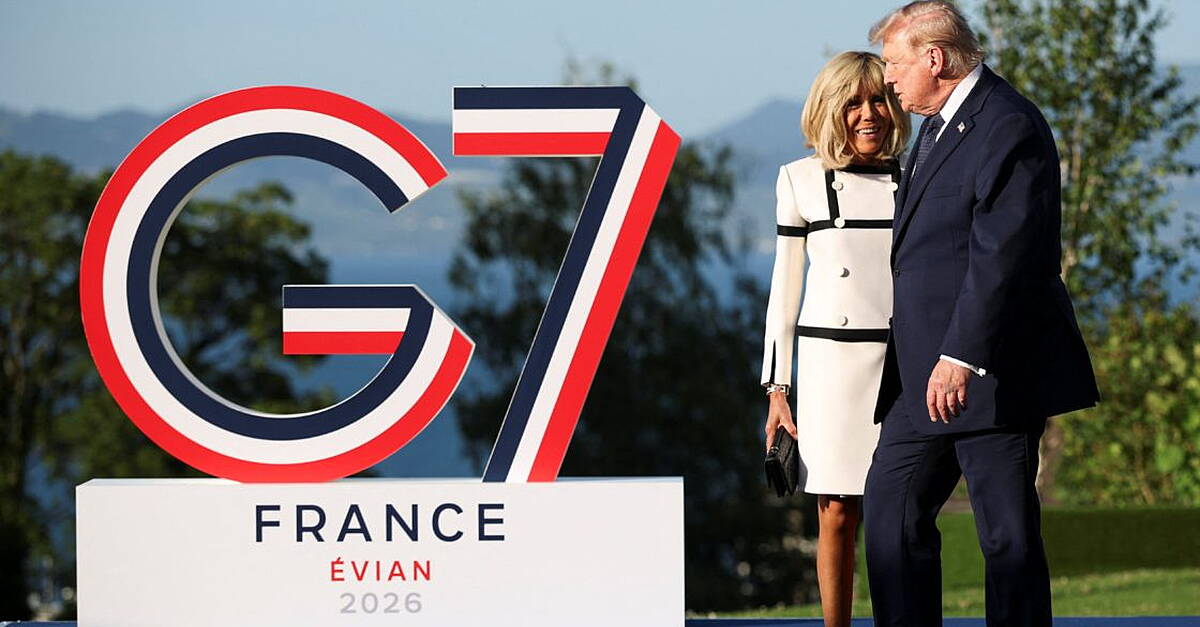
Donald Trump started his visit to the G7 summit of leading industrialised nations on Monday by declaring his agreement aimed at ending the US war with Iran is a potential breakthrough for global security and a chance for the US to turn the page in its relationship with its long-time adversary.
The US president sought to make clear that he arrived in Evian-les-Bains with the wind at his back for talks with G7 leaders, including some who have been sharply critical of his managing of the 15-week conflict, which has led to a surge in global energy prices – though he did not immediately seem willing to lay out the details of what was in the emerging deal.
Some of those details are still to be negotiated in talks over the next 60 days, although Mr Trump said the memorandum of understanding would likely be released after it is signed on Friday.
“I think a lot of great things are going to happen in the Middle East right now, and very importantly the oil (price) is plummeting down and the stock market is shooting up like a rocket today,” Mr Trump said at a meeting with the summit’s host, French President Emmanuel Macron, before they joined a working dinner with other leaders.
“The Iran deal that we made is going to bring a lot of success to the world,” he said.
Mr Trump has had friction with Mr Macron, British Prime Minister Sir Keir Starmer, German Chancellor Friedrich Merz and Italian Prime Minister Giorgia Meloni over failing to consult them before the decision to go to war.
But sealing an agreement before jetting off to the summit might change the dynamic of the three-day gathering.
Mr Macron at the start of Monday’s meeting congratulated Mr Trump for finding a way to an agreement.
“It’s a very important matter for peace of the whole world,” Mr Macron said.
Mr Trump has pushed back on the four European leaders – members of the Nato military alliance – for their lack of support for the US in the conflict.
He is expected to discuss with leaders the demining of the Strait of Hormuz.
Britain and France have expressed interest in assisting with the demining once the conflict is paused.
Fear of potential mines is among the reasons tanker traffic has come to a halt during the war, and quickly clearing them will be crucial to regaining the confidence of commercial vessels.

Mr Macron on Monday said France was ready to move within days to deploy assets, including mine-clearing vessels, to the region to help.
Senior US officials told reporters that the while the agreement provides for the immediate opening of the strait and lifting of the US naval blockade, it will take weeks for traffic to return to previous levels.
Mr Macron invited the leaders of three nations that are not part of the G7 – Egypt, Qatar and the United Arab Emirates – to take part in a session on the Middle East on Tuesday, when Iran is expected to be a central focus.
Mr Trump had fiercely criticised former president Barack Obama for the 2015 nuclear agreement, which Mr Trump argued failed to stop Tehran from advancing toward a weapon and funnelled billions of dollars into the Islamic Republic’s coffers.
In 2018, Mr Trump left the deal, known as the Joint Comprehensive Plan of Action. Britain, China, France, Germany, Russia and the European Union were also signatories to the pact.

Mr Trump in an interview on Sunday with The New York Times pushed back on comparisons to the Obama-era nuclear deal.
“We negotiated from strength,” Mr Trump said. “He was basically paying them off.”
But Mr Trump has not explained how his agreement will address some key issues about Iran’s nuclear programme, including who will be in charge of verifying that Iran is complying with the agreement and who will destroy or remove 972 pounds (441 kilograms) of highly enriched uranium believed to be buried under nuclear sites that were badly damaged by US strikes last summer.
The memorandum of understanding includes the possibility of releasing Iran’s frozen funds, sanctions relief and a 300 billion-dollar (£223 billion) fund to help rebuild Iran – all of which would be tied to Tehran meeting certain benchmarks aimed at assuaging White House concerns, senior US officials told reporters on Monday.
Some Democrats and hawkish critics say Mr Trump has failed to explain how the financial relief in his agreement will differ from what Mr Obama did in the 2015 nuclear deal.
“For all his critique of JCPOA, we had international observers, we actually had an alliance there that included the Europeans, and Russia and China were all signatories,” Senator Mark Warner, the top Democrat on the Senate Intelligence Committee, told CBS’s Face The Nation on Sunday.
Republican Senator Lindsey Graham, a close ally of Mr Trump and an Iran hawk, expressed scepticism, saying that Congress will need to review and vote on any nuclear deal with Iran, and said he expects vice president JD Vance – “the architect of the deal” – to present it.
“I am somewhat concerned that Iran’s view of the agreement seems different than what the American negotiating team is claiming,” Mr Graham said on social media.
Leaders are expected to discuss a range of economic and trade issues.
Mr Trump told the New York Post he has warned Mr Macron the US will “have no choice” but to slap 100% tariffs on French wines unless Paris eliminates its digital tax on American tech companies, renewing a long-running threat from him that dates to his first administration.
Wines and spirits exported to the US from the European Union currently face a 15% tariff.
In an interview with broadcaster TF1, Mr Macron said on Monday that it is not “for the United States to decide what European or French law should be”.
Mr Macron also invited Ukrainian President Volodymyr Zelensky for a working session with G7 leaders on Tuesday to discuss the Russia-Ukraine war.
At the moment, Mr Zelensky is not scheduled to hold one-on-one talks with Mr Trump while they are both in France, but Mr Trump on Sunday held separate phone calls with Mr Zelensky and Russian President Vladimir Putin.
Russian presidential aide Yuri Ushakov told reporters that Mr Trump emphasised the need to end hostilities with Ukraine and stated his readiness to influence European allies and Kyiv toward that goal, including at the G7.
Mr Zelensky had offered to meet Mr Putin with Mr Trump and European leaders at the G7 gathering, but the Kremlin did not reply, a Ukrainian official familiar with the matter told The Associated Press.
Mr Putin is wanted by the International Criminal Court for alleged war crimes, and France would be obliged as an ICC member to arrest him. The US and Russia both oppose the court.
Mr Trump suggested that, after an Iran deal, he will now have greater bandwidth to focus on the Russia-Ukraine war.
“Now that this is finished, we’re going to be focusing on that,” he said, referring to diplomatic efforts to stop the fighting that followed Moscow’s full-scale invasion of its neighbour in February 2022.


NPFL: Kano Pillars vow to stay focused on rebuilding process

Troops rescue Late General Rabeâs widow in Katsina after bandits shoot her and flee

FIFA to investigate ‘white supremacy’ hand signal made by Australian VAR official ahead of Germany’s 7-1 win over Curacao

God abeg whoâs in charge of Nigeria – Singer Rudeboy questions Nigeria’s leadership
Lacari returns to streaming, says forensic review found no illegal content

Couple and one other arrested over physical ab#se of a 10-year-old child in Anambra

ASUU directs members to shun Kano varsity’s new governing document

 Breaking3 days ago
Fight breaks out between student, hostel staff and Rev. Sister at Coal City University
- Investigation7 hours ago
"If bandits kidnap my wife, I won’t pay ransom. I’ll remarry because they would have slept with her" – Nigerian man
- Business2 days ago
Wema Bank’s 5 for 5 Rewards Delivers ₦17.96 Million to 273 Customers in One Month
- World2 days ago
Horror as girl, 5, kidnapped and raped while being driven home on motorbike by grandad
- Breaking1 day ago
I had s3x with my wife only 6 times, her pregnancy canât be mine – Man tells Kaduna court
- Politics12 hours ago
Governor Okpebholo congratulates Edo Queens, reaffirms commitment to sports development in Edo State
- Business3 days ago
FG may pay salaries through eNaira platform – Report
- News1 day ago
Kogi bans night travel, restricts okada operations over security concerns