World
At the National Gallery, the clearest view of America is in the mines

This Video Is Trending Right Now
The National Gallery of Art is taking a low-key approach to celebrating the country’s 250th birthday. Rather than mount a major semiquincentennial blockbuster, it has opted to reintroduce visitors to its permanent collection of American works, while staging a few smaller shows around the edges.
But concurrent with these exhibitions — about the American flag as icon and a survey of American works on paper — it has mounted a smart, bracing show about the visual culture of American mining and extraction, which turns out to be a better summation of America than the official 250th programming.
All of these American shows, including a small exhibition about Niagara Falls, leave you with the sense that our governing metaphors and imagery are exhausted, that we need to refresh them, that the only way forward is to let go of the old symbols and ideas and seek new ones that can truly encompass a vigorous, multicultural democracy.
“Beneath the Surface: Mining and Photography” may seem an odd exhibition to open during the 250th festivities, given its focus on one of the world’s most dangerous and environmentally destructive industries. Yet it is the strongest of the shows, and the most engaged with the American sublime. Mining predates the emergence of photography in the late 1830s, but the extraction business and the image business were quickly intertwined. Mining companies, like railroads, used photography to document their ambition and investments, and the government hired photographers like Timothy O’Sullivan to create photographic surveys of land newly opened for commercial exploitation.
These surveys produced images that function both as crime-scene photos — capturing terrible ecological destruction — and proof-of-life images, revealing the enormous expanse and beauty of the American landscape. As miners moved west, following the real or rumored discovery of valuable minerals in Colorado, Nevada, California and other states, photography also became sociological, documenting the struggles of the men who worked in the shafts and pits.
Photographers captured the danger and grit of the mines and the terrible working conditions, which would later fuel organized labor’s militant pushback against the ruthless oligarchs of the Gilded Age. But daguerreotypes of individual miners bore more personal memory, in some cases physically back to loved ones left hundreds or thousands of miles away. They also preserved memory of the self, as mining changed the miner, immersing him in a culture of corruption, fierce competition and greed.
The extraction industry disrupted Native American communities and exacerbated racism against immigrants in search of quick wealth, and it sluiced away remnants of America’s sense of its innocence. In some cases, it broke the miner, as in a terrible scene captured in David Belasco’s 1911 novel “The Girl of the Golden West,” in which a man is convulsed by regret and homesickness after hearing a sentimental song: “I’m tired o’ drillin’ rocks; I want to be in the fields again; I want to see the grain growin’; I want the dirt in the furrows at home; I want old Pensylvanny; I want my folks; I’m done, boys, I’m done, I’m done …!”
The need to preserve personal dignity in these conditions created powerful energies that still roil the American project. Milton Rogovin’s photographs of steelworkers in Buffalo made in the late 1970s and ’80s, and Richard Avedon’s monumentally scaled portraits of oil field laborers from the same period, capture a resilience one sees in nascent form in an early daguerreotype of a miner from the 1850s. This is dignity despite humiliation, community despite exploitation, defiance despite desperation. There is an acceptance of suffering as somehow the natural essence of America, as inescapable as the amber fields of grain and the purple mountain majesty.
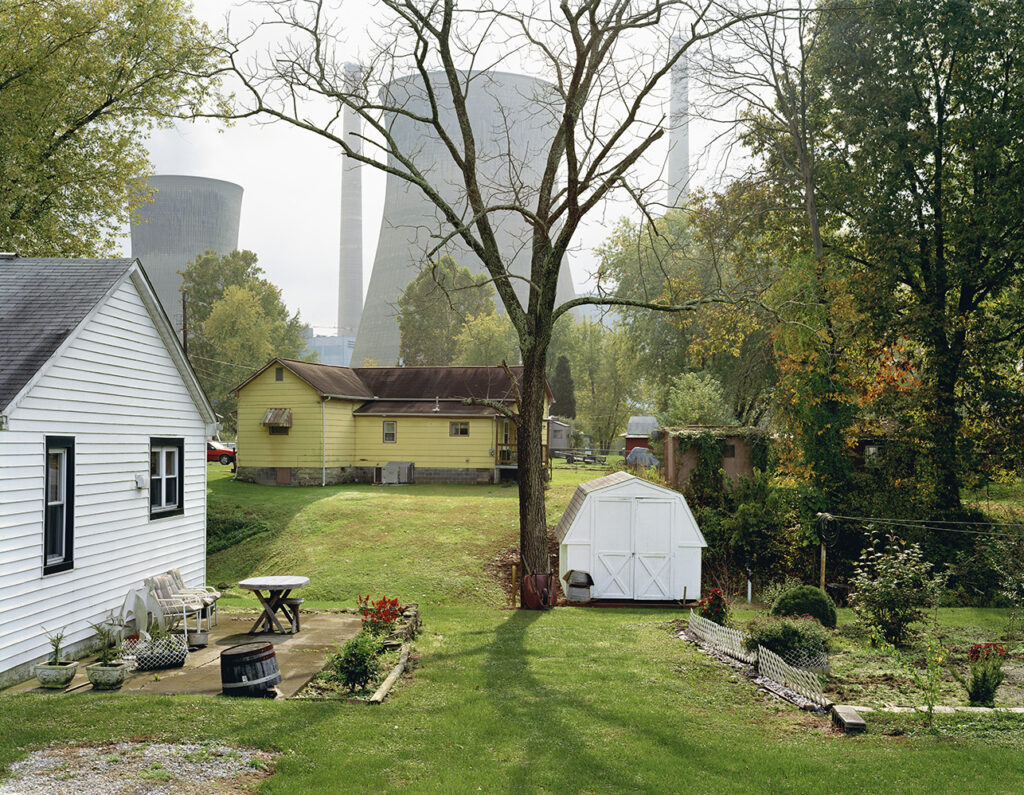
Some of the most striking works on view are large color photographs that capture these weird contiguities of America. The title of Mitch Epstein’s ink-jet print “Amos Coal Power Plant, Raymond City, West Virginia 2004” reduces its subject to the bland metadata of where, what and when, but this giant image has the visceral punch of Renaissance history painting. In the foreground are humble houses, tended with care and love, despite the limited means of the landowners; in the background are the hulking cooling towers and belching smokestacks of a coal plant. Industry encroaches and blights the domestic landscape.
Some 20 years later, we are seeing new iterations of this same dynamic: giant football-field-size boxes clad in gray, bearing down relentlessly on suburban neighborhoods where local political leaders have sold out the preservation of community and beauty to build data centers fueling the AI boom and the oligarchs who profit from it. We are trapped in the same place, retreating inward, into our homes and into our familiar despair, as new technologies capable of civilizational annihilation, mining data, not rock, gather their forces all around us.
The striking juxtaposition of domesticity and industrial power is surreal, and the surreal haunts American iconography, where every essential symbol has at least a double meaning, and so much of what defines our daily lives seems to be accidental, the wayward product of recklessness, as if everything is happening in a dream. In a circa 1939 rustic chintz fabric pattern on view in yet another exhibition, “Dear America: Artists Explore the American Experience,” we see multiple images of George Washington looking a little dazed or vacant, with a shield-like emblem showing the scales of justice and the word “peace.” Created on the cusp of a world war against fascism, the repetitions, clumsy but urgent, feel like an incantation: Make this go away and let us get back to the old safe place, no matter whether it ever existed. Let us wrap ourselves in a happy, familiar tale.
Even more dreamlike is Carrie Mae Weems’s 2014 photograph “Echoes for Marian,” which shows a solitary figure dressed in black standing in front of the Lincoln Memorial. The contrast of the black-and-white image is heightened, with the white marble of the facade and columns blazing bright in the sun. With the exception of a few figures to one side, the scene is empty but for the supplicant figure, whose presence only accentuates an antiseptic sense of silence. And that also feels incantatory. Enough of these icons scrubbed of history, scrubbed of meaning, mere sepulchres of empty symbolism.
No one captured the manic American need for symbols, and the vacuity of those symbols, with darker poetry than the photographer Robert Frank, whose work is seen in a third exhibition, “American Icon: The U.S. Flag in Art.” The flag is a leitmotif throughout his 1959 photobook, “The Americans,” including in the first image, “Parade—Hoboken, New Jersey,” made in 1955. Here, the flag obscures, becoming a substitute identity for a figure whose torso is only partially visible through a darkened window.
Stenciled on one wall of the exhibition are these words, from the United States Flag Code: “The flag represents a living country and is itself considered a living thing.” It is a curiously pagan statement in a country where so many people embrace orthodox forms of religion, which usually frowns on this kind of idolatry. It is also a maddening statement in a country where the majority of the Supreme Court scoffs at the idea that the Constitution is a living document, but the flag somehow has the rights of a living being. More than a few of the works on view in this show, where the flag is worn as clothing, written over with words and images, would be considered illegal by the letter of the flag code.
It’s a nice coincidence that the exhibition “Niagara Falls: Mist and Majesty” surveys the iconography of a symbol that should be considered an organic, living thing. This small show, with some 20 works, centers on Frederic Edwin Church’s 1857 painting “Niagara,” one of the most dazzling American paintings of the 19th century, and probably a visual allegory for the torrential cataclysm of pending civil war. It is juxtaposed with tourist images made when the falls were America’s premiere natural attraction, as well as Native American meditations on the river as living presence, including a video installation by Shelley Niro, a Mohawk artist, which focuses on the river as a transnational site of ritual and connection.
And it’s a sad coincidence that Church’s monumentally scaled “Niagara” was acquired by the National Gallery under what turned out to be false pretenses. The gallery took the work from the financially strapped Corcoran Gallery of Art in a 2014 agreement that included a promise that it would mount exhibitions at the historic Corcoran building on 17th Street. The 250th exhibitions are perfectly scaled for those galleries. But in 2023, gallery leaders quietly “revised” that agreement, reneging on their commitment, thus assuring that the public would continue to have limited — if any — access to a building that was once the locus of the city’s artistic life.
And, thus, the semiquincentennial exhibitions include this bitter coda, a reminder that throughout American history promises have too often been hollow. The curators have done a good job charting that hollowness within the canon of our visual symbols and our fungible ideals. The institution embodied those same values when it broke its promise to the people of Washington. Why do power plants encroach on modest neighborhoods? For the same reason that any institution can make and break promises. It’s all about power.
America needs an infusion of honor and integrity. Perhaps sometime in the next 250 years.


JUST IN: Fidelity Bank Sponsors the 2026 Young Innovators Camp

Tinubu has not borrowed up to N80tn in three yearsâ Nigerian Government

UNILAG begins Post-UTME, warns candidates against malpractice

World Cup: ‘Thank God Spain won’ – Oliseh slams Argentina players over bad behaviour

Sowore Challenges ICPC to Release Full Gbajabiamila Interrogation Video

143 firms bid for 37 oil assets as NUPRC targets 300,000bpd output boost

Posthumous 70th Birthday: Akeredolu’s legacy continues to speak for him – Adegbonmire

 Society1 day ago
2026 Ballon d’Or: Top 4 players to win award after World Cup final revealed
- Society1 day ago
Pepper Seller Caught On Camera Applying Pepper On Newborn Baby As Rituals To Usher Her Into The Business
- World2 days ago
Spain earns $51 million for World Cup win and runner-up Argentina gets $34 million as total payout for all 48 teams hits record-high $871 million
- Investigation3 days ago
US President Trump questions Thomas Tuchelâs tactics in England World Cup loss to Argentina
- Society3 days ago
Prosecution Presents Evidence Against Adu-Boahene in GH¢49.1 Million Trial-Deputy AG Says
- Investigation3 days ago
Iâll retire and get a tattoo of our manager if Spain win World Cup 2026 – Spanish defender, Cucurella
 Investigation3 days ago
Police arrest four over mob k!ling, exhume victimâs remains for autopsy
- Investigation3 days ago
Iran will teach USA âunforgettable lessonsâ – Iranian Supreme Leader