World
Democrats chip away at GOP cash lead centered on Trump

This Video Is Trending Right Now
Republicans are heading into the fall campaign season with a lopsided cash advantage across their flagship committees and super PACs, but Democrats narrowed the gap with stronger fundraising by individual candidates.
The latest campaign finance reports showed the GOP’s wealth concentrated in the hands of President Donald Trump and his advisers, as super PACs and party committees they control dominated the party’s fundraising. Democrats, by contrast, spread their contributions across individual congressional candidates, making them better-equipped than their head-to-head opponents.
GOP super PACs and party committees had $478 million more than their Democratic counterparts, according to a Washington Post analysis of the latest disclosures. But Democratic candidates held a combined $141 million edge over their opponents, and Democrats also had more in other PACS like fundraising committees and unions.
Those advantages narrowed the overall cash gap to $230 million in the GOP’s favor, the data showed.
Even with their higher total, Republicans saw cause for concern. Operatives view campaigns themselves as better messengers for positive advertising, and they get cheaper rates than super PACs. Online donations point to voter enthusiasm, which polls show favoring Democrats. And the GOP’s single biggest war chest — Trump’s super PAC — has not said how much it will spend in the midterms.
The upshot is that Republicans might have more to spend, but Democrats’ dollars could go further.
“I would call it a draw,” said a Republican adviser on Senate races who spoke on the condition of anonymity to discuss internal strategy. “That is one of the through-lines of the cycle, it has been noticed by donors and activists. It’s a problem for sure for Republicans.”
Democrats celebrated shows of strength in the races that will decide control of the House, with their candidates raising more money than the Republicans in 20 out of 26 targeted districts. Endangered incumbent Rep. Zach Nunn (R-Iowa) raised $986,000 in the second quarter, compared to more than $2.2 million for Democratic challenger Sarah Trone Garriott.
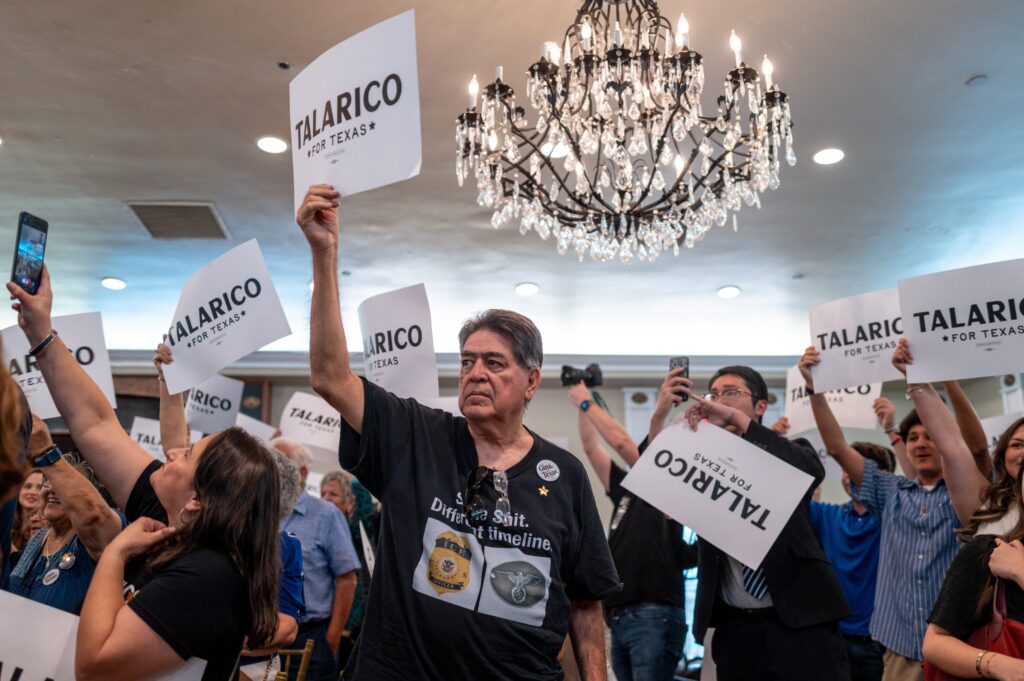
Democrats also posted eye-catching totals in key Senate races. State Rep. James Talarico (D-Texas) raised $28 million last quarter, more than a combined $23 million for the Republicans in all nine competitive Senate races. The biggest war chest belongs to Sen. Jon Ossoff (D-Georgia), with $42.6 million on hand as of June 30. His Republican opponent, Mike Collins, reported just $2 million in the bank.
For the first time this year, candidates and party committees can share funds without restriction, thanks to a June Supreme Court decision. That change benefits Republicans because their richer party committees can effectively spend money just like candidates can.
The Democratic National Committee had just $16.3 million (and $18 million in debt) in contrast to the Republican National Committee’s $128.5 million.
“Republicans are building a campaign machine to win,” a National Republican Congressional Committee press secretary said.
Super PACs, which can accept unlimited donations, remain barred from coordinating with candidates or party committees. Super PACs also have to pay full freight for airtime and mail, whereas campaigns and parties pay discounted rates.
Republicans still led with large checks from ultra-wealthy donors. Nine of the top 10 individual donors in this midterms cycle are supporting Republicans, according to a Post analysis of campaign finance data. In the second quarter, GOP candidates got a boost from hedge fund billionaire Ken Griffin, who put over $30 million behind Republican congressional candidates, including $10 million to the flagship Senate Leadership Fund super PAC.
The GOP would not have an edge without the $400 million stockpile from Trump’s main super PAC, MAGA Inc., run by the top operatives from his campaign, Chris LaCivita and Tony Fabrizio. But the group has neither publicly announced its spending plans nor publicly shared them with Republican allies. Many Republicans expect Trump to reserve some of the money to protect his future political power or cover legal expenses.
Trump’s financial dominance makes it harder for Republicans to consider breaking with him even as his approval ratings drop with independents and young voters who propelled his 2024 win.
“Smart Republicans would be finding a way to distance themselves but they can’t because the money, if it ever does come, would be turned off,” said Lauren French, communication director for the Democrats’ Senate Majority PAC.
Democrats acknowledge they can’t keep up with landing large checks while they are out of power, especially when the Trump administration has been so open about offering policy wins to contributing industries. The main Democratic super PAC supporting House candidates tries to compensate by locking in airtime early at lower rates, reserving ads worth $272 million in April. Republicans dismissed those bookings as a publicity stunt because they can change later.
About the data
The Post included all candidates whose principal campaign committees reported at least $100,000 in cash on hand and who are running for Congress this November. This includes candidates awaiting primaries and runoffs, but excludes those who lost their primaries or withdrew, incumbents who did not run for reelection, and dead candidates, according to the Ballotpedia database. The Post also included all PACs that raised or spent at least $1 million since the start of 2025. To categorize their partisan lean, The Post analyzed their independent expenditures since 2023, transfers, their websites and their description in OpenSecrets. If at least 90 percent of their independent expenditures or contributions went to support candidates of one party, they were classified as that party. Bipartisan special interest groups were not classified as either party.


Atiku to Tinubu on PFIPC: You are trapped, apologise, resign

I left Google after 10 years without another job lined up. An 8-month career break gave me the reset I needed.

31 Companies Win Nigeria’s Oil and Gas Blocks in Major Bid Round

Ekiti man arrested for multimillion-naira fraud

Veteran actor, Chiwetalu Agu and wife recreate their court wedding photos as she turns a year older

Man Arrested in Cross River Over Fake Doctor Job Scam

A Morning of Controlled Chaos in Maine

 Society2 days ago
Pepper Seller Caught On Camera Applying Pepper On Newborn Baby As Rituals To Usher Her Into The Business
- Society2 days ago
2026 Ballon d’Or: Top 4 players to win award after World Cup final revealed
- World2 days ago
Spain earns $51 million for World Cup win and runner-up Argentina gets $34 million as total payout for all 48 teams hits record-high $871 million
- Investigation22 hours ago
65-year-old married female teacher blindfolded and tied 10-year-old schoolboy to bed before having s3x with him
- Society3 days ago
Nigerian Lady Weeps Uncontrollably On Social Media As Her Bank Account Gets Hacked, Life Savings Wiped Out Except ₦194
- Investigation23 hours ago
"I ‘m fine and healthy" – Video of late Mary Habila debunking her d3ath rumours 3 days before she d!ed at Umahi’s residence
- Investigation17 hours ago
âBusinesses are dy!ng in South Africa. Nobody is making money – South African man decries low patronage days after anti-immigrant protest
- Investigation3 days ago
Woman allegedly k!lls husbandâs mistressâ two-month-old baby in Benue