World
Downwardly Mobile in Hollywood

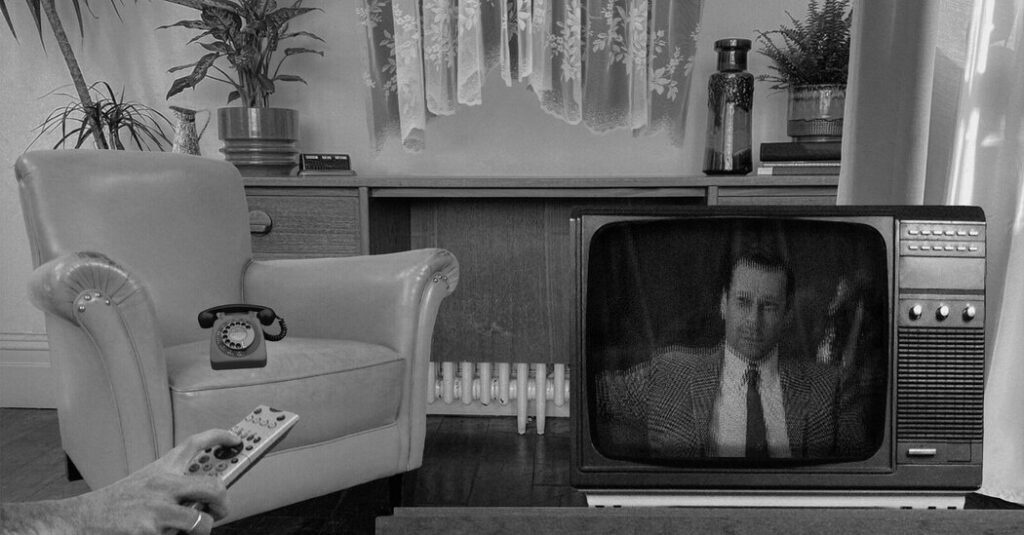
This Video Is Trending Right Now
I left journalism to become a television writer and novelist more than a decade ago, as the streaming wars set off by Netflix fed a seemingly unlimited demand for eight-to-12-episode seasons of scripted drama. I still recall a showrunner who was interviewing me for a job saying this was the only industry in which you fail upward. I didn’t inquire if he was referring to me specifically. But having reported on the American work force for a few decades, I knew that wasn’t true: America is replete with undeserved upward mobility. Downward mobility was more common, though, in industry after industry, from steel to stockbrokers.
Having already ridden the magazine industry almost all the way down, I had stumbled onto another gravy train in my middle years. God bless peak TV. Many of us recall fondly that golden age of premium scripted drama, which started in the late 90s: “The Sopranos,” “The Wire,” “Breaking Bad,” “Mad Men.” TV had been elevated into a literary art form, one that remunerated far better than actual literature.
Writing novels proved financially bleak, but it had been good training, because TV seasons had become novelistic. If during my childhood every episode of every drama ended where it began — the case solved, the killer convicted, the relationship repaired — television seasons now had multiple story arcs, secondary and tertiary characters were getting their own runs and favorite characters were even killed off in this new, multi-mirrored medium. I would get writing work on “Ray Donovan,” “Monarch: Legacy of Monsters,” “Tokyo Vice” and a few others.
Now the news in Hollywood is disturbingly familiar to a print refugee like me: mergers and acquisitions, as companies seek economies of scale. The latest doom indicator is Paramount Skydance’s impending acquisition of Warner Brothers Discovery, which is likely to cost thousands of jobs in Hollywood once the combined companies restructure. It will also most likely mean, despite Paramount’s word to the contrary, fewer shows and movies being produced. The new corporate owners think there’s too much content, as they like to call it, being produced and not enough money. At least in the context of the tens of billions of dollars in debt these mergers took on that now has to be paid off. Peak TV has fallen off a cliff.
That is, unless the group of 12 states, including California, that have filed an antitrust suit against the deal can keep the two apart. A federal judge just applied the brakes, issuing a temporary restraining order that stops the two companies from closing the deal for 14 days. The court is pondering whether to hold things up further, until the states’ legal challenge is resolved. The suit alleges that the combination is anticompetitive and thus illegal. The states’ aim is to stop David Ellison, who runs Paramount, and his billionaire father Larry Ellison, who founded Oracle, from gaining control of two Hollywood studios and two big subscription streaming services, Paramount+ and HBO Max. I’ve written for shows for both of them.
Paramount’s execs claim they’ll produce just as much entertainment, which they very likely won’t. Also, that by making more with less in the slimmed-down company, it will actually be good for the industry. That’s a pitch to Wall Street, not to the actual human beings like me who make up the industry. They’ll make lower-cost movies and shows, perhaps using A.I.
The possible merger isn’t the only thing causing problems for the industry. Even the way we consume news is changing. I learned about the Paramount deal not from cable news nor from a newspaper — that would be quaint — but, as I recall, from a video fed to me via TikTok that may have been narrated by an A.I.-generated newscaster. I honestly couldn’t tell if she was real or not.
I didn’t interact with that video in any way, so then the algorithm — which seems to be deciding an awful lot these days — immediately returned my feed to A.I.-narrated videos of the Battle of Stalingrad, historical re-evaluations of N.B.A. players (“The Van Arsdale brothers were a problem!”) and scantily clad middle-aged women promising to cook and do much more for me. (I have no idea what the latter are doing on my feed; blame the algo.)I’m not sure who is feeding me my news, nor most of my content. Frankly, after a few hours watching videos on my phone, I can’t recall much of what I’ve seen, just that a lot of time has passed.
Nor am I alone. According to one industry survey, Americans are spending an average of more than six hours daily watching their screens. The problem for my industry is what they are watching. Consumers are willing to stare at their phones and watch short-form, user- and A.I.-generated videos for extended durations that would have made Sam Goldwyn plotz. Even worse, they’re not watching the meticulously crafted shows and movies that Hollywood excels at producing.
Many of the writers, directors, producers or actors I’ve worked with wouldn’t even recognize or know how to make this stuff. Apparently, people will watch anything BUT the expensively produced content I write — unless it is in the form of unlicensed 15- to 30-second clips.
I haven’t checked my math, but in the time it takes to watch an entire episode of quality streaming television. I can watch several thousand short form videos, many of them repetitive and nonsensical, but as soon as I feel the first synaptic offloading of dopamine, I swipe to another video. My attention span is shattered. An hourlong episode of TV now feels like an imposition. And I write hourlong episodic television for a living.
A surprising number of consumers would rather be fed a steady drip of content confirming their own preconceived notions and biases than take a chance and spend several hours that could, potentially, make us feel differently about the world than when we started. For that is what great movies and TV shows, like books and theater and music and painting — and even magazine articles — can do. But that requires some attention span, and perhaps allowing our preconceptions challenged — nope. Swipe. Next video.
Fortunes are still being made from the product appearing on those screens. Industries are thriving. Just not my industry. Instead, Meta, Apple, Alphabet, Amazon and Oracle are among the companies prospering mightily from all that attention. They have market caps that can eat a media conglomerate alive or, in the cases of Apple or Amazon, basically create one. Hollywood has been consolidating for more than a century. And even if the Paramount deal shrinks the industry further, great movies and television shows will continue to be made. Though they may not be made in the United States. Or by humans.
When I was a magazine writer, when I had a new story published I’d often be so excited that I would buy a copy on the newsstand. Then, at some point in the 2000s, I stopped bothering to check those newsstands. From there it was a short step to never seeing a physical copy of my story in the magazine I’d written it for. My own consumption pattern revealed that very few people needed print magazines, not even the people writing them.
I am ashamed to admit it’s been months since I’ve watched an entire season of a television series. Yet I’ve spent more hours glued to a screen than I ever have. Content remains a big business; it’s just that the screens got smaller. All of which leaves me back in familiar terrain: an industry managing decline. For many of us, it was a good, upper-middle-class life — and it still has some life in it for a lucky few.
Mr. Greenfeld is now co-executive producer on Mob Land.
Source photograph by Michael Yarish/AMC, Via Everett Collection
The Times is committed to publishing a diversity of letters to the editor. We’d like to hear what you think about this or any of our articles. Here are some tips. And here’s our email: [email protected].
Follow the New York Times Opinion section on Facebook, Instagram, TikTok, Bluesky, WhatsApp and Threads.


DOJ opens probe into Harvard’s financial aid for alleged discrimination against American students

Police Arrest Three Fleeing Sales Managers Over Alleged N200m Property Theft

Kwankwaso Rejects Another Muslim Muslim Ticket Ahead of 2027 Election

Arabinrin Aderonke: One year after tax reform laws: Tinubu’s economic foresight taking shape

Militant group, Houthis to impose Naval Blockade on Saudi Arabia, opening new front in US-Iran War that could escalate global oil prices

Two die as Lexus car collides with motorcycle in Abeokuta

First came Zyn. Then came pouches for everything.

 Society3 days ago
Heartbroken Girlfriend Storms Studio To Remove Portrait Tattoo Of Cheating Boyfriend From Her Back
- Breaking3 days ago
Ondo police arrest father for burning his 10-year-old daughter’s private part with hot iron over bedwetting
- Society1 day ago
2026 Ballon d’Or: Top 4 players to win award after World Cup final revealed
- Investigation3 days ago
âI canât date a man who earns less than me. Iâve supported men financially before, and Iâm done with thatâ â Mercy Eke
- Society24 hours ago
Pepper Seller Caught On Camera Applying Pepper On Newborn Baby As Rituals To Usher Her Into The Business
- World1 day ago
Spain earns $51 million for World Cup win and runner-up Argentina gets $34 million as total payout for all 48 teams hits record-high $871 million
- Society3 days ago
Man Finds Beautiful Lady Stripped Totally ‘Nɛkɛd’ In Deep Forest, Says She Doesn’t Know How She Got There
- Investigation3 days ago
US President Trump questions Thomas Tuchelâs tactics in England World Cup loss to Argentina