Society
FUTA Alumna, Adenike Akinsemolu, returns home with Landmark Green Microbiology Summit

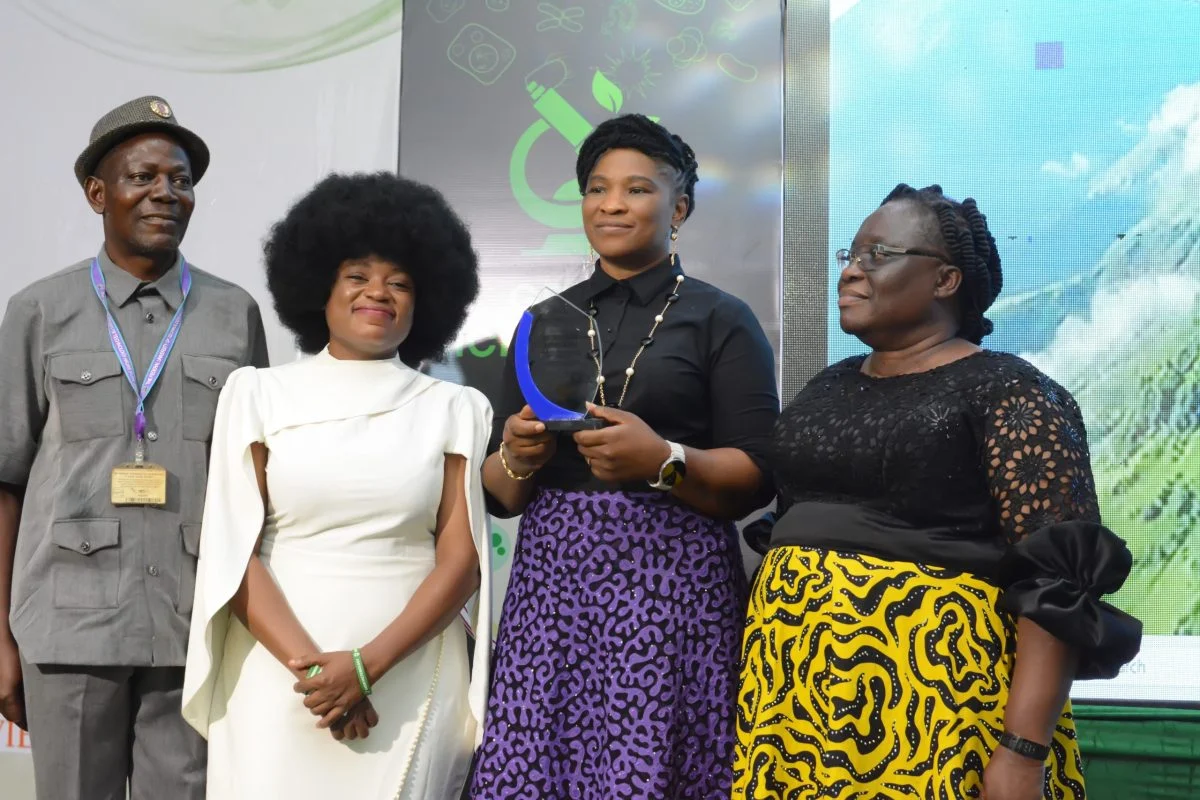
Global scientific gathering brings together academics, industry leaders, government representatives, researchers and students to explore the role of microorganisms in building a sustainable future
The Federal University of Technology, Akure, welcomed one of its distinguished alumnae, Dr Adenike A. Akinsemolu, on Thursday, 16 July 2026, for a landmark homecoming event held as part of the inaugural Society for Green Microbiology Global Summit.
The four-day Summit, held from 15 to 18 July 2026, convened scientists, researchers, industry professionals, policymakers, educators, students and sustainability practitioners from around the world. It began with a global virtual launch featuring internationally recognised experts and continued with a major physical gathering at FUTA on its second day.
Hundreds of participants attended the FUTA event, representing universities, research institutions, government agencies, industry, secondary schools, civil society organisations and the wider public. The occasion combined scientific discussion, institutional recognition, youth engagement, exhibitions and the formal launch of the Society for Green Microbiology.
For Akinsemolu, who undertook part of her academic training at FUTA, the event represented both a professional milestone and a deeply symbolic return to the institution that contributed significantly to her development as a microbiologist and sustainability scholar.
The central feature of the programme was her Founding Public Lecture, titled “Green Microbiology: The Microbial Blueprint for a Changing Planet.”
In the lecture, Akinsemolu traced humanity’s evolving relationship with microorganisms—from the historical fear of microbes as agents of disease to the growing recognition of their indispensable roles in human health, food production, environmental restoration, climate regulation and sustainable innovation.
She explained that microorganisms should no longer be viewed solely through the lens of infection and disease. Instead, bacteria, fungi, algae, archaea and other microorganisms must be recognised as essential partners in addressing some of the world’s most urgent environmental and developmental challenges.
Akinsemolu presented Green Microbiology as an emerging interdisciplinary framework that integrates microbial science with sustainability, climate action, circular economy principles, innovation, ethics and social responsibility. She outlined its core principles, including sustainability, renewability, biodegradability, biocompatibility, microbial diversity, multifunctionality and collaboration.
The lecture highlighted the application of microorganisms in sustainable agriculture, food production, wastewater treatment, renewable energy, pollution control and ecosystem restoration. Examples included the use of nitrogen-fixing bacteria and mycorrhizal fungi to improve soil fertility, microbial communities for waste valorisation, algae for carbon capture, and specialised bacteria capable of breaking down petroleum pollutants and certain forms of plastic waste.
She also explored emerging frontiers such as microbial technologies for self-healing construction materials, artificial intelligence-assisted microbial discovery, sustainable biomanufacturing and the use of extremophilic microorganisms in space exploration.
Beyond scientific innovation, Akinsemolu called for the institutionalisation of Green Microbiology through new university curricula, postgraduate programmes, specialised research laboratories, national policies, professional networks and student chapters.
She emphasised that laboratories should increasingly be designed around practical societal questions, including how microorganisms can help improve food security, reduce pollution, support climate resilience and create sustainable materials and industries.
Concluding the lecture, she declared: “If the 20th century taught fear of microbes, the 21st must teach us to work with them wisely.”
The programme was hosted by FUTA’s Department of Microbiology and International Strategy Office, with the Vice-Chancellor, Professor Adenike Temidayo Oladiji, serving as Chief Host. Professor Daniel J. Arotupin delivered the welcome remarks, while Dr Helen Onyeaka of the University of Birmingham, United Kingdom, addressed the gathering in her capacity as International Co-Chair of the Summit.
Professor Charles O. Adetunji delivered a featured perspective talk, contributing to the scientific conversation on microbial innovation and its applications in sustainable development.
A major highlight of the event was the Distinguished Experts Forum, themed “Harnessing Microbial Power for a Sustainable Planet.” The forum brought together eminent microbiologists and scholars, including Professor Babatunde Rabiu, FAS; Professor Ganiyu O. Oyetibo; Professor Kehinde I. T. Eniola; and Professor Nkem Torimiro.
Moderated by Professor Anthony K. Onifade, the panel examined the future of microbial science, the relationship between research and industry, opportunities for young scientists, and the need for stronger institutional and governmental support for microbiology-based solutions.
The event also featured the formal launch of the Society for Green Microbiology, chaired by Sir Chief Fred Adejo. The Society was established to create a global platform for research, education, innovation, professional development and collaboration at the intersection of microbiology and sustainability.
Professor Felix A. Akinyosoye received a Lifetime Achievement Award in recognition of his distinguished contributions to microbiology, mentorship and academic development. The Vice-Chancellor, Professor Oladiji, was also conferred with Distinguished Honorary Membership of the Society.
Students and young innovators were prominently represented through a secondary school debate and talk competition, a pitch session, exhibitions and opportunities for direct engagement with leading scientists.
The FUTA gathering formed part of a wider Global Summit programme that included keynote and plenary presentations, scientific paper sessions, poster presentations and contributions from researchers across several countries.
The successful Summit marked an important moment in the advancement of Green Microbiology as both a scientific discipline and a global movement. It also transformed Akinsemolu’s return to FUTA into more than a personal homecoming: it became an opportunity to inspire a new generation of scientists and to challenge institutions, governments and industries to recognise the microbial foundations of a sustainable future.


Nnamdi Kanu’s Lawyers Vows Action Over Call to Kill IPOB Leader

Computer science enrollment fell for the first time in 20 years after ChatGPT’s rise, a Stanford economist says

Monkey abandoned in laundry bag on London bus
Monkey abandoned in laundry bag on London bus

US, FG unveil digital Nok heritage platform to preserve over 250 ancient artefacts

AliExpress Faces Record €550 Million EU Fine Under Digital Services Act for Illegal Goods

Troops foil Boko Haram extortion mission, k!ll terrorist in Yobe

 Society1 day ago
2026 Ballon d’Or: Top 4 players to win award after World Cup final revealed
- Society1 day ago
Pepper Seller Caught On Camera Applying Pepper On Newborn Baby As Rituals To Usher Her Into The Business
- Investigation3 days ago
âI canât date a man who earns less than me. Iâve supported men financially before, and Iâm done with thatâ â Mercy Eke
- World2 days ago
Spain earns $51 million for World Cup win and runner-up Argentina gets $34 million as total payout for all 48 teams hits record-high $871 million
- Investigation3 days ago
US President Trump questions Thomas Tuchelâs tactics in England World Cup loss to Argentina
- Investigation3 days ago
Iâll retire and get a tattoo of our manager if Spain win World Cup 2026 – Spanish defender, Cucurella
- Society3 days ago
Prosecution Presents Evidence Against Adu-Boahene in GH¢49.1 Million Trial-Deputy AG Says
- Politics3 days ago
Davido wants music collaboration with Rihanna