World
Guy Tudor, Whose Art Brought Obscure Birds to Life, Dies at 91

This Video Is Trending Right Now
Guy Tudor, a self-taught ornithologist, wildlife illustrator and MacArthur fellow whose field guides to birds trained generations of naturalists and citizen scientists about how to distinguish a Rufous-breasted Leaftosser from a Lesser Hornero, died on July 14 in Greenport, N.Y. He was 91.
His death, at Stony Brook Eastern Long Island Hospital, near his home, was caused by pneumonia, Claudette F. Welch, a friend, said.
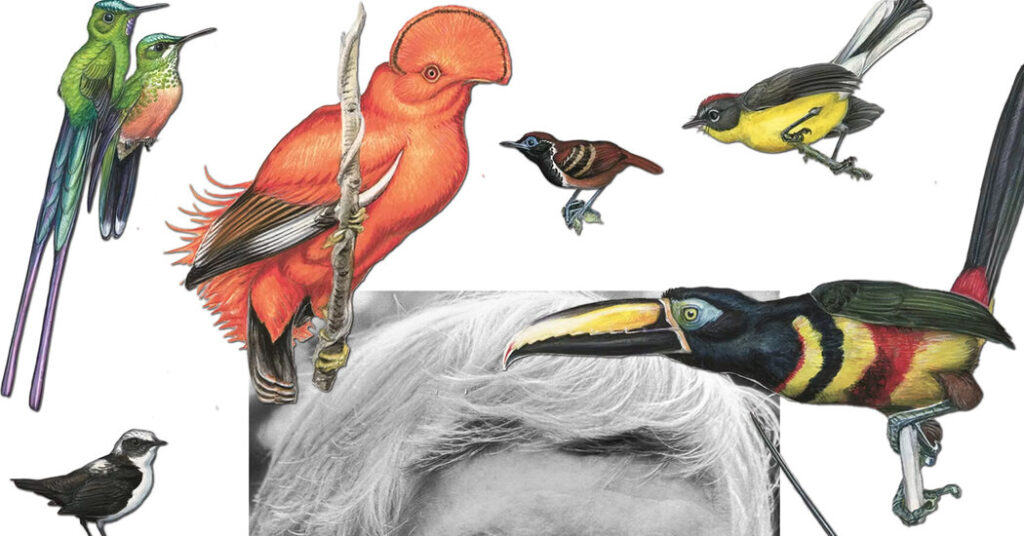
Digital avian databases like eBird were far in the future when Mr. Tudor first set about documenting swaths of the avian world in watercolors and gouaches renowned for their delicacy and precision, and for the artist’s singular knack for capturing the quiddities of winged creatures with paint and brush.
“Guy liked birds, like the Spadebill, with a lot of character,” Sophie Webb, a biologist, wildlife illustrator and author, said.
Despite its classification as a tyrant flycatcher, she added, the diminutive Spadebill is so notably shy that it might be a washout in the forest but for its voice, an assertive trill that broadcasts distinctly short-king energy.
It was Mr. Tudor’s ability “to capture the unique behavior, motion and exact plumage of obscure species” that earned him a MacArthur fellowship in 1990, said Terence Clarke, an artist and naturalist who was a friend of Mr. Tudor’s.
The Spadebill’s typical range is from southeastern Mexico to Central and South America. So, too, was Mr. Tudor’s.
For much of a career that spanned decades, he pursued the oscines, or songbirds, of the neotropics to their habitats in the Southern Hemisphere — sketching, making compendious field notes and amassing a vast file of images that he used as a reference tool when painting the plates for definitive books like “A Guide to the Birds of Columbia” (1986), by Steven L. Hilty and William L. Brown. It and many of Mr. Tudor’s other books, including “A Guide to the Birds of Venezuela” (1978) and “Field Guide to the Songbirds of South America” (2009), became landmarks in the field.
In both work and life, Mr. Tudor pitched his ambitions as much toward avocational birders as professional ornithologists. “Guy was a born mentor and teacher,” Mr. Clarke said, one who helped “launch the careers of literally generations of young scientists, field researchers and wildlife artists, despite being a total curmudgeon.”
His nearly lifelong base of operations was a modest four-room apartment in Forest Hills, Queens. There, in collaboration with the ornithologist Robert S. Ridgely, he produced, among other books, the multivolume monument that is “The Birds of South America” (1989 and 1994). Within its pages are represented almost 1,700 species, or roughly half of all identified species found between the Isthmus of Panama and the Tierra del Fuego archipelago.
Hunched over a drawing board, with an ever-present American Spirit cigarette dangling from his lips, Mr. Tudor conjured with pen and brush the hosts of the tropical heavens — Spadebills, yes, but also resplendent creatures like the Keel-billed Toucan, the Scarlet Macaw, the Turquoise-browed Motmot, the Paradise Tanager and the Long-wattled Umbrellabird.
Guy Adwill Tudor III was born on Sept. 28, 1934, in New York City, to Charles Tudor and Margaret (Matthews) Tudor.
His father was a journalist, artist and art director employed by the Resettlement Administration in Washington who worked alongside photographers like Walker Evans, Carl Mydans and Dorothea Lange to create a portrait of rural poverty during the depths of the Depression.
He would go on to become a founding art director of Life magazine and is best known for designing the magazine’s indelible logo.
“My father and grandmother were both illustrators,” Matthew Tudor, Mr. Tudor’s brother, said in an interview. “I don’t remember my father doing illustrations of animals, but that’s what my brother started out with, birds and then caterpillars and butterflies — anything with wings.”
Guy grew up in the Yorkville neighborhood of Manhattan and attended the private boarding school Governor Dummer Academy (now the Governor’s Academy), then Princeton and Yale. Later, he served in the Army.
He was married twice, to Elizabeth Linko and Michele Le Marchant, who both predeceased him. A son from his first marriage, Michael Seton Tudor, died in infancy. Mr. Tudor’s brother is his sole immediate survivor.
In a life marked by rebelliousness and wanderlust, birds were a dependable constant, his brother said: “He was very fond of noting that he had gone to 50 countries logging his birds.”
Matthew Tudor added: “Once he got off a plane in Caracas carrying a telescope he had affixed to the butt of a rifle and immediately started pointing it around on the tarmac, looking for birds. Half the military of Venezuela came charging at him.”
Yet it was not only birds that fascinated Mr. Tudor. He revered all winged creatures.
In 1984, he helped found the New York City Butterfly Club, serving as its longtime president and hosting meetings in his cramped apartment. He went on to be one of the founders of the North American Butterfly Association, whose annual census counts have starkly illuminated species decline resulting from threats by pesticides, habitat loss and climate change.
“Guy was a deeply passionate conservationist,” said John A. Gwynne Jr., a bird illustrator and a founder of the storied Sakonnet Garden in Little Compton, R.I., who collaborated on field guides to the birds of Venezuela and Brazil with Mr. Tudor.
“People claim Guy was a curmudgeon, but it’s really that he was alarmed — and rightly so — by what is happening to the natural world,” Mr. Gwynne added. “He always used to say, ‘The infidels have invaded my church, and they’ve almost reached the altar.’”


Amid Rising Insecurity, Nigerian Police Spend ₦402.8million On Burial Expenses In 14 Months

‘What he said is not true” – Al-Mustapha dismisses ex-DSS operative’s Abacha death claims

Ida Schmertz, Who Studied Women in Politics, Dies at 91

Wisconsin’s capital city cancels signature events, grapples with fallout from police shooting

A Summer of Extremes Set the Conditions for Europe’s Wildfires

One dies in Lagos-Ibadan expressway crash

Katsina Govt. disburses N3.6bn for community projects, rehabilitates 3,900 facilities

 Society3 days ago
FULL TEXT: Trump’s letter to Tinubu
- Investigation3 days ago
âIt is an honour to stand with you in fight against terroristsâ- Trump tells Tinubu
 Breaking2 days ago
âFailed nation, failed parenting and lack of home training’- Lawyer, Deji Adeyanju blasts podcast host for saying a poor man has no place in her heart’
 Investigation3 days ago
âI have gone back to our family â- Gov. Fubara says as he declares support for Wike’s governorship candidate
- Breaking3 days ago
âl did not k!ll him, he d!ed on top of me" – Sani Abacha’s mistress says
- Investigation3 days ago
ââGo home, Nigeria is your home. We wonât accept you in South Africa”- South African women hurl anti-immigrant slurs at former Miss Universe Nigeria, Chidimma Adetshina amidst her deportation court case
- Investigation3 days ago
Nyesom Wikeâs daughter, Jazmyne bags Bachelor of Law degree from University of Southampton
- National2 days ago
“Court Declines To Review Miyetti Allah leader’s ₦2bn Bail Terms” — Directs Him To Vacation Judge