World
He Was One of America’s Most Important — and Most Divisive — Scientists

This Video Is Trending Right Now
ALBERT SABIN: The Life of a Polio Vaccine Pioneer, by Karen Torghele
Twenty years ago, the National Museum of American History held an exhibition titled “Whatever Happened to Polio?” It focused on Jonas Salk, whose vaccine helped tame the devastating virus that crippled and killed tens of thousands of children in the baby boom era following World War II. Salk became a national icon, our first homegrown celebrity-scientist. His face adorned the cover of Time magazine. Numerous biographies appeared. When people speak of polio today, it’s Salk they remember.
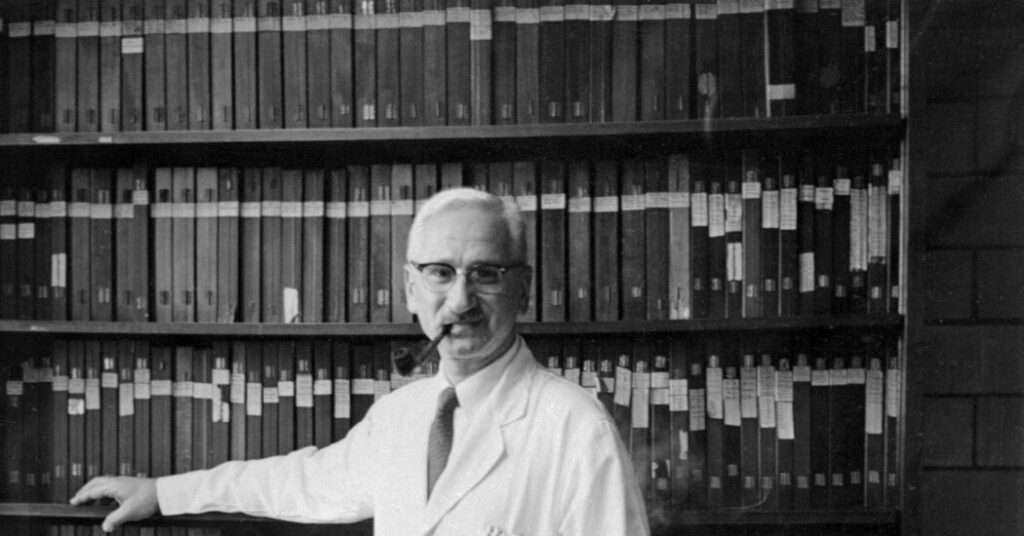
The adulation served to marginalize the contributions of others, none more so than Albert Sabin, whose competing polio vaccine proved essential in controlling the disease. Sabin remained in the shadows for several reasons, including his sour demeanor and the fact that Salk’s vaccine came out before his own. Karen Torghele’s “Albert Sabin: The Life of a Polio Vaccine Pioneer” is the first serious biography to appear. It does full justice to one of medicine’s forgotten giants.
He was born Abram Saperstein in Bialystok, Russia, in 1906, and his earliest memories included the antisemitic pogroms that swept the region with murderous regularity. His family fled to America in 1921, settling in Paterson, N.J., an immigrant stronghold known as “Silk City” for the textile factories that lined the Passaic River. Abram entered high school with a new name, Albert Sabin, and a modest goal of finding steady work in the mills.
His plans changed when a relative agreed to pay his way to New York University in exchange for a promise that Sabin join his dental practice following graduation. Sabin loved the science but hated dentistry. He won a scholarship to the N.Y.U. School of Medicine, one of the few places that didn’t restrict Jewish applicants. At Yale, for example, the dean’s instructions were remarkably precise: “Never admit more than five Jews, take only two Italian Catholics, and take no Blacks at all.” For Sabin — and later for Salk — N.Y.U. was the only game in town.
Sabin’s early career cemented his reputation as a gifted researcher, but a troubled colleague. It reached the point, says Torghele, where his mentors felt compelled to warn prospective employers. While working at the prestigious Rockefeller Institute, Sabin received a lucrative offer from the Children’s Hospital of Cincinnati, where he’d spend most of his career. The key recommendation came from Tom Rivers, the institute’s exalted hospital director, who concluded: “He has a very hard time getting along with people here, but he is a genius!”
Cincinnati proved a good fit. Given ample laboratory space and a hefty budget, Sabin concentrated on vaccines. He also knew a bit about polio. The key difference in the late 1940s was its emergence in epidemic form in Western nations like the United States. Sabin speculated that polio was a disease of cleanliness. As sanitation improved, children were less likely to be exposed (and naturally immunized) as infants. Squalor, he believed, could sometimes protect against disease.
Torghele, an epidemiologist who worked at the Centers for Disease Control and Prevention for more than 25 years, is a sure guide to the breakthroughs that made Sabin’s work possible. Researchers discovered that there are three types of polioviruses, that all could be safely grown in a laboratory, and that they enter through the mouth, replicate in the gut and use the bloodstream to reach the nervous system, where the damage occurs. The obvious solution was a vaccine.
Two rival versions emerged — an injected, killed-virus vaccine developed by Salk, and an oral, live-virus vaccine championed by Sabin. Salk’s was simpler to produce; it didn’t require the delicate balancing act that occurs with live viruses, which must be strong enough to produce a natural infection in the body without triggering a full-blown case of the disease. Salk tested his vaccine in 1954, in what stands as the largest public health experiment in American history. More than a million schoolchildren participated, some getting the real vaccine, others a look-alike placebo. A private charity, the March of Dimes, provided the funding and ran the trials. The government played almost no role.
The positive results turned Salk into a superstar, much to the displeasure of other polio researchers who viewed Sabin, for all his nasty bluster, as the superior scientist with the better product. (Tom Rivers referred to Sabin as “the smart Jew” and Salk as “the young Jew.”) To compound matters, Sabin couldn’t test in the United States because so many children had already received the Salk vaccine. But in 1959, at the height of the Cold War, the Kremlin and the U.S. State Department gave him permission to run trials in the Soviet Union, where polio was rampant. Nearly 78 million oral doses were consumed, and the early reports were glowing. The vaccine was “close to 100 percent effective.” No dangerous side effects were listed. It was cheaper than Salk’s vaccine and easier to administer. Who wouldn’t choose a sugar cube over a painful injection?
Sabin’s vaccine was fully licensed in the United States in 1962. The number of confirmed polio cases in 1960 causing permanent paralysis or death stood at 2,525 — a dramatic drop from a high of 21,269 in 1952, before Salk’s vaccine became available. By the mid-1970s, that figure had dropped below 20, thanks largely to Sabin’s laboratory magic. Polio seemed on the verge of eradication.
Sabin’s professional success did little to quell his personal demons. Fortunately, Torghele doesn’t play psychoanalyst. Her portrait of Sabin’s private life is both straightforward and painful to read. He had multiple affairs. He showered family members with verbal abuse. His first wife killed herself by placing a plastic bag over her head. His second wife quickly realized her mistake and divorced him. He remained so distant from his two daughters that he cut them from his will. His gods were science and self-promotion, not necessarily in that order.
Salk, too, remained an enduring target. Sabin never stopped belittling him, even leading a successful campaign to deny Salk admission to the elite National Academy of Sciences. “I could go into the kitchen and do what he did,” Sabin sneered.
Both men died — Sabin in 1993, Salk in 1995 — with Sabin the apparent victor. But his vaccine had a flaw that became clearer over time. In rare instances, the attenuated strains reverted to virulence, causing polio in the vaccinated child. Sabin vehemently denied the danger, but Torghele certainly intimates that he knew. During the Russian trials, she writes, several scientists had alerted him to the problem. He responded by persuading them to remain silent for the good of the vaccination program.
In 2000, the C.D.C. removed Sabin’s live-virus vaccine from its immunization schedule, replacing it with a modern version of Salk’s killed-virus vaccine. There was no denying the obvious: Sabin’s vaccine was no longer worth the slim but undeniable risk it posed. Polio could never be eradicated when vaccine-derived cases kept popping up.
Whatever Happened to Polio? The widespread administration of a more powerful Salk vaccine essentially ended the threat in the United States and beyond. Hot spots remain in remote regions of Asia and Africa, where the numbers are small but persistent, and where the Sabin vaccine is still favored because of its low cost and easy delivery. The irony is that it will take both vaccines to completely eradicate the disease — Sabin’s to contain it where it still circulates, Salk’s to finish it off. An endgame that must have both men spinning in their graves.
ALBERT SABIN: The Life of a Polio Vaccine Pioneer | By Karen Torghele | Yale University Press | 390 pp. | $38


FG begins registration for renewed hope employment initiative in Ondo

E.U. Debate About Import Ban Reveals Deep Divides Over Israel

Suspected cable thief nabbed in Bayelsa community

Hollywood’s open secret: It’s battling AI — but already recruiting to use it

Katty Kay: confidence is the skill that turns thoughts into action—and companies need to start teaching it

Men’s ‘relationship coach’ Gehgeh responds as men criticise him for getting married after teaching them that marriage is a scam and they should have baby mamas instead

Wildfires drive 250,000 people from homes and edge towards wine city of Bordeaux

 Breaking3 days ago
âFailed nation, failed parenting and lack of home training’- Lawyer, Deji Adeyanju blasts podcast host for saying a poor man has no place in her heart’
 News3 days ago
Court rejects Bello Bodejo's request to review ₦2 billion bail conditions
- Society3 days ago
Mid-Year Budget Review: Government Allocates GH¢400 Million For New Buses To Boost Public Transport Fleet
- Investigation3 days ago
Chelseaâs Garnacho joins Aston Villa on loan
- Investigation3 days ago
US didnât detain our President after World Cup Final – Argentine FA says
- News3 days ago
Femi Otedola Increases First HoldCo Stake With ₦77bn Share Purchase
 News3 days ago
Court Delays Trial Of Alleged Abuja Land Grabbers Over ₦500m Fraud Case
- News3 days ago
Businesswoman Loses ₦1m Goods After Exhausting Lagos Trip