World
His father could no longer go where wheelchairs stopped. So he turned an industrial robot into a walking mobility chair

This Video Is Trending Right Now
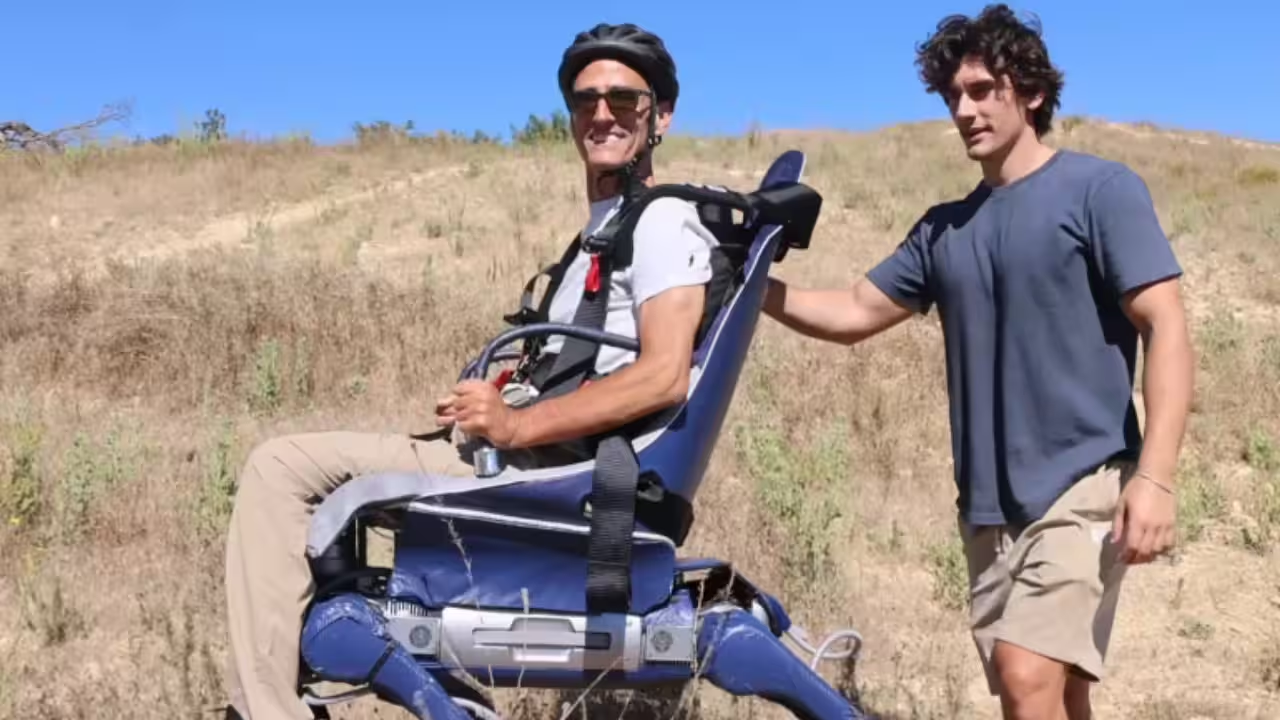
For most wheelchair users, everyday life is designed around the limits of accessible infrastructure. A dropped kerb or a ramp may solve one obstacle, but steep hills, rocky trails, forest paths and staircases can still put entire destinations out of reach. Rather than accept those limitations, American maker and engineer Jake Laser set out to build something entirely different for his father, who has lived with multiple sclerosis (MS) for the past 20 years.The result is what Laser calls the “bionic leg chair,” a robotic mobility vehicle that combines advanced quadruped technology with a custom-built seat, allowing his father to travel across terrain that conventional wheelchairs cannot navigate. By adapting an industrial robot rather than designing a mobility aid from scratch, Laser has demonstrated how robotics originally developed for industry could one day help redefine personal accessibility.
An industrial robot becomes an all-terrain mobility aid
At the heart of the project is an industrial-grade quadruped robot built by Unitree, a robotics company known for developing agile, four-legged machines. Unlike traditional robots that rely solely on legs, this platform uses a hybrid leg-and-wheel design, with powered wheels mounted beneath each robotic foot.That combination gives it the best of both worlds. On pavements and smooth indoor floors, the robot rolls efficiently like a wheeled vehicle, reducing energy consumption and providing a comfortable ride. When it encounters stairs, rocks, tree roots or uneven ground, it can transition to walking mode, lifting each leg independently to climb obstacles that would stop even specialised off-road wheelchairs.For Laser, the platform offered an ideal foundation for a mobility device capable of travelling almost anywhere a person on foot could reasonably go.
Laser built it with his father in mind
Laser’s motivation was deeply personal. His father has lived with multiple sclerosis for two decades, a neurological condition that can progressively affect movement, balance and muscle control. Although wheelchairs restore mobility in many situations, they remain constrained by the terrain around them.Wanting to give his father greater independence outdoors, Laser transformed the quadruped robot into a personal transport system by installing a custom seat, developing modified control software and designing an automotive-inspired body around the machine. The result is a vehicle that allows its occupant to remain seated while the robot walks, rolls and climbs beneath them.More than an engineering exercise, the project was designed to restore access to places that had gradually become inaccessible, from hiking trails and countryside paths to uneven natural landscapes where traditional mobility aids struggle.
Would you support further investment in robotics to improve mobility for people with disabilities?
3k+ users shared opinion today
5k+ users already voted today
3k+ users shared opinion today
Share Opinion
How the ‘bionic leg chair’ works
The robotic chair retains the quadruped’s original ability to balance dynamically while moving. The on-board computer constantly adjusts the legs in order to keep the robot stable, regardless of whether it travels over difficult terrain or climbs stairs.Laser redesigned the control system in order to simplify the robot’s use as an assistive device, and the special seating system ensures safe positioning of the passenger. However, despite the futuristic style of the design, which makes the robot look like a car instead of heavy machinery, it is still an advanced robotic device made to perform in harsh conditions.The wheel/legs design allows the robot to move smoothly on smooth ground while keeping the capability to overcome obstacles that would require leaving the wheelchair behind.
A glimpse into the future of accessible mobility
Laser documented the project on Youtube channel on his channel @JLaservideo, where it has drawn widespread interest from engineers, robotics enthusiasts and accessibility advocates alike. Although the bionic leg chair is a bespoke prototype rather than a commercial product, it highlights the growing potential for robotics to transform mobility beyond conventional wheelchairs.There is a growing trend of researchers developing legged robots for use cases such as disaster relief and recovery, industrial inspection, and even healthcare and rehabilitation. These efforts imply that one day, similar technology will offer individuals with disabilities greater opportunities to explore inaccessible locations.The case of Jake Laser is unique not only because the innovation represents a technological breakthrough but also because it was motivated by a need to help someone in the developer’s family. The young man’s desire to give his father a chance to visit certain places once again led to a brilliant idea of turning an industrial quadruped into a walking mobility chair.


MURIC to ICPC: Release El-Rufai’s personal physician

Police restrict movement ahead of Edo local government elections

“I Didn’t Resign” — Carlos Queiroz Denies Quitting As Black Stars Coach Amid Confusion

FCT Police Rescue Four Kidnap Victims After Gun Battle With Suspects in Abuja Hills

Road Safety Advocacy: Dangote wins Corporate Excellence Award

FG intensifies efforts to keep Nigeria Ebola-free

UK police launch murder inquiry after death of former Tory minister Ann Widdecombe

 Investigation3 days ago
15-year-old student slashes schoolmate with cutlass for allegedly touching her brâ¬ast repeatedly during school clean-up exercise
- Society2 days ago
Madness!! Ghanaian Tiktoker Goes Live On Tiktok To Bath To Gain More Followers And Accumulate Gifts
- Investigation1 day ago
Disturbing comments made by men after man was caught r@ping his wife’s teenage niece in Imo
- Breaking20 hours ago
Mum gives birth in her sleep and nurses don’t find her baby until minutes later under pile of blankets
- Society3 days ago
Insecurity: Nigerian army graduates 17 pioneer CSK men
- News3 days ago
BREAKING: Tinubu orders ICPC to probe presidential intervention council
- Politics2 days ago
Standard, commemorative ₦100 notes remain legal tender, says CBN
- Investigation3 days ago
Iâve never made that kind of money – Woman in viral video who claimed she makes N2.5 million monthly from selling roasted corn retracts her statement (video)