World
How A.I. Mania Turned This Stock Market Into a ‘Version of Squid Game’

This Video Is Trending Right Now
South Korea has never witnessed a financial frenzy quite like this.
Driven by the global artificial intelligence boom, its stock market benchmark, the KOSPI, doubled in the first half of this year, adding trillions of dollars in value and outperforming every major global index. But then came the whiplash.
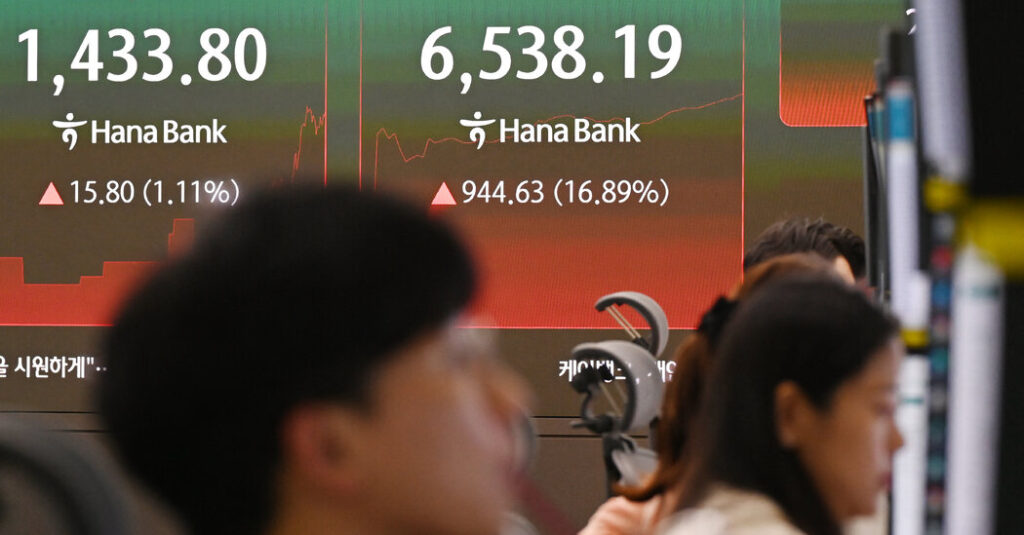
As the South Korean stock market became the epicenter of both investment enthusiasm and anxiety related to A.I., it turned extremely volatile. The shifting sentiment has been focused on two leading chip suppliers to the boom in building A.I. data centers, Samsung Electronics and SK Hynix. Together they account for more than half the value of the KOSPI.
The swings became so violent that regulators repeatedly ordered mandatory trading brakes almost every other day this month. By Wednesday’s close, the KOSPI had plunged about two-fifths from its peak, wiping out more than $2 trillion in just two consecutive days. The mood reversed quickly, on the heels of bullish comments from Microsoft and Amazon about spending on data centers.
On Friday, the index rose a record 18 percent, closing at 6,595 points.
This violent roller-coaster ride has transformed the local stock market into what some frustrated South Koreans now call the “Kospi Casino,” deflating the euphoria cultivated under President Lee Jae Myung. Mr. Lee had positioned himself as the highest-profile champion of the rally, anchoring his political brand to the economic windfalls of A.I.
Now, with the KOSPI wildly seesawing and his domestic approval ratings eroding, citizens are openly questioning whether the Lee administration overhyped a fragile market.
In June, when the index hovered around 8,000, Mr. Lee famously declared the market “undervalued.” Just this month, he proclaimed, “I believe A.I. is akin to humanity discovering fire anew.” Driven in part by such encouragement, millions of South Koreans opened trading accounts and bet on Samsung and SK Hynix.
The companies’ memory chips store and shuttle the massive amounts of data used in training and running A.I. models. The stock prices of both companies had dropped sharply over the last month, even as they reported huge increases in revenue and profit and said they could not keep up with demand.
But on Friday, shares in Samsung soared 27 percent, while SK Hynix rocketed 30 percent.
Across Asia, other markets and companies exposed to A.I. spending saw strong gains — albeit tame by comparison to the KOSPI. Japan’s Nikkei 225 rose 4 percent. In Taiwan, the stock market jumped 8 percent, propelled by a 10 percent rise in shares of Taiwan Semiconductor Manufacturing Company, the most valuable firm there and the producer of Nvidia’s advanced A.I. chips.
The KOSPI delivered an extraordinary 76 percent gain last year, making it the top-performing major index globally. The total market capitalization soared to $5 trillion in early June, briefly eclipsing India, Canada, and major European nations to become the world’s 6th largest equity market. Today, the market is a compounding political liability.
“The market has become a veritable gambling site,” said Lee Jong-soo, an office worker in Seoul. “I lost so much in semiconductor and A.I. stocks in recent weeks that I am terrified to even look at my screen. In fact, I deactivated my stock-market notifications on my cellphone.”
In Seoul’s subways, many commuters were no longer streaming K-dramas; they were staring blankly at smartphone screens, watching their savings vaporize at an alarming rate. Online trading boards were overflowing with reports from people whose “life has been totally screwed.” Not far from where Mr. Lee waited for the bus under a sweltering summer sun, furious traders delivered rows of funeral flower wreaths to the front gate of the National Assembly. Their black-on-white ribbons bore a stark warning: “Don’t ignore the tears of ants!”
That was a reference to South Korea’s retail day traders, for whom the market crash is not a matter of abstract statistics — it is an existential tragedy. Regular citizens were actively encouraged to invest in the market by a government aggressively promoting equities to steer household wealth away from an overheated real estate sector. Young professionals, students, and even conscript soldiers took out high-interest loans, praying stock gains would outpace bank interest and cushion them against a bleak job market.
Particularly enticing were single-stock leveraged exchange-traded funds, or E.T.F.s, that tracked Samsung and Hynix. These products promised double gains in those shares — but delivered double the losses when they fell.
After government regulators authorized the launch of these E.T.F.s in late May, they helped fuel the market ahead of local elections the following month but ended up “stepping on the accelerator” during the subsequent market plunge, said Shin Dong-uk, an opposition lawmaker.
Mr. Lee, the president, was away on a state visit to Latin America this week. Furious citizens back home seized on his absence, flooding his social media travel posts with vitriol and accusing him of touring abroad while his people suffered. Panic has infiltrated the ruling camp too.
“Common sense cannot explain what we are witnessing,” warned Son Myoung-soo, a lawmaker from the governing Democratic Party. “We are not suffering an Asian financial crisis, a global financial meltdown, or a war — yet our financial market is on the verge of total collapse. Anyone can see this market has decayed into a playground for gamblers.”
Khoon Goh, the head of Asia research at ANZ, an Australian banking group, shared that sentiment. “The KOSPI has been trading like a meme stock or crypto,” he said. “It’s not normal behavior for a major index.”
By Wednesday, Finance Minister Koo Yun-cheol and top policymakers were forced to apologize for greenlighting the high-risk E.T.F.s without properly evaluating their dangers.
Mr. Lee’s aides and financial regulators have urged the public not to blame E.T.F.s entirely. They pointed to global concerns about A.I. spending pulling markets down across the world, reminding them that the KOSPI is still up more than 50 percent this year. Though the government rushed to enforce emergency volatility curbs on leveraged ETFs on Friday, for millions of retail traders, the rescue mission arrived too late.
The high-risk E.T.F.s have helped turn South Korea’s stock market into “a real-life version of Squid Game,” said Jeong Eui-jeong, the head of the civic group Korea Stockholders Association, referring to the dystopian K-drama. “They should never have been born.”
Daisuke Wakabayashi and Steve Lohr contributed reporting.


Umahi tells South-East to reward Tinubu with votes in 2027

34 workers k!lled in Pakistan coal mine blast

Fans are convinced Ariana Grande spills on Ricky Alvarez reunion in steamy ‘Petal’ song ‘Bad Thing (Bunny Hop)’

Nobody is selling football – FIFA to continue consultation on investor plan despite UEFAâs vote to boycott

Trump’s Gaza Deal Sparks Questions on Whether Israel, Hamas Will Comply

Nigerian govt to publish detailed account of petrol subsidy savings — Finance minister

Herder collapses as 42 of his cows di£ at once in FCT community

 World2 days ago
My daughter’s squishy toy burst on her legs. We ended up in the emergency room.
- Breaking3 days ago
ââDo not shake hands”- UNILAG shares anti-r@pe advisories to female students
- Investigation3 days ago
âVilification, murd£r of Nigerians in South Africa will not be toleratedâ – Fani-Kayode speaks after graphic video showed ‘Nigerian man t0rtured to de@th’ in SA (video)
- National3 days ago
EXCLUSIVE: Police Indict Unity Bank Cooperative Officials in ₦85 Million Fraud Investigation
- National3 days ago
FG Exceeds 2024 Borrowing Target by ₦4.79tn as Debt Hits ₦12.62tn
- National3 days ago
Oyo takes delivery of two surveillance aircraft
- World3 days ago
Who Wins (and Who Loses) in the Democrats’ New 2028 Primary Calendar?
- World3 days ago
What Is Open-Weights A.I.?