World
How NATO Is Quietly Reinventing Itself for Trump

This Video Is Trending Right Now
The portents were not good. Before departing for the recent NATO summit in Ankara, President Donald Trump took to Truth Social to berate the alliance. He posted figures suggesting the alliance was a financial burden on the United States. He complained about allies neither contributing their fair shares nor standing with America. And he deemed it ridiculous for the U.S. to continue along this “one-sided” path.
Things didn’t improve when Trump touched down. During his first press conference at the summit, he singled out the big European allies—France, Germany, Italy, and the United Kingdom—for their lack of support over Iran. He reprised the demand that the Danish territory of Greenland be ceded to American control, and bashed the allies for insufficient defense spending. Trump suggested the allies were lucky to have him, claiming he only showed up as a favor to his “friend,” Turkish President Recep Tayyip Erdogan.
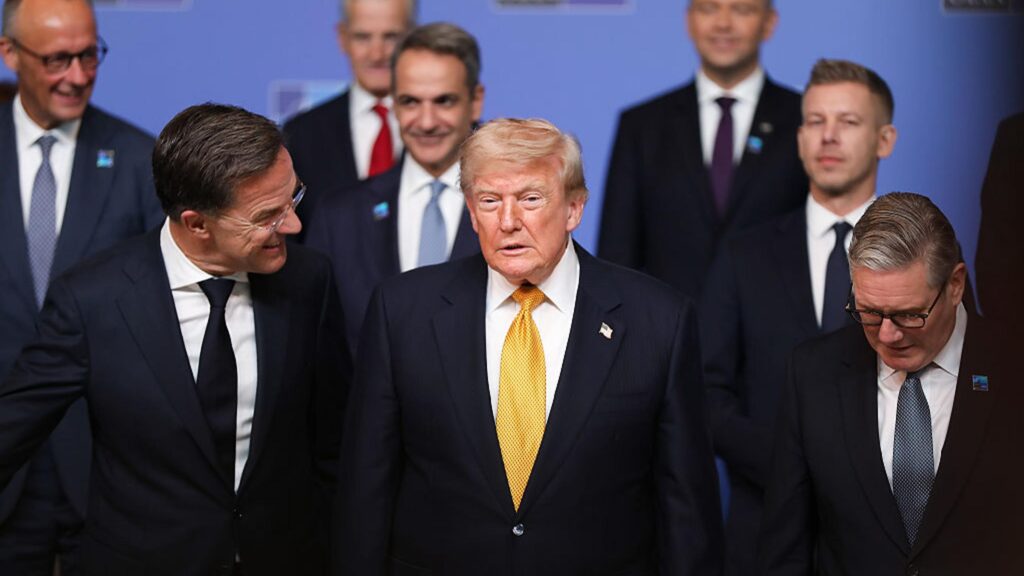
Yet a day later, the mood had changed. Trump departed Ankara praising “the love” among the allies. He was seduced by a carefully orchestrated procession of prime ministers and presidents of member countries of the alliance, each in turn swallowing hard and praising his leadership. They were following a script already played to great effect by NATO Secretary General Mark Rutte, who has helped NATO survive Trump by perfecting the art of flattering the American president.
“Teflon Mark” and the art of the deal
When Rutte was appointed by the allies, he was not the obvious choice. As Dutch prime minister, he had led a country with a poor record of defense spending. There was also a strong argument at the time that NATO ought to select its first female Secretary General, or its first from an Eastern European ally.
But Rutte’s skill as a consensus-builder elevated his standing. Rutte had led Dutch coalition governments for nearly 14 years, and his reputation for deal-making and political survival had earned him the nickname, “Teflon Mark.” Crucially, for these reasons, Rutte also enjoyed the support of the Biden White House.
Rutte began work at NATO in Oct. 2024. Trump entered the White House for the second time three months later. Armed with an already well-honed gift for flattery, Rutte spared little time in cozying up to the incoming American president. At every opportunity since, he has praised Trump’s leadership. European and Canadian defense spending increases have, in Rutte’s telling, became the “Trump trillion.” He has an unerring ability to deflect difficult questions at press conferences—recently on Iran—so as to spare America any embarrassment.
When a Danish journalist accused him in Ankara of lacking self-respect for failing to counter Trump’s claims to Greenland, Rutte replied by comparing Trump’s impact on NATO to that of President Dwight D. Eisenhower, NATO’s first Supreme Allied Commander Europe and early advocate of fair transatlantic burden sharing. Trump rewarded Rutte by praising him as an “extraordinary person” and a “smart leader.”
Rutte’s unstinting support of Trump does carry a cost. Calling Trump “Daddy” at NATO’s 2025 Hague summit was cringeworthy for many diplomats. And sometimes Rutte’s spin on events rankles national sensitivities: his talking up of flights flown from bases in Italy to support Operation Epic Fury, the American war against Iran, recently drew a public rebuke from the Italian defense ministry. In January, Rutte intervened to set up a framework for discussing the Greenland question, prompting the Danish defense minister to point out that Rutte could not negotiate on Denmark’s behalf.
These reservations aside, Rutte remains, for now, an asset for the alliance: someone who can smooth over Trump’s impetuosity. NATO leaders understand his relationship with Trump is one of convenience, not political affinity. Rutte has worked tirelessly to support NATO’s broader agenda: standing up to Russia, supporting Ukraine, and, in his words, promoting “a stronger Europe in a stronger NATO.”
And Rutte is not averse to praising other NATO leaders. He commended German Chancellor Friedrich Merz for his “political courage” in ramping up German defense spending, and days before the NATO summit complemented then-British Prime Minister Keir Starmer for his “leadership” on Ukraine.
NATO’s savior?
Is it, then, too much to claim that without Rutte, NATO would be doomed? Similar questions were asked about Rutte’s predecessor, the Norwegian Jens Stoltenberg. As Secretary General during Trump’s first term, Stoltenberg too had an uncanny ability to read Trump’s mood and shield the allies from criticism.
Serious academic work has argued that Stoltenberg was, in part, responsible for NATO’s survival. Stoltenberg had to manage an American president who felt NATO was playing the U.S. as a sucker. In his memoirs, Stoltenberg recalls fearing, at the 2018 NATO summit, that the alliance “was about to stop functioning” if Trump made good on his threats to withdraw the U.S. security guarantee.
A deal brokered by Stoltenberg and Rutte—then at the summit as Dutch prime minister—kept Trump on board. Flattery, again, was the device. At the summit, Stoltenberg credited Trump’s strong leadership on defense spending for NATO’s revival.
What these examples suggest is that Secretary General of the NATO is no shrinking violet. Of the 14 office holders to date, five have been foreign ministers and two have served as defense ministers. The last three—Rutte, Stoltenberg, and his predecessor, the Dane Anders Fogh Rasmussen—came to the job as sitting prime ministers.
That standing allows the Secretary General to hold his own with NATO’s national leaders and with the alliance’s military commanders—the Supreme Allied Commander Europe and the Chair of the NATO Military Committee. The Secretary General can draw on considerable bureaucratic advantage: he heads up the International Staff at NATO headquarters, oversees the alliance’s polished public communications operation, and serves as the chief organizer of NATO summits.
But the Secretary General cannot countermand the nations. And here, ultimately, the U.S. carries the greatest influence. Despite his reservations, Stoltenberg could not prevent the U.S. from terminating NATO’s mission in Afghanistan in 2021. Today’s U.S. troop drawdowns in Europe, even if they directly affect NATO’s conventional defenses, are decided in the White House and the Pentagon. It is Rutte’s job to cast them in a positive light.
A shape shifting NATO
America has been critical of burden-shirking among the allies since NATO was formed. Trump has turned that sentiment into a weapon. Deference and sweet-talk have been Europe’s disarming response. It doesn’t always work: cozying up to the president—as Italian premier Giorgia Meloni recently found out—does not preclude a Trump tongue-lashing. Yet flattery did work in Ankara. Rutte deserves credit as the flatterer-in-chief.
Still, sycophancy only gets you so far. Practical measures aligned with American preferences are also needed. Away from the political theater, in recent months, the alliance has been quietly reshaping itself toward America’s preferred vision of European security: a “NATO 3.0.” Its chief architect, U.S. Under Secretary of War for Policy, Elbridge Colby, has spoken of the allies assuming “primary responsibility” for the conventional defense of Europe.
To that end, Europeans and Canadians are spending colossal sums on their militaries, and funneling more arms and aid to Ukraine, now that the U.S. is reluctant to do so. The transatlantic alliance may, as a result, be entering terra incognita.
The U.S. remains embedded in NATO’s command structure and is the ultimate guarantor of allied security through extended nuclear deterrence, but an unprecedented process of the Europeanization of NATO is under way. And it could fulfil America’s original vision for the alliance: that it serve as a framework within which Europe, as the historian Marc Trachtenberg has written, would be “able to defend itself without direct American support.”
That vision has gone unfulfilled for nearly eight decades. Its realization will be about more than NATO alone. It would involve a more defense-focused European Union, ad hoc coalitions of the willing, and regional and bilateral initiatives that criss-cross the continent. NATO will remain its center of gravity. And so the role of the Secretary General will continue to loom large.
The post How NATO Is Quietly Reinventing Itself for Trump appeared first on TIME.


“I’m 40 and Still Looking for a Husband” — Woman Opens Up About Being Ghosted After Every Date

âIf my son ever gets a girl pregnant, he’s leaving my house immediatelyâ â Cardi B shares parenting stance

Wike’s endorsement of Tinubu demoralising for PDP members — Dan Ulasi

Woman Ends Engagement After Terrifying Graveyard Escape Story

Rams are fine with Aaron Donald taking his time to make comeback decision

SGF calls for stronger ACPN-NAFDAC partnership to fight counterfeit drugs

52 Year Old Woman Arraigned Over Alleged ₦700k House Fraud

 Investigation3 days ago
65-year-old married female teacher blindfolded and tied 10-year-old schoolboy to bed before having s3x with him
- Investigation3 days ago
âBusinesses are dy!ng in South Africa. Nobody is making money – South African man decries low patronage days after anti-immigrant protest
- Investigation3 days ago
"I ‘m fine and healthy" – Video of late Mary Habila debunking her d3ath rumours 3 days before she d!ed at Umahi’s residence
- National3 days ago
CBN opened domiciliary accounts for Gbajabiamila-linked PFIPC on accountant-general’s order before N400 million bribe probe: Cardoso
- National3 days ago
INEC Officials Accused of Demanding ₦2,000 for PVCs in Onitsha [VIDEO]
- Investigation2 days ago
Married woman humiliated after allegedly being caught cheating on her husband with another man in Kogi community
- Investigation3 days ago
âl did not k!ll him, he d!ed on top of me" – Sani Abacha’s mistress says
- Investigation3 days ago
âThe court should marry her offââ Father of 11 begs Sharia Court to compel 27-Year-Old daughter to marry