World
McKinsey: Global households got $40 trillion richer in 2025 as the paper wealth economy swelled to $1.8 quadrillion

This Video Is Trending Right Now
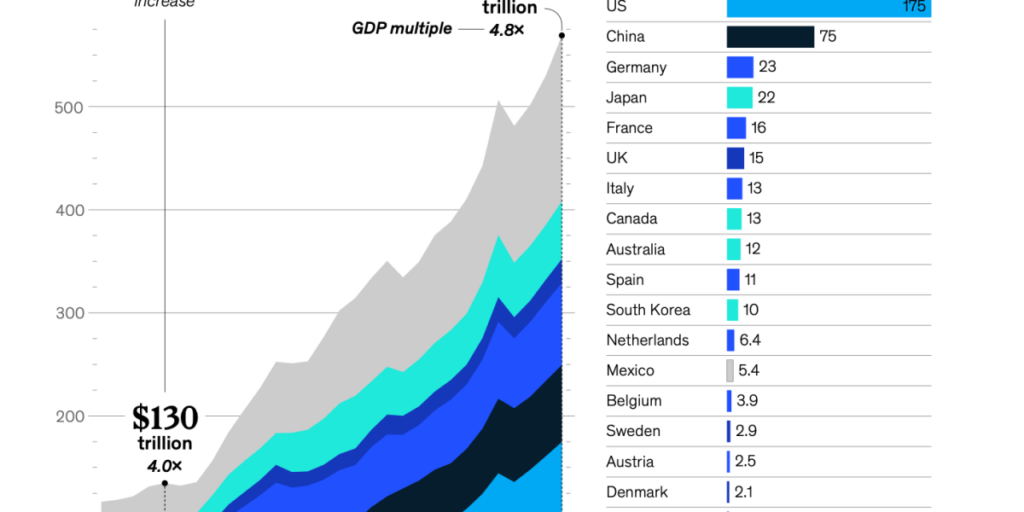
Global households added a record $40 trillion in wealth in 2025, pushing total household net worth to $570 trillion—a 7.3% jump that outpaced the 5.9% average growth rate seen since 2000—as the world’s overall balance sheet of assets swelled to nearly $1.8 quadrillion, according to the McKinsey Global Institute’s newly released “Global Balance Sheet 2026: Imbalance and Divergence” report. These are both record levels, it’s almost needless to say.
This is more than quadruple the value from 2000, at nominal values and market exchange rates, and a faster growth rate than GDP, “posing questions about its health and stability,” McKinsey drily noted, and it’s not uniform across countries.
Household wealth per capita is growing in most countries, but largely not keeping pace with GDP, which the institute attributed to slowing real-estate values, as real estate is the largest component of household wealth in most economies. The U.S. and Australia have the highest wealth per capita and saw household wealth expand by at least 20 percentage points of GDP.
The AI-fueled paper wealth problem
The headline finding is this wealth surge was overwhelmingly a “paper” phenomenon rather than genuine economic expansion. Only about 20% of the new household wealth came from real capital formation—actual investment in productive assets—while equities alone accounted for 57% of new wealth versus just 15% from real estate. That marks a sharp reversal from the historical 2000–2024 pattern, when real estate drove the majority of wealth gains.
U.S. equity values reached 2.4 times corporate net assets in 2025—nearly double the historical average—with just over half of S&P 500 market-cap growth from 2021 through 2025 attributable to the “Magnificent Seven” AI-linked mega-cap stocks. The U.S. now accounts for nearly half of all corporate equity value among major economies globally, a share that has grown substantially over the past 15 years. This concentration means American corporate earnings, and specifically AI monetization, have become a linchpin for global wealth stability.
While the U.S. relied on rising equity multiples, China’s balance sheet growth came through debt accumulation instead. Corporate debt there reached 80% of real assets (versus a 50% global norm) and 1.7x GDP, even as declining property values dragged down Chinese household wealth. This divergence is central to McKinsey’s “imbalance and divergence” framing: The world’s two largest economies are inflating their balance sheets through fundamentally different, equally precarious mechanisms.
In a final note to executives, the institute wrote a balance sheet that is so “out of kilter” with the underlying economy can unwind one of three ways: higher productivity, higher inflation, or asset price corrections. Balance sheets can also remain swollen and stagger on under secular-stagnation-like conditions, “effectively kicking the can down the road for potential correction.”
Every single one of these scenarios is still possible for every major economy, it added.
For this story, Fortune journalists used generative AI as a research tool. An editor verified the accuracy of the information before publishing.


Tinubu’s latest idea is my 21-year-old blueprint — Atiku

Hilaria Baldwin flaunts fit figure in bikini as fans marvel at mom of 7

Saxophonist apologises over K1 De Ultimate’s paternity controversy ‘song’

Greenhouse CEO says job seekers are paying $20 to apply for every job on the hiring platform and spamming bosses—he calls it the AI doom loop

Obi-Kwankwaso Ticket has best chance of winning in 2027 â Former SGF Babachir Lawal

New York City women are making up to $30,000 per month by renting out their closets to strangers

Buhari had misgivings about Tinubu in 2023, Babachir claims

 World3 days ago
Please Don’t Thank Us for the Land
- News3 days ago
Five Nigerian Politicians Children Graduate From UK Universities
- Investigation3 days ago
âThey must be held accountableâ â US govt condemns k!lling of nine members of popular cleric, Reverend Dachomoâs family members
- News3 days ago
How to apply for Tunde Onakoya’s ₦250m scholarship, free laptop
- Investigation3 days ago
âAnti-abortion campaigners are not pro-life, they are pro-controlâ â Singer, Olivia Rodrigo shares her views on reproductive rights
- Investigation10 hours ago
âThe Olodo uprising term was not coined by meâ â Nigerian musician Ycee
- Investigation3 days ago
âThe only woman to spray me dollarsâ â Music executive, Soso Soberekon celebrates wife, Ebiere, at bridal shower
- News3 days ago
FG Begins Training of 5,000 Meter Installers Nationwide