National
NACAT Unveils ‘Breaking the Chains’ Initiative, Premieres Innocence for Sale Documentary to Strengthen Fight Against Human Trafficking


Secrets Reporters
The Network Against Corruption and Trafficking (NACAT) has launched a nationwide campaign against human trafficking with the private screening of its documentary, Innocence for Sale, alongside the unveiling of its community-based prevention initiative, Breaking the Chains.
The event, held in Abuja, brought together representatives of government Ministries, Departments and Agencies (MDAs), security agencies, civil society organizations, development partners, youth groups, media practitioners, and anti-trafficking advocates to strengthen collaboration against one of Nigeria’s most persistent organized crimes.
Delivering the welcome address, Miss Joy Tomo described the documentary as more than a film, saying it is a national call to action designed to expose the realities of human trafficking and inspire collective responsibility.
According to her, Innocence for Sale tells the stories of real victims whose lives have been devastated by trafficking through forced labour, domestic servitude, sexual exploitation, child labour, forced marriage and other forms of abuse.
She noted that while thousands of trafficking victims have been rescued over the years, many more remain trapped because traffickers continue to exploit poverty, unemployment, misinformation, unsafe migration, weak institutions and the silence of communities.
“The documentary is not about statistics alone; it is about Nigerians whose dreams were stolen through exploitation. It challenges every viewer to ask a simple but important question: ‘Now that I know this, what will I do?’” she said.
Miss Tomo also paid tribute to survivors who courageously shared their painful experiences, describing them as symbols of resilience whose voices should inspire stronger policies, improved victim protection and greater public awareness.
Speaking during the presentation of the Breaking the Chains initiative, Mr. Onoja Johnson explained that the programme is designed to empower communities to become the first line of defense against human trafficking.
He said the initiative will combine documentary screenings, community dialogues, survivor-centred storytelling, youth engagement, media advocacy and partnerships with government institutions to strengthen prevention, improve reporting mechanisms and support survivors.
Johnson disclosed that the programme would begin as a pilot across Nigeria’s North Central geopolitical zone before expanding nationwide, with a target of directly reaching more than one million Nigerians over the next three years.
Participants commended NACAT for producing what they described as a compelling advocacy documentary capable of influencing public attitudes and government action.
They recommended that future editions of the documentary include subtitles for improved accessibility, while also calling for translations into Hausa, Igbo and Yoruba to broaden its national reach.
Stakeholders further urged that survivors’ identities should be adequately protected through facial blurring and other confidentiality measures.
Participants stressed the need to involve families, religious leaders, traditional rulers and community influencers in future awareness campaigns, noting that local communities remain critical in preventing trafficking and supporting victims.
They also encouraged survivors to speak up and report abuse through trusted channels while calling on civil society organizations to intensify public enlightenment campaigns aimed at changing mindsets and reducing vulnerability.
The event also provided a platform for survivors of human trafficking to courageously share their personal experiences, lending their voices to the campaign and offering practical recommendations on preventing trafficking at the grassroots. They urged parents and guardians to have only the number of children they can adequately care for, stressing that economic hardship and neglect often increase children’s vulnerability to exploitation.
The survivors further emphasized the importance of making every home a safe haven where children feel loved, protected and free to speak openly about their challenges without fear. According to them, strong family support, parental guidance and open communication are critical first lines of defence against traffickers who prey on vulnerable children and young people.
Adding to the discussion, Gladys Emmanuel, representing Tabitha Empowerment Centre, commended NACAT and its partners for adopting a multi-sectoral approach to combating human trafficking through advocacy and documentary screenings. She emphasized that preventing trafficking must begin within the family by strengthening family values and creating safe, supportive homes capable of protecting children and young people from exploitation.
She further noted that while women and girls remain highly vulnerable, young men and boys are increasingly falling victim to labour exploitation, sexual exploitation and organ harvesting. Gladys advocated audience-specific engagement sessions for young people and adults to encourage more open discussions on sensitive issues. She also called for the translation of advocacy materials into Nigeria’s major indigenous languages and the inclusion of subtitles, sign language interpretation and other accessible formats to ensure persons with disabilities are not excluded from anti-trafficking campaigns. She concluded by applauding NACAT for the initiative and urged the organization to expand its community-based awareness programmes across the country.
Representatives of security agencies reaffirmed their commitment to strengthening collaboration in the fight against trafficking.
Delivering a goodwill message, Assistant Commander of Narcotics and Principal Staff Officer, Drug Abuse Sensitization, FCT Strategic Command of the National Drug Law Enforcement Agency (NDLEA), Nduka Augustine, said drug trafficking and human trafficking are closely linked through organized criminal networks.
He called for stronger partnerships among law enforcement agencies, civil society organizations and communities to protect vulnerable Nigerians from exploitation.
Also speaking, Chioma Amadi of the Federal Ministry of Youth Development emphasized the importance of empowering young people through education, skills acquisition and entrepreneurship, describing youth development as a critical strategy for preventing human trafficking.
The participants resolved that anti-trafficking education should be expanded to schools and communities, while government agencies, development partners, media organizations and civil society groups should strengthen collaboration to improve prevention, victim rehabilitation and prosecution of traffickers.
They further pledged support for NACAT’s Breaking the Chains initiative, describing it as a sustainable platform for protecting vulnerable populations, restoring dignity to survivors and mobilizing communities to actively combat human trafficking across Nigeria.
Citizens were also encouraged to promptly report suspected cases of human trafficking through the National Agency for the Prohibition of Trafficking in Persons (NAPTIP) and other relevant law enforcement agencies.


Five ways to build your side hustle in Nigeria with Gemini

‘Outer Banks’ Season 5 Trailer Teases a Final Treasure Hunt That Could Bring Back the Dead

Human Trafficking: Woman Jailed 5 Years, Orders To Pay Victim Compensation -By Paul Sanusi

Army troops rescue abducted soldier, civilian in Zamfara

The Paramount Deal Is in Trouble. It’s Not About the Movies.

Actor Jared Leto faces new s3xual misconduct allegations from four women

IG explains why police failed to produce fake PFIPC DG before Reps panel

 Breaking3 days ago
âI am in the era of overcoming my fear" – Nigerian acid attack survivor writes as she reveals her amazing transformation after getting a beauty makeover
- Investigation3 days ago
âThe Olodo uprising term was not coined by meâ â Nigerian musician Ycee
- Society3 days ago
Transfer: Argentina goalkeeper Emiliano Martinez wants to leave Aston Villa – Spaletti
- News3 days ago
BBNaija Season 11 premieres today with ₦160m grand prize
- Society3 days ago
Buhari never created fictitious PFIPC — Media office
- Investigation3 days ago
âHe didnât invite anybody in the family because we donât have moneyâ â GehGehâs sister speaks on his wedding
- Investigation2 days ago
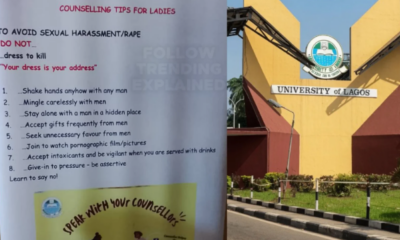
ââDo not shake hands”- UNILAG shares anti-r@pe advisories to female students
- Society2 days ago
H1 2026: FCMB Group sustains performance, Reports 99% growth in profit before tax to ₦157.3 billion