Investigation
Nigeriaâs challenge is low revenue not high debt â World Bank


The World Bank has stated that Nigeria’s biggest fiscal challenge is weak revenue mobilization rather than excessive borrowing, urging the government to prioritize efforts to boost revenue generation to support sustainable economic growth.
Speaking during an interview on Channels Television on Friday, July 3, the World Bank Country Director for Nigeria, Mathew Verghis, said Nigeria’s debt profile remains moderate by international standards and is significantly different from countries experiencing debt distress
“From our assessment, Nigeria doesn’t have a high indebtedness problem; it has a low revenue problem,” Verghis said.
He explained that Nigeria’s debt-to-GDP ratio is lower than that of many comparable countries, stressing that concerns should focus on improving government revenue rather than limiting borrowing.
“When we looked at the numbers, Nigeria is a moderately indebted country, meaning it has less debt relative to its economy than most of its neighbors and many other countries,” he said. “Nigeria is in a very different situation than Ghana, for example, which is going through a debt restructuring.”
Verghis defended government borrowing as a necessary tool for financing long-term investments that stimulate economic growth and improve living standards.
“Nigeria borrows for the same reasons that all countries borrow. If you want to deliver results to people, the money available on an annual basis is not enough. So you borrow, deliver results, and that improves your ability to repay,” he said.
He cited the expansion of electricity access as an example, noting that providing power to about 32 million Nigerians requires substantial upfront investment.
“To be able to connect and provide energy to 32 million Nigerians, Nigeria needs to borrow money now. But with increased access to energy, the country will become wealthier and better positioned to repay the loans,” he added.
The World Bank official, however, warned that low government revenue poses a greater threat to Nigeria’s fiscal sustainability than its current debt level.
“Nigeria’s debt is not particularly high, and in fact, it’s quite moderate by international standards. Its revenues are very low by international standards, and unless those revenues are raised, it will not be able to pay back debt,” Verghis said.
According to him, strengthening revenue mobilization would enable the government to increase investments in infrastructure, healthcare, education and other sectors that drive job creation, improve human capital and reduce poverty over the long term.
The remarks come as the World Bank recently unveiled a new Country Partnership Framework for Nigeria spanning 2026–2032, which places job creation at the center of its support for the country through investments in infrastructure, healthcare, agriculture and digital connectivity


INEC extends CVR exercise to July 26, introduces online registration

One dies in captivity as police rescue abducted Ekiti worshippers
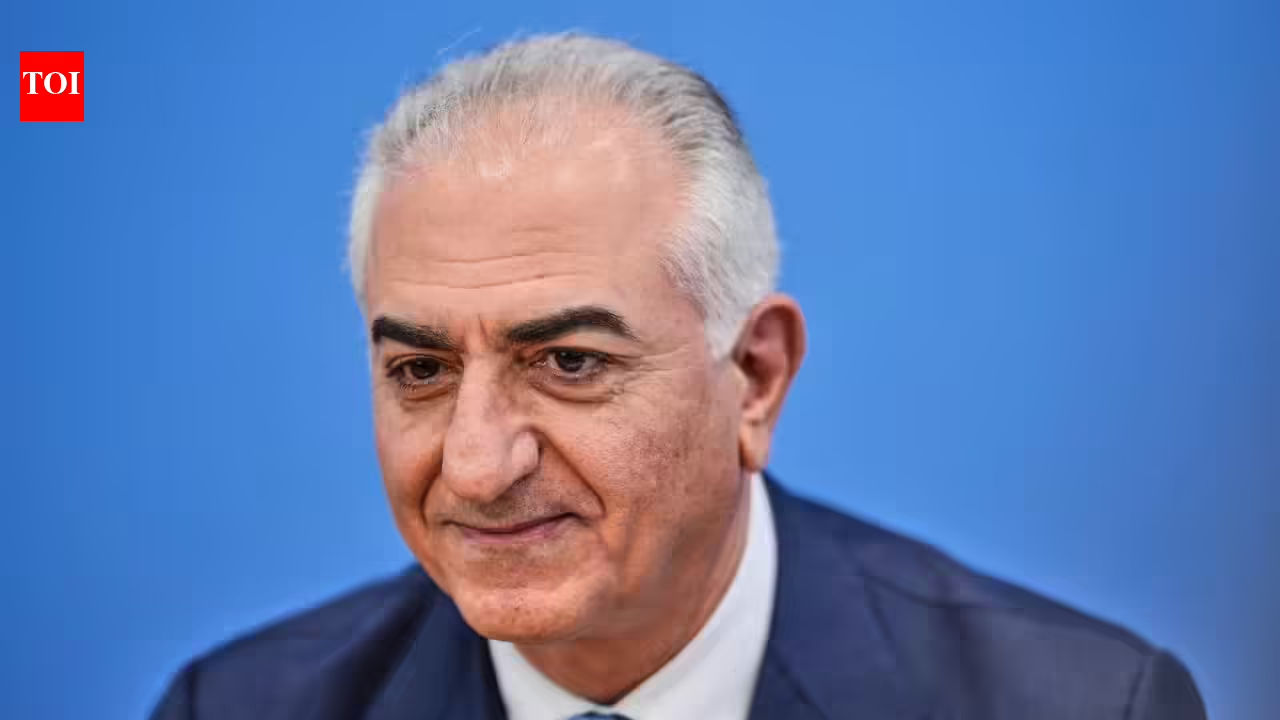
'Iran mourns 40,000 killed by Khamenei, not him': Exiled crown prince calls funeral 'propaganda'

NDC Deputy Chairman, scribe, others defect to PDP in Ebonyi

I did not confer any Chieftaincy title on Baba Ijesa â Ooni of Ife

Corona school graduates 52

Ex-Jigawa Governor Lamido criticises Pantami over past ‘infidel party’ remark on PDP

 Society3 days ago
Iyabo Obasanjo clarifies father’s real age
 National14 hours ago
Against Nigerian Law, CBN Deputy Governor Emem Usoro Allows Her Eleven Years Old Twin Daughters To Be Company Boss
- Investigation3 days ago
Eight de@d and 13 injured after being hit by truck ‘being driven by child’
- Breaking3 days ago
Panelists and guests on a podcast burst into laughter after 54-year-old US woman âmarriedâ to a 36-year-old Nigeria-based man, who she sends money to every month, laments about lack of love from him
- World2 days ago
WW3 fears explode as Cuba warns Donald Trump it's 'preparing for war'
- Investigation2 days ago
Man who took sister-in-law to court over his brotherâs £5m fortune lands huge bill after losing battle
- World3 days ago
Monaco bombing: Ukrainian oligarch's alleged mistress loses both legs as wife speaks out
- Investigation2 days ago
â15k from someone in the US who promised me âbig moneyâ feels somehowâ â X user sparks debate