World
No. 1 on the Fortune Global 500: Amazon’s Jeff Bezos on how his garage startup became the largest company in the world by revenue

This Video Is Trending Right Now
Jeff Bezos won’t pretend he didn’t see this day coming. Sure, when he was sitting in his Bellevue, Wash., garage in 1995, at a makeshift desk made from a wooden door slab, he probably wasn’t imagining that his nascent online bookshop would grow into the largest company in the world. Instead, he may have been puzzling over how to set up extension cords to keep his computers and servers running without tripping his home’s circuit breakers. Or he may have been mulling over changing the name of his tiny startup, then called Cadabra, to Amazon.
But three decades later, now that his startup has become an “everything company” that reportedly delivers as many packages as the U.S. Postal Service; now that the Amazon Web Services (AWS) cloud business powers a third of the internet; and now that Amazon has topped the Fortune 500 and ascended to the No. 1 spot in the Global 500—making it the biggest company in the world—Bezos admitted to Fortune: “It’s not like it’s a complete surprise.”
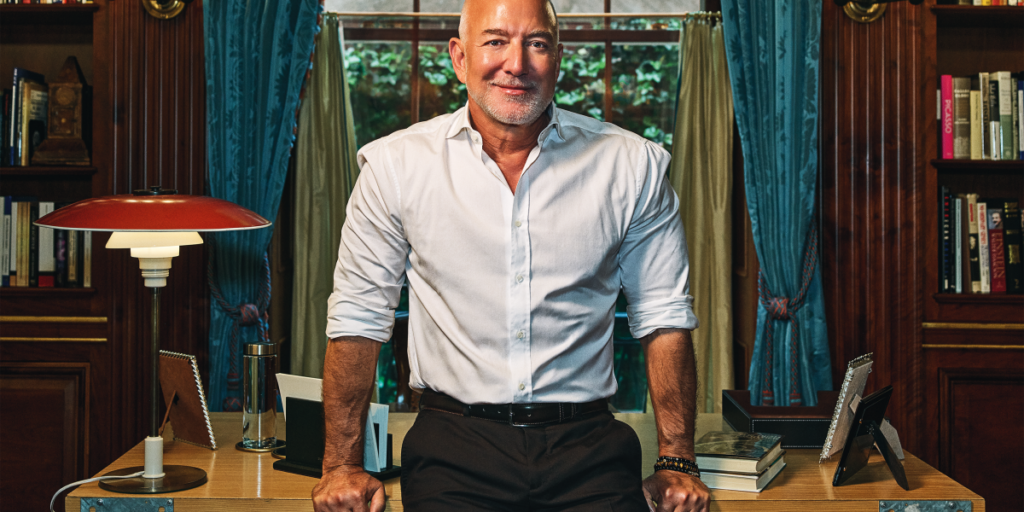
And anyhow, Bezos added in April, sitting at that original door-desk in his study in Washington, D.C., bigness was never the point. “I don’t want us to take pride in being big,” Bezos said. “I want us to take pride in servicing customers. And it turns out, if you service customers really well, that will drive growth.”
“Customer obsession” has long been a mantra for the 62-year-old Amazon founder. (In fact, he used the phrase 10 times during our conversation.) And with good reason: It’s what propelled the company to the top of Fortune’s annual list of the largest companies in the world by revenue, a spot held by Walmart for over a decade. Amazon will likely become the first company to reach $1 trillion in revenue in the next few years.
Bezos, one of the richest people in the world, handed the CEO role to AWS chief Andy Jassy in 2021, but he still serves as Amazon’s executive chair, and he’s often asked about the company’s next big projects. Satellite internet? Advertising solutions? Health care? Yes, yes, and yes.
But the company’s biggest venture by far is a bid to own the future of AI. Amazon devoted $131 billion to capital expenditures in 2025 and estimates that it will spend some $200 billion in 2026—largely on AWS and generative AI. In April, Amazon inked a multibillion-dollar deal with Meta, which will use Amazon’s Graviton chips to support AI initiatives. It has also partnered with Anthropic, agreeing to invest as much as $25 billion in the AI startup, which will purchase more than $100 billion of Amazon’s cloud services.
“A few of our offerings have become durable pillars, things like Marketplace and Prime and AWS,” Bezos said. “What I see right now is that our chips business, our silicon business, is lining up to be our next pillar.”
If Bezos is right—and his track record suggests he often is—Amazon’s current enormous size could soon look modest.
Of course, for a company this dominant, there are always risks. In addition to battling Walmart in the retail sector, Amazon faces tough competition in the AI arms race—and there’s no denying that Amazon has some catching up to do.
Bezos’s decision to step away from the CEO role and focus on his other tech companies created concerns that the founder was taking his foot off the gas at Amazon just as the AI race was starting, said futurist and NYU Stern School of Business professor Amy Webb: “I would be curious to know if the next 10 years of the company is going to be as dramatic and exciting as the past 10 years,” she said.
With all the big plans ahead, Bezos said he’s also laser-focused on what’s not going to change: that foundational ethos of low prices, fast delivery, and a vast selection—an approach that’s just as powerful when applied to chips and servers as it is in the world of books and groceries. It’s what put Amazon on the map in the first place, and what keeps customers coming back.
“It’s impossible to imagine a scenario where a customer would say, ‘Jeff, I love Amazon, I just wish you delivered a little more slowly.’ Or, ‘I love Amazon, I just wish your prices were a little higher,’” Bezos said. “Because you can count on those things, you can keep putting energy into them.”
It may look now like the success of Bezos’s model was a foregone conclusion, but getting investors to take a chance on an online-only store in the early days of the internet was not easy. Before Amazon’s launch in 1995, Bezos recalls having to explain to people what the internet was. He spoke with some 60 investors to raise a million dollars. Twenty-two said yes, with checks of roughly $50,000 each.
Amazon went public two years later, on May 15, 1997, at a price of $18 and a valuation of nearly $440 million. (It’s now valued at $2.6 trillion.) Initially, investors were cautious. A 1999 Barron’s cover story titled “Amazon.bomb” questioned whether the startup would ever turn a profit.
“People make this comment that if you had bought Amazon at its IPO, you’d be enormously wealthy now. But I think if you had bought Amazon at its IPO and held the stock throughout the entire time, you would’ve been almost completely irrational,” said Evercore ISI analyst Mark Mahaney. “It was so speculative when it went out. The company, the management team, Jeff Bezos’s prior business experience running a large company: zero.”
Bezos concedes that Amazon’s trajectory since its launch was improbable, to say the least. “You could not at that time have predicted the magnitude of change that would occur—and anybody who did predict that magnitude of change would probably have been quickly institutionalized and sent to the mental hospital,” he said. “It wouldn’t have been credible or believable.”
Amazon didn’t become profitable until the early 2000s, years after expanding its product offerings beyond books. It was the launch of cloudcomputing division AWS in 2006 that changed everything. Today, millions of businesses and governments use AWS cloud infrastructure and services to power everything from streaming videos on Netflix to ordering food on DoorDash. Operating income for AWS reached $45.6 billion in 2025, on revenue that rose 20% to $128.7 billion from the prior year.
Beyond AWS, a string of consumer-facing initiatives extended Amazon’s reach over the next two decades. In 2005 the company launched Prime, a membership offering unlimited two-day shipping that would balloon into a 200-million-subscriber loyalty engine that includes groceries, music, and video. The Kindle debuted in 2007, dragging the publishing industry into the digital age and giving Amazon dominance over the ebook market. Streaming followed in earnest in 2011, when Amazon bundled video into Prime, and by 2013 it had begun producing original series—winning two major Emmys for Transparent in 2015. The company acquired MGM in 2022 for $8.5 billion, instantly turning Amazon into a Hollywood studio with a 4,000- film library and the James Bond franchise. In between, the company made a major foray into physical retail with the $13.7 billion acquisition of Whole Foods in 2017, giving it 400-plus brick-and-mortar locations across the country.
What is it that makes Amazon so “sticky” for customers? Harvard Business School professor Sunil Gupta says it’s the company’s new spin on the traditional “razor and blades” model—selling a foundational item (the razor) cheap to drive higher-margin repeat purchases (the blades). “What Amazon has shown us is the ‘razor’ could be in one industry, and the ‘blade’ could be in a completely different industry,” Gupta said. “So I can make movies, but I don’t have to make money on the movies because I get you as a Prime customer, and then you buy more stuff—and that’s where I make money.”
Bezos points to the company’s famed leadership principles, with their emphasis on constant innovation, as the key to its success. “A lot of companies will tell you they’re customer-obsessed, but they’re really competitor-obsessed,” Bezos said. “You can’t be customer-obsessed unless you love inventing…You have to do new things. And Amazon is culturally very good at both of those things.”
Letting go of those foundational principles is the biggest risk to Amazon’s continued dominance, Bezos said. “If we ever stop obsessing over customers, if we ever stop inventing, if we start making short-term trades,” he said, “we could probably coast for a while, but we would lose.”
It’s hard to imagine now, but this may eventually happen, said Bill Carr, former vice president of digital media at Amazon, and now a consultant. No company can keep soaring forever. “Jeff has even said this: There will be a day when Amazon goes the way of the dodo,” he said. “Amazon will cease to exist at some point. It’s inevitable.”
Perhaps to stave off that extinction, Amazon’s corporate culture is notoriously hard-driving and competitive. In 2015, the New York Times called it a “bruising workplace” and reported that white-collar workers were “encouraged to tear apart one another’s ideas in meetings, toil long and late (emails arrive past midnight, followed by text messages asking why they were not answered), and held to standards that the company boasts are ‘unreasonably high.’” At the time, Amazon said the article lacked necessary context.
Jeff Wilke, former CEO of Amazon’s Worldwide Consumer business, recalls a culture of intense collaboration. “People want juicy details of conflict among senior people and all kinds of secret conversations and stuff, but in 22 years, we just had our heads down focused on building the company,” Wilke said. “I’m really proud of the way that we, the company, behaved over all those years. And I think it’s pretty special.”
There can be such a thing as too much innovation, said Wilke, recalling a moment when this became clear to him: Wilke noticed his team was drowning in work because so many tasks were deemed top priority. “Everything can’t be the most important thing in the company,” Wilke said.
He sat down with Bezos and asked him to consider the possibility that he was “releasing too much work into the system.” Bezos agreed, Wilke said, but also challenged his team to figure out how to get even more done. “He was relentless in inventing himself—and in working with those of us in the senior team to invent—ways to increase the capacity of the organization,” said Wilke, who left in 2021 to build his own manufacturing company.
Carr agrees that working at Amazon could be all-consuming. But, he said, “Amazon is a hard place to work and a hard place to leave…Creating a billion-dollar business out of nothing isn’t something you can do if you work nine-to-five and at a casual pace.”
AI is now opening new doors to accelerate Amazon’s astonishing growth—at least that’s what the company is betting. Amazon’s expected $200 billion spend on AI infrastructure in 2026 puts it at the top of a Big Tech AI capex arms race that analysts expect will exceed $700 billion this year across the largest hyperscalers.
The company’s Trainium and Graviton chips are forays into a space long dominated by chipmakers such as Nvidia and AMD. Bezos, who calls these chips the “foundation upon which all of this AI sits,” said Amazon will launch its next-generation chip, Trainium4, next year.
Despite its prescient pivot to cloud computing, observers say Amazon got a sluggish start in the AI era. But there’s some reason to think it’s catching up: The influential tech analyst Mark Shmulik of Bernstein captured Wall Street’s mood in October 2025 when he mused that AWS appeared to be “in last place in AI.” But by January, he’d changed his tune, naming Amazon a top pick for 2026 and expressing optimism that AWS could reverse the narrative about its struggles with AI.
And many see Jassy—with his experience running AWS—as exactly the right man to pull off Amazon’s pivot to AI. “He is a better CEO right now than Jeff Bezos would have been because this is the moment for cloud; Jassy is a cloud guy,” said Laura Martin, a senior analyst at investment banking firm Needham & Co.
Jassy told Fortune that AI will change “every customer experience that we know today and invent a whole host of new ones…I do think we’re living in a world where…the key to the compute is often the chips,” he said. “The growth in AI has been so significant, but we have a chips business that we built over the last decade here that is growing very quickly.”
On Amazon’s first-quarter earnings call, Jassy put the company’s new pillar of business in perspective, sharing that in the first three years of the company’s AI wave, AWS’s AI revenue run rate exceeded $15 billion—nearly 260 times its $58 million revenue run rate three years after launching. In other words, AWS’s new AI business has scaled to a revenue level hundreds of times what AWS itself reached at the same age—and AWS was already widely considered the fastest-growing business in tech history.
Put simply: AI is looking like a wave that’s bigger than anything even Amazon has ridden.
There are some who aren’t rooting for Amazon to grow even larger. Stacy Mitchell, co–executive director of the nonprofit Institute for Local Self-Reliance, has been one of Amazon’s most vocal critics. “Yes, there are innovations that Amazon brought along, but the company also exploited shifts in public policy that gave them a significant advantage over their smaller competitors,” Mitchell said. “And it ultimately allowed them to dominate the market in a way that I think is harmful to competition and to consumers.”
In 2023, the Federal Trade Commission and 17 states sued Amazon, accusing the company of illegally stifling competition. John Newman, then–deputy director of the FTC’s Bureau of Competition, called Amazon a “monopolist that uses its power to hike prices on American shoppers and charge sky-high fees on hundreds of thousands of online sellers.” The trial is expected to start in 2027.
Whether or not Amazon is determined to be a monopoly, there’s arguably some irony in the company’s dominance, given Amazon’s mantra of “customer obsession”: As every economics textbook teaches, the less real competition in a market, the worse the consumer experience tends to be. “To save what people love about Amazon,” Mitchell said, “Amazon needs to face competition.”
Amazon also has an increasingly uneasy relationship with the people who make its customer obsession possible: its workers. With its pioneering of practices to continually increase speed, efficiency, worker-tracking, and automation, Amazon has transformed the American labor landscape. But at a moment of deep economic anxiety—and a widening chasm between the working class and the wealthiest Americans—Amazon has also become a symbol of everything critics say is broken about the modern workplace. In recent years, warehouse workers have rallied to unionize and demand better conditions. (Amazon points out that it has invested billions to improve worker safety.) And in its white-collar ranks, Amazon has cut nearly 30,000 corporate jobs in the past year.
As for Bezos himself, after the 30 years he has spent engineering the fastest, cheapest way to move goods across the world, he has become the face of what many workers say that relentless speed has cost them. He has also come under fire for his stewardship of the Washington Post, which he purchased in 2013, and for his overtures to President Donald Trump.
For his part, Bezos is focusing some of his efforts outside of Amazon: He’s investing heavily in his Blue Origin space tech company. Despite setbacks including a rocket explosion in May, the company reportedly is raising $10 billion at $130 billion valuation.
He is also working on a secretive AI startup called Prometheus, reportedly valued at more than $40 billion.
The idea behind Prometheus, he told Fortune in June, is to “accelerate the dream-build loop”—reducing the friction and helping inventors go from idea to product quickly. The company is creating AI tools to help engineers manufacture intricate products faster.
“If you take a step back, all civilizational wealth is driven by invention,” Bezos said, adding: “We have an endless set of things to invent.”
This article appears in the August/September 2026 issue of Fortune with the headline “Architect of the everything era.”


Schools are adding pepper-spraying drones to help combat active shooters

Japan issues Tsunami alert after 7.1-Magnitude Quake

Police Bust Cattle Theft Syndicate Recover Six Stolen Cows in Ogun

RMD Reflects on Life at 65 and Staying Forever Young

Relationship Material? 3 Green Flags Hidden in Someone’s Music Taste

Nigeria demands end to attacks in South Africa

Oshiomhole faults IGP Disu, says criminals must be shot on sight

 Investigation3 days ago
Iâve never seen N1bn cash in my life – Senator Ali Ndume says as he denies intermediary claim
- Investigation3 days ago
Iâm running for a fourth term as President of the United Statesâ – President Trump
- Breaking2 days ago
âIf my son ever gets a girl pregnant, he’s leaving my house immediatelyâ â Cardi B shares parenting stance
- Investigation3 days ago
No restriction on movement during sanitation exercise â Lagos commissioner
- Investigation3 days ago
IG did not issue âshoot-on-sightâ order in Benue- Police
- Investigation2 days ago
âThe Olodo uprising term was not coined by meâ â Nigerian musician Ycee
- News3 days ago
Davido sets London premiere date for ‘Oriade’ album
- Investigation3 days ago
Arsenal want to sign Real Madrid superstar Vinicius Jr with move approved âat all levelsâ