World
Quake survivors in Japan sleep in cars in sweltering heat as death toll rises

Thousands of survivors of a powerful earthquake in south-west Japan have spent Friday in crowded shelters or sleeping in cars as they faced shortages of water and fuel and punishing summer temperatures that stoked fears of heat-related illness.
The death toll rose to 34, the Kumamoto prefectural government said, as rescuers raced to find those still missing after the quake triggered a shopping centre explosion, toppled a factory chimney and flattened homes.
Japanese Prime Minister Sanae Takaichi stressed that authorities must secure water supplies by doing “whatever it takes” and called for close co-ordination with the military and other relevant agencies.
The earthquake left thousands of homes without power, but Ms Takaichi said electricity was now fully restored. The local power company also said there were no immediate reports of remaining outages.
The magnitude 7.1 earthquake hit Japan’s southern main island of Kyushu on Tuesday. As search operations entered a fourth day, it was not known how many people remained missing.
More than 1,500 buildings were damaged, including 179 that were destroyed, according to preliminary assessments by Japanese officials.
Officials said 34 quake-related deaths had been confirmed, with one more death still under investigation. At least 96 people were injured, including six seriously.
Kumamoto authorities said more than 79,000 homes remained without water. More than 9,000 people were staying in shelters, where power sources were being added to provide air conditioning.
Fuel has also become scarce as power outages disabled petrol stations and quake damage disrupted deliveries from other regions. Many have resorted to sleeping in their cars, but with the fuel shortage, they struggle to keep the air conditioning running in sweltering temperatures.

Japan’s weather agency and the Ministry of the Environment issued an extreme heat alert for Kumamoto on Friday as temperatures peaked at 36C.
Hirokazu Sato, who lost his home in the earthquake, said he and his wife and three children would remain in their car until they can move into temporary housing.
“I don’t know how soon I’d be able to move in,” said Mr Sato. “We need to have the air conditioning on throughout the day and night, which uses up gas.”
Kumamoto is also a major industrial hub, and there are concerns that the quake could possibly disrupt semiconductor and car parts supply chains for months to come.
Taiwan Semiconductor Manufacturing Company, a global chip giant that operates a lab in Kumamoto, said it temporarily evacuated workers from the facility after it experienced strong shaking from the earthquake.
The company said all personnel were safe and operations were gradually resuming after post-quake inspections found the structure was sound, although detailed inspections and impact assessments were still under way.

Japanese officials had described Friday afternoon as a crucial point for rescue efforts as some experts say survival chances decline after the first three days.
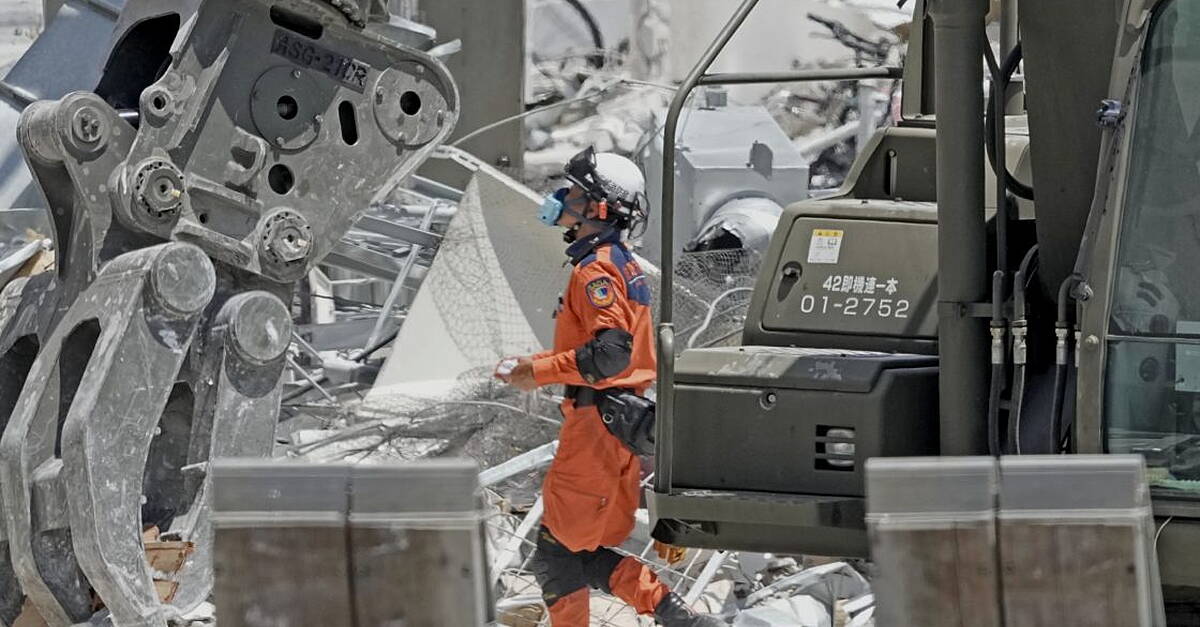
With search dogs, rescuers continued looking for survivors across the Kumamoto area, including at the collapsed Aeon Mall in the town of Kashima, one of the hardest-hit sites. The complex was bustling with thousands of people when the quake happened.
The company said about 3,000 shoppers were evacuated to a car park before an explosion happened in another part of the shopping centre, where some staff remained working. The shopping centre’s second floor collapsed, trapping people.
At the site, seven people were confirmed dead and 11 had been rescued, Japanese chief cabinet secretary Minoru Kihara told reporters in Tokyo on Friday. Authorities did not say how many were still missing.
Meanwhile, a search operation has ended at a Nippon Paper Industries factory in the Yatsushiro area where a chimney collapsed in the quake, Mr Kihara said. Searchers rescued 11 people there, while nine others were confirmed dead.
Smaller-scale searches continued on Friday at the sites of collapsed houses in badly hit towns in southern Kumamoto.

In the town of Hikawa, one of the most badly damaged parts of Kumamoto, officials said more than 800 of the town’s 4,500 homes were destroyed or damaged. Many residents slept inside their vehicles in parks, at the town hall car park or outside their homes.
Meanwhile, Shinkansen bullet trains resumed between Kumamoto and Fukuoka to the north but with reduced services, according to Kyushu Railway, while those connecting cities down south to Kagoshima were still suspended.
Local trains in quake-hit areas, mainly in southern Kumamoto, were still suspended due to quake damage.


FG to stop electricity subsidy payments from 2027

Gehgeh Breaks Silence on Viral Wedding Drama, Reveals What Really Happened

Court jails two Chinese nationals 50 years for illegal mining

German Court Delivers Landmark Ruling Against AI Music Firm Suno, Citing Copyright Infringement

Bandits attack Catholic Bishopâs residence and abduct seminarian in Benue

Oloyede Leaves JAMB, Reveals Next Move After 10 Years in Office

New JAMB Registrar assumes office, declares war on malpractice

 Breaking3 days ago
ââDo not shake hands”- UNILAG shares anti-r@pe advisories to female students
- World2 days ago
My daughter’s squishy toy burst on her legs. We ended up in the emergency room.
- National3 days ago
EXCLUSIVE: Police Indict Unity Bank Cooperative Officials in ₦85 Million Fraud Investigation
- National2 days ago
FG Exceeds 2024 Borrowing Target by ₦4.79tn as Debt Hits ₦12.62tn
- Society3 days ago
Transfer: Beşiktaş deny receiving Saudi bid for Ndidi
- National3 days ago
Kaduna 2027: PDP’s Bawa unveils running mate
- Investigation3 days ago
Nigerian woman di£s of cardiac arrest while visiting the UK
- World3 days ago
Who Wins (and Who Loses) in the Democrats’ New 2028 Primary Calendar?