World
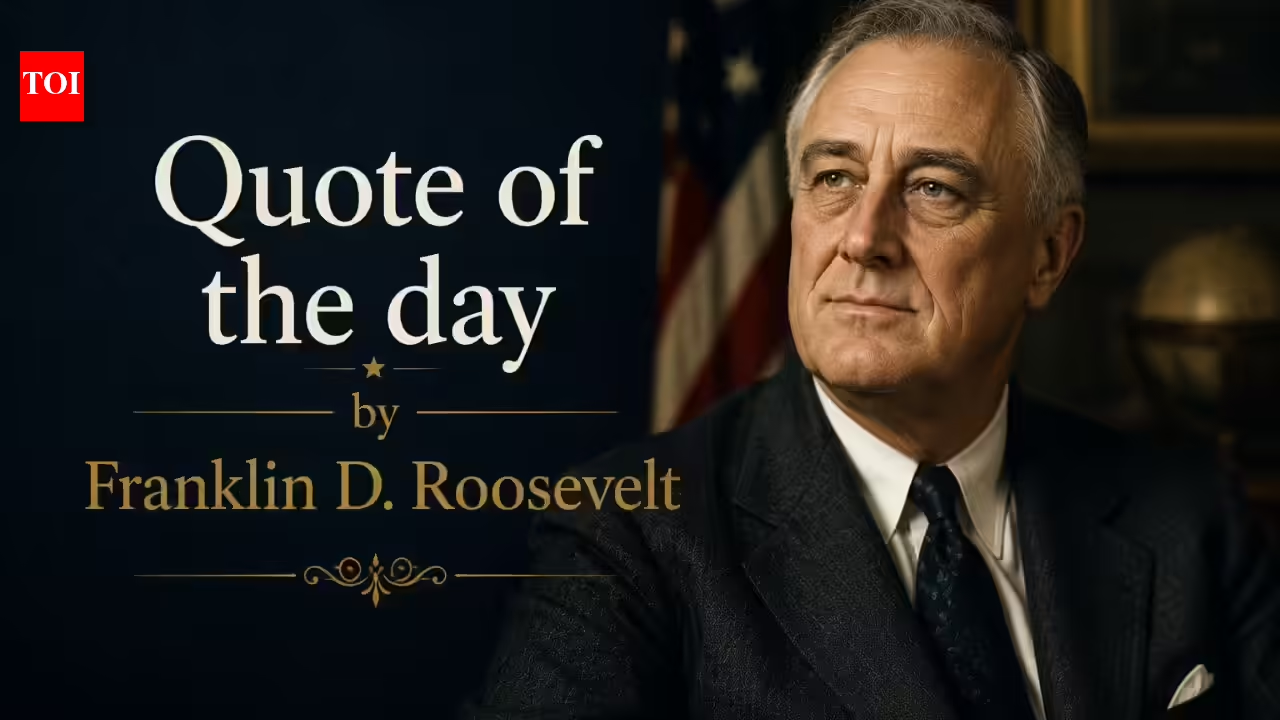
Quote of the day by Franklin D. Roosevelt: "Men are not prisoners of fate, but only prisoners of…"

This Video Is Trending Right Now
Franklin D. Roosevelt said this in a speech on the fourteenth of April, 1939, months before the Second World War began. “Men are not prisoners of fate, but only prisoners of their own minds,” he told the audience. “They have within themselves the power to become free at any moment.” He was speaking to a specific moment, but the line has outlived the occasion by decades, because it makes a claim that applies well beyond the politics that first produced it: circumstances alone do not decide what a person is capable of. The mind usually gets there first. Roosevelt himself was in a position to know this better than most, given what he had already lived through by the time he said it.
Quote of the day by Franklin D. Roosevelt
“Men are not prisoners of fate, but only prisoners of their own minds.”
The speech behind the words
Roosevelt delivered this line during a Pan American Day address, at a time when European dictators were using the language of victimhood to justify aggression, describing their own countries as somehow “encircled” or “imprisoned” by neighbouring democracies. Roosevelt was directly rejecting that framing. A nation, he was arguing, is not actually a prisoner just because it claims to be one. The same, in his view, applied to individual people.He clearly thought the line mattered, because he repeated it himself two weeks later in a separate address on child welfare, quoting his own earlier speech almost word for word. That is not something a politician does with a throwaway line. It suggests the idea sat close to how he genuinely saw the world.At the time, fascist leaders in Europe were openly comparing their own nations to prisoners hemmed in by hostile neighbours, using that language to justify military expansion. Roosevelt’s response treated the comparison as a kind of excuse dressed up as a grievance. A nation choosing to see itself as trapped, in his framing, was making a choice about how to interpret its situation, not simply describing a fact about the world.
A president who tested this idea on himself
Roosevelt was not just making a political point from a safe distance. In 1921, at thirty nine years old, he was diagnosed with polio and lost the use of his legs for the rest of his life. Many people at the time assumed his political career was finished. He did not accept that.He spent years working through rehabilitation and eventually returned to public life, becoming Governor of New York before serving four terms as President, guiding the country through the Great Depression and most of the Second World War. He never regained the ability to walk unaided. What he refused to accept was the idea that this fact alone determined what else was possible for him.
Why the idea still holds up
Strip away the specific politics of 1939 and the core claim is a fairly ordinary one, just rarely stated this plainly. People often treat their circumstances as the whole story, age, background, one bad result, a difficult year, and quietly stop trying before circumstances have actually forced them to.Roosevelt is not claiming that hardship does not exist or that willpower fixes everything. He is pointing at something narrower. Giving up mentally, before you have actually been beaten, creates a limit that was never really there to begin with. The outside obstacle and the internal one are not the same thing, even though they often get treated as if they are.
Putting it into practice
The useful move here is noticing which limits in your own life are actual facts and which ones are just assumptions you have stopped questioning. Someone might decide they are too old to start something new, or that one failed attempt at public speaking means they simply cannot do it. Often that belief has hardened into something that feels like fact, long after the original evidence for it has faded.A fair way to test this is to ask what you would attempt if you were genuinely certain the outcome did not depend on luck or circumstance alone. If the honest answer is different from what you are actually doing, that gap is worth paying attention to.
Other famous quotes by Roosevelt
- “The only thing we have to fear is fear itself.”
- “Happiness lies not in the mere possession of money; it lies in the joy of achievement.”
- “Confidence thrives on honesty, honour, the sacredness of obligations, faithful protection, and unselfish performance. Without them, it cannot live.”
- “The only limit to our realization of tomorrow will be our doubts of today.”


Sextortion: US Consulate, FBI laud EFCC, seek enhanced information sharing

2026 World Cup: Argentina eliminate Egypt as seven teams qualify for quarter-final

Three Nigerian students win gold at International STEM Olympiad in Rome

Recreational drugs, including cannabis, can cause stroke — Study

Police Prosecutor Took Bribe, Removed 18 Key Exhibits To Sabotage My Case,' Ogun Resident Accuses Senior Officer Of Cover-Up

$88M LA mansion, even JLo eyed, sells for half its price

PSC dismisses four police officers, sanctions 31 others for misconducts

 Society1 day ago
H0rny Old Man Caught On Camera In Broad Daylight Trying To Chop Mad Woman At Roadside
 Society2 days ago
Sad Video emerges showing Kenyan Lady working in the Middle East crying in distress
- Society1 day ago
Chaos At Cemetery As Area Boys Hijack Dead Body In Coffin, Stops Family From Burial Over Unpaid Debt
- Politics2 days ago
Okpebholo seeks wider support as UNIBEN launches ₦100bn Trust Development Fund
- Investigation1 day ago
If this was AFCON the nonsense being said would be crazy â Former Congolese footballer Yannick Bolasie slams FIFA over Balogun red card reversal
- Society2 days ago
Armed Robbers Target Mobile Money Vendor, One Shot Dead as GH¢140,000 Is Recovered
- News2 days ago
Obi demands accountability over IMF’s ₦8.83tn off-budget spending report
- Investigation2 days ago
She brandished cutlass at me in church during Sunday service – Divorce-seeking pastor tells Oyo court as wife accuses him of 18-year-old girl