News
Rare Total Solar Eclipse To Turn Northern Spain Dark In August

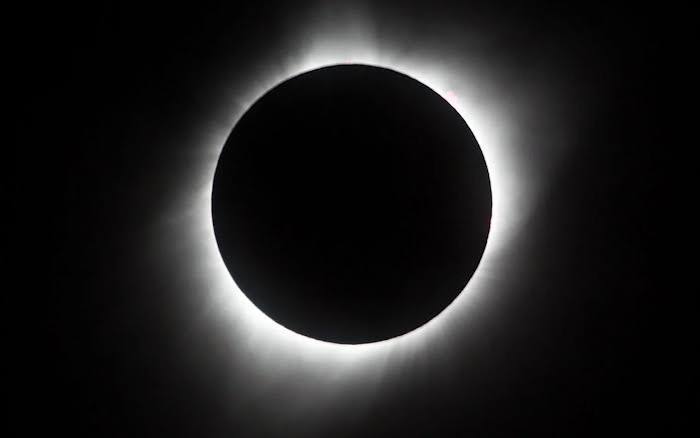
(Solar Eclipse. Photo by Punch News)
Day will briefly give way to night across a stretch of northern Spain on August 12, as the Moon completely blots out the Sun during a rare total solar eclipse.
Here’s what you need to know about the eclipse, the first to be visible in mainland Europe since 2006.
What is an eclipse?
Eclipses occur when the Moon passes directly between the Sun and Earth, casting a narrow band of shadow across the planet.
This produces a strange twilight in which temperatures fall, shadows take on odd angles, and some animals go to sleep. Such phenomena led ancient cultures to view eclipses as signs of the apocalypse or messages from the gods.
In reality, though, it is simply the result of what NASA describes as a cosmic coincidence.
The agency notes that although the Sun is roughly 400 times larger than the Moon, it also happens to be about 400 times farther away, meaning that for observers standing in the right location, the Moon completely blocks the Sun, revealing its outer atmosphere known as the corona.
Where can it be seen?
On August 12, a remote part of northern Russia will be the first region to witness the total eclipse.
The path of totality, as it is known, will then sweep across Greenland, Iceland, Spain and the northeastern tip of Portugal.
Within Spain, it will move roughly from the northern city of Oviedo down to the island of Mallorca.
How long will it last?
For those watching from Spain, the total eclipse will last under two minutes, occurring just before sunset.
The northern city of Burgos, for instance, will experience darkness for exactly one minute and 48 seconds.
The eclipse will last slightly longer in parts of Russia and Greenland, though still under two and a half minutes.
Partial eclipses, which happen as the Moon begins and finishes crossing the Sun, will however last around one hour and 45 minutes and will be visible across most of Europe, Canada, the northern United States and northwest Africa.
How rare is it?
Solar eclipses occur roughly once or twice a year, but because the band of totality is so narrow, the same location may have to wait as long as 400 years before experiencing another one.
On August 2, 2027, a total solar eclipse will sweep across southern Spain, northern Africa and the Arabian Peninsula.
Some media outlets have dubbed it the eclipse of the century, since its totality will last six minutes and 23 seconds, the longest of the 21st century.
Spain will get another treat on January 26, 2028, when an annular, or ring of fire, eclipse crosses its southern regions.
Do you need protection?
Yes. It is important never to look directly at the Sun during an eclipse, as doing so can cause serious eye damage.
Experts recommend using specially designed eclipse glasses that filter UV rays and meet the ISO 12312-2:2015 standard.
Since there are no pain receptors in the eyes to alert the brain to injury, damage often goes unnoticed until later.
Research has shown that following the total solar eclipse in the United States in 2024, the rate of people googling “my eyes hurt” surged noticeably.








Police Arrest Father And Son With Four Guns In Bayelsa

Never think marrying a man you are clearly feeding. It never ends well – Actress Nkechi Blessing Sunday

PSC sacks four senior police officers, demotes 10

Hassan Ocholi pledges quality representation for North Central on TETFund board

Demons rule entertainment industry – Jim Iyke claims

Missing Man Found Alive After Being Swept Away By Flood In Anambra

Police arrest fake Inspector, recover uniforms in Akwa Ibom

 Society2 days ago
H0rny Old Man Caught On Camera In Broad Daylight Trying To Chop Mad Woman At Roadside
- Investigation17 hours ago
15-year-old student slashes schoolmate with cutlass for allegedly touching her brâ¬ast repeatedly during school clean-up exercise
- Society2 days ago
Chaos At Cemetery As Area Boys Hijack Dead Body In Coffin, Stops Family From Burial Over Unpaid Debt
- Investigation2 days ago
If this was AFCON the nonsense being said would be crazy â Former Congolese footballer Yannick Bolasie slams FIFA over Balogun red card reversal
- News3 days ago
Obi demands accountability over IMF’s ₦8.83tn off-budget spending report
- National3 days ago
Transfer: Real Madrid confirm fourth signing under Mourinho
- National21 hours ago
May Yul-Edochie Urges Court To Shut Down Yinka Omolola Theisen, Others’ Social Media Accounts Over Alleged Cyberbullying
- Breaking3 days ago
Report alleging ₦500bn offer to split S’South votes false, baseless – Jonathan