World
Researchers discover cave with rare cave pearls in Vietnam's Phong Nha-Ke Bang National Park

This Video Is Trending Right Now
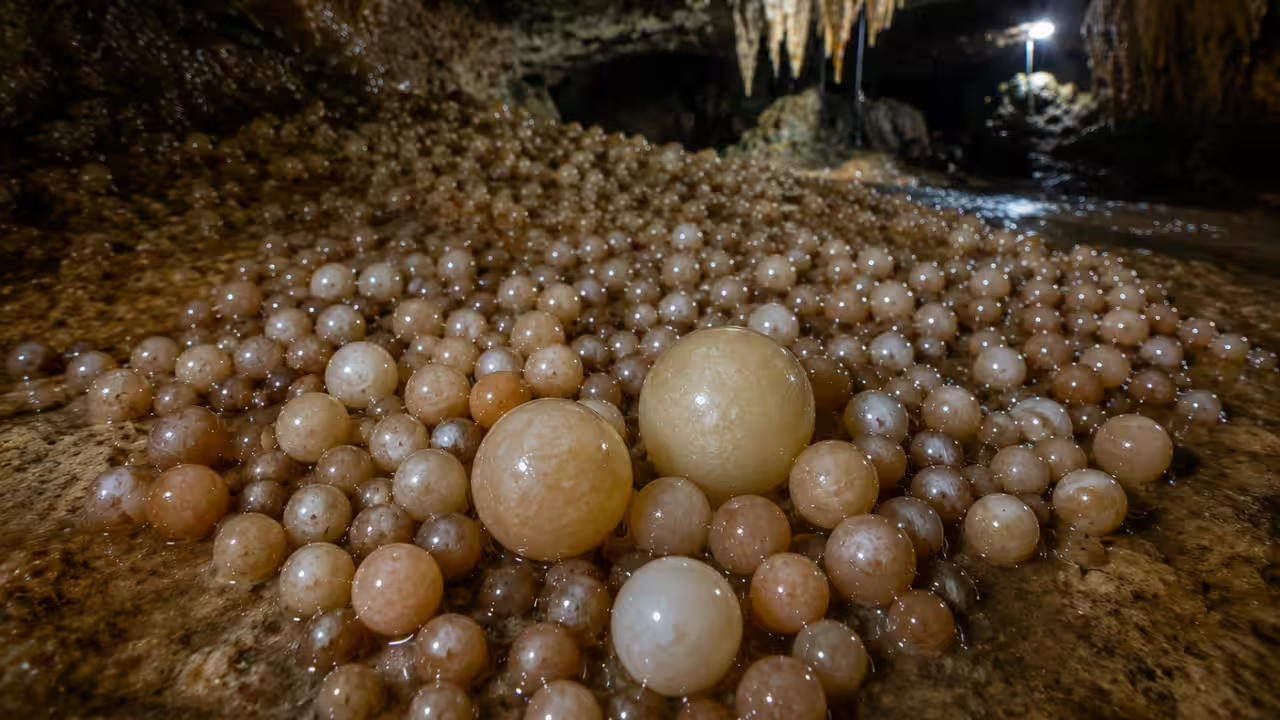
Deep within the limestone mountains of Phong Nha-Ke Bang National Park in Quang Tri Province, Vietnam, scientists have uncovered a remarkable new cave that is already drawing attention for its geological significance. Named Thang Cave (Victory Cave), the newly explored cavern contains rare cave pearls, smooth, spherical mineral formations that develop over thousands of years under highly specific conditions. Alongside its impressive chambers and intricate rock formations, the discovery offers researchers valuable insights into the region’s ancient karst landscape and the geological processes that continue to shape it. Situated within one of the world’s most celebrated cave systems, Thang Cave adds another chapter to Vietnam’s reputation as home to some of Earth’s most extraordinary subterranean wonders, highlighting how much of the underground landscape remains unexplored despite decades of scientific exploration and international research in the region.
What is Thang Cave and where was it discovered
Thang Cave, meaning “Victory Cave”, was discovered by researchers exploring the limestone karst of Phong Nha-Ke Bang National Park in Quang Tri Province. The protected UNESCO World Heritage Site is renowned for its extensive network of caves, underground rivers and dramatic karst formations, many of which remain only partially explored.The newly identified cave features expansive chambers, stalactites, stalagmites and other mineral deposits that have formed over millions of years, making it an important addition to the park’s growing catalogue of geological treasures.
Why are the cave pearls found in Thang Cave so rare
As reported by TV BRICS, among Thang Cave’s most extraordinary discoveries are its rare cave pearls, smooth, bright white mineral formations found in unusually large clusters across natural rock basins. Formed over thousands of years, cave pearls develop when mineral-rich water repeatedly deposits thin layers of calcium carbonate around tiny particles, creating almost perfectly spherical structures. Although cave pearls can occur in limestone caves worldwide, experts involved in the exploration noted that such a high concentration is exceptionally uncommon, with even experienced cave survey teams rarely encountering deposits of this scale.Beyond their visual appeal, the cave pearls indicate that Thang Cave has maintained remarkably stable geological and hydrological conditions over long periods. Their abundance, together with the cave’s towering stalactites, stalagmites and pristine limestone formations, makes the newly discovered cavern an important site for geological research and strengthens the scientific value of Phong Nha-Ke Bang National Park, one of the world’s most significant karst landscapes.
Why the discovery matters for science and conservation
The discovery of Thang Cave highlights how much of Vietnam’s underground landscape remains unexplored despite decades of speleological research. Each newly documented cave contributes valuable information about karst formation, groundwater systems and the biodiversity that thrives in these isolated environments.Scientists believe further exploration could reveal additional geological features and previously unknown species adapted to life underground. At the same time, the find underscores the importance of protecting fragile cave ecosystems, where even minor disturbances can damage mineral formations that have taken thousands of years to form. As research continues, Thang Cave is expected to become an important site for geological study while reinforcing the global significance of Phong Nha-Ke Bang National Park. Cave pearls forming over thousands of years in stable, undisturbed conditions are a record of geological continuity as much as a mineral formation. Finding them in unusually high concentrations suggests Thang Cave has been largely untouched by the surface disturbances that interrupt their growth elsewhere, which makes the timing of its discovery, and the question of what happens next, genuinely consequential for what it contains.


NDLEA nabs South African mother with 5.75kg heroin at Abuja airport

Trump pays tribute to late Senator Lindsey Graham, calls him ‘one of the greatest people’

Brazil is releasing millions of genetically modified mosquitoes to fight one of its worst dengue outbreaks in years

Oyo Kidnap: Tinubu spared no effort in students, teachers release – Sunday Igboho
Bandits Kidnap Corpse Of Augustine Ikwue, Mourners, Demand ₦450M Ransom

BREAKING: Dozens Feared Dead As Suspected Herdsmen Launch Fresh Attacks In Benue State

Anglican Church rejects Islamisation of Nigeria, Sharia integration

 Breaking3 days ago
Mum gives birth in her sleep and nurses don’t find her baby until minutes later under pile of blankets
- News3 days ago
Northern Governors Launch ₦1bn Monthly Security Fund to Fight Insecurity
- Investigation3 days ago
âMan butchered his own mother with a machete then ran into ocean to escape cops
- Breaking2 days ago
Police release image of Zimbabwean man ‘on the run’ after his wife and two children are found de@d at home in UK
- Investigation3 days ago
â"Your marriages are not working because you’re l£sbians" Actress Shan George slams married women who are divorcing and blaming their husbands
- Politics3 days ago
NGX extends rally as investors gain ₦962bn
- Investigation3 days ago
Student pilot forced to land plane alone after instructor âjumped to his de@th mid-flightâ
- Investigation3 days ago
ââTwisted doctor, 29, admits secretly filming 900 hospital staff after hiding phone in toilets to spy on colleagues