News
The real money behind football’s biggest prizes

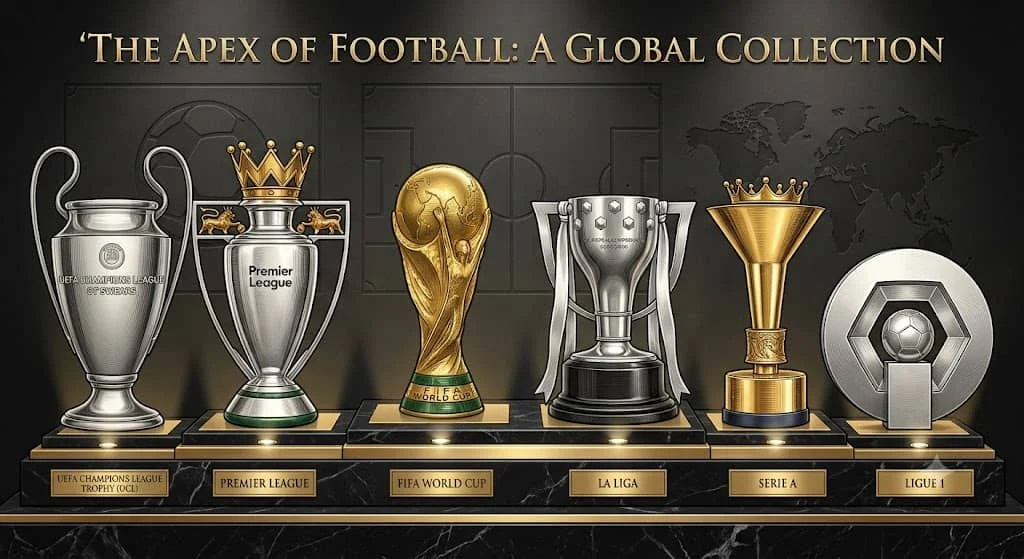
From World Cup to Champions League, Premier League: What are football’s biggest trophies really worth?
A debate has lingered in the football community over the true value of winning a trophy.
Not its prestige. Not its history. Not the emotions attached to lifting it.
The money.
How much is the FIFA World Cup actually worth? Is winning the UEFA Champions League financially more valuable than winning the World Cup?
Is the Premier League title worth more than several championships in Spain, Italy, Germany or France?
And why might some clubs prioritise one trophy over another?
The questions have become more prominent following claims that the financial value of the World Cup is lower than that of the Champions League, while another popular argument suggests that winning the Premier League is financially equivalent to winning several La Liga titles.
But football’s prize-money structure makes such comparisons more complicated.
Some competitions have a clearly defined winner’s prize.
Others distribute money through participation payments, performance bonuses, television rights, commercial revenue and historical coefficients.
Therefore, to properly value a trophy, PidomNigeria Online on Thursday examined the direct prize money and the wider competition-related financial rewards attached to some of football’s biggest international, European and domestic trophies.
World Cup: $51m for the champion
The 2026 FIFA World Cup offered the largest prize pool in the history of the competition.
The total distribution to the 48 participating teams was $871m, with Spain, the eventual champions, receiving $51m for winning the tournament.
Argentina received $34m as runners-up, while England and France received $30m and $28m respectively for finishing third and fourth.
The $51m, however, is the champion’s performance prize rather than the total financial value of participating in and winning the tournament.
FIFA’s distribution also included payments to teams according to how far they advanced and preparation money for all participating nations.
The overall figure was therefore significantly larger than the winner’s cheque alone, AP News reported.
The World Cup’s direct champion’s prize is therefore substantial, but the competition’s financial model is different from that of club football.
The tournament is played once every four years and the money is distributed to national associations rather than directly to clubs or players.
Champions League: Football’s financial heavyweight
The UEFA Champions League is where the financial comparison becomes particularly striking.
For the 2025/26 season, UEFA projected €2.467bn for clubs participating in the Champions League and Super Cup distribution system.
UEFA said the Champions League distribution included:
- €670m in equal shares;
- €914m in performance-related bonuses;
- €853m through the value pillar.
Each of the 36 clubs in the league phase received a basic equal share of €18.62m, before performance payments and value-pillar distributions were added.
UEFA’s system means that a successful club can accumulate money throughout the competition rather than simply receive one winner’s cheque, a report on its website said.
The difference can be enormous.
A report by La Gazzetta dello Sport estimated that the Champions League winner could reach approximately €150m in total competition-related income, depending on the club’s performance, coefficient and market-related payments.
In the 2025/26 season, a separate calculation reported by The Athletic estimated Paris Saint-Germain’s Champions League earnings at about €146m, including the final victory.
This is why the argument that the Champions League can be financially worth more than the World Cup has some basis when comparing the total competition-related earnings of a successful club with the World Cup winner’s direct performance prize.
But it is not an entirely like-for-like comparison.
The World Cup is a national-team tournament held once every four years, while the Champions League is an annual club competition in which participating clubs can earn money at multiple stages.
Premier League: No winner’s prize
The Premier League is one of the clearest examples of why the phrase “prize money” can be misleading.
The league itself says there is no specific prize fund for being crowned champions.
Instead, clubs receive central payments, including merit payments based on their final position.
The Premier League explains, “But in the Premier League there is no specific prize fund for being crowned champions.”
It adds that the club finishing first receives the highest merit payment, calculated on a sliding scale from first to 20th place, Premier League said.
For example, the 2024/25 season, champions Liverpool received £53.1m in merit payments.
That was only one component of the club’s total Premier League-related income.
The league also distributes broadcast and central-commercial revenue. The Premier League confirmed that clubs received central payments for the 2024/25 season and that the competition committed more than £550m to the wider game during the campaign.
Therefore, the value of winning the Premier League cannot accurately be described as simply £53.1m.
The real financial benefit includes the champion’s merit payment, central distributions, commercial income, sponsorship consequences and the value of qualification for European competition.
Is one EPL title worth five La Liga titles?
The popular claim that winning the Premier League is worth five La Liga titles requires careful examination.
The two competitions do not operate identical prize-money systems.
La Liga’s clubs receive revenue through a system based heavily on the distribution of audiovisual rights and other central income.
The financial reward for finishing first is therefore not simply a single cheque labelled “La Liga winner’s prize”.
Reports have estimated the champion’s performance-related distribution at roughly €55m–€60m, although the precise amount depends on the applicable distribution formula and other revenue streams.
That means the claim that one Premier League title is financially equivalent to five La Liga titles cannot be accepted as a simple comparison of winner’s prizes.
The difference between the two leagues is more accurately found in the size of the entire commercial ecosystem.
The Premier League’s television and commercial revenues are substantially larger, meaning that the financial gap between English clubs and clubs in other major European leagues can become much wider when all central payments, sponsorships and European income are considered.
Verdict: the “10 La Liga titles” claim is not a direct prize-money comparison. It is a broader revenue comparison, and even then it depends on what income is included.
Bundesliga: Champion’s value is tied to central distribution
The Bundesliga also does not operate with a simple winner-takes-all championship prize.
Germany’s DFL distributes centrally marketed media revenue according to a formula incorporating factors including equal distribution, sporting performance, fan and media interest and youth development.
For the 2025/26 to 2028/29 cycle, the DFL approved a new distribution mechanism while retaining the main pillars of equal distribution, performance, interest and youth development, according to DFL Deutsche Fußball Liga.
This means that winning the Bundesliga brings a financial advantage through the performance component, but the champion’s real financial value is also tied to the club’s overall revenue profile.
A Bundesliga champion therefore cannot simply be compared with a Premier League champion by looking for a single official winner’s cheque.
Serie A: Approximately €70m has been reported for the champion
Serie A offers another example of how the value of a league title is linked to television-rights distribution.
Reports have placed the value of the Serie A champion’s league-related financial reward at approximately €70m, although the exact amount varies according to the distribution system and the different revenue components allocated to clubs.
The Italian model distributes a portion of television revenue according to league position.
For the 2025/26 season, La Gazzetta dello Sport reported that the league-position component was a pot of approximately €100m, with the second-placed club receiving €13.2m, third receiving €11.3m and fourth receiving €9.4m from that particular component.
That figure is separate from the broader financial consequences of Champions League qualification.
The distinction is important.
For many Serie A clubs, the financial value of finishing high in the table may come as much from qualifying for the Champions League as from winning the Scudetto itself.
Ligue 1: Title is valuable, but financial gap is wider
France’s Ligue 1 also operates through central television and commercial distributions rather than a single large winner’s cheque comparable to the Champions League.
The financial value of winning the title includes the champion’s share of league distributions, performance-related payments, commercial benefits and, crucially, qualification for the Champions League.
The difference between Ligue 1 and the Premier League is therefore not simply about the cash attached to lifting the trophy.
It is also about the size of the domestic broadcast market and the commercial value that comes with playing in England’s top division.
That is why the financial consequences of winning a league title can differ dramatically even when the sporting achievement is comparable.
Domestic cups: prestige often exceeds prize money
The difference between sporting prestige and direct prize money is perhaps most obvious in domestic cup competitions.
FA Cup — £2.12m
The 2026/27 Emirates FA Cup prize fund lists £2.12m for the winner and £1.06m for the runner-up.
The Football Association’s official prize-fund document states: “Final winners … £2,120,000.”
The FA Cup champion therefore receives a direct prize far smaller than the money available in the Champions League.
Yet the competition remains one of the most historically significant trophies in English football.
DFB-Pokal — a smaller direct prize, huge domestic prestige
Germany’s DFB-Pokal also operates within a prize-fund system that rewards clubs as they progress through the competition.
Bayern Munich won the 2026 final, defeating VfB Stuttgart 3-0 to claim their 21st DFB-Pokal title.
The direct prize money is modest compared with the Champions League, but the trophy remains a major part of German football’s domestic honours.
Coppa Italia
The Coppa Italia’s financial value is similarly dwarfed by the Champions League. Its importance comes from domestic prestige, European qualification consequences and the commercial value attached to winning a national cup.
Coupe de France
The Coupe de France also demonstrates that a trophy’s direct prize money does not necessarily determine its importance.
For many clubs, particularly those outside the elite, a deep cup run can generate visibility, gate receipts, sponsorship interest and the opportunity to defeat bigger opponents.
Why clubs may not care equally about every trophy
The financial figures also help explain why clubs sometimes appear to prioritise one trophy over another.
A club chasing the Champions League may rest players in a domestic cup because the European competition can generate tens of millions more in direct and indirect income.
A club fighting relegation may prioritise league survival over a cup run because remaining in the Premier League can be worth far more financially than winning a domestic knockout trophy.
A club outside the European elite, however, may view a domestic cup as its best route to silverware and continental football.
Therefore, the same trophy can have a completely different financial value depending on the club.
For a global super-club, a domestic cup may be a secondary target.
For a smaller club, it could be the biggest achievement in its history.
The verdict: what is football’s most valuable trophy?
The answer depends on what is being measured.
By direct performance prize, the 2026 World Cup champion’s `$51m is enormous but lower than the cumulative income a successful Champions League winner can generate.
By annual domestic league economics, the Premier League is the financial giant, although it does not pay a single winner’s prize.
By domestic championship-related payments, La Liga and Serie A can also provide tens of millions to their champions, meaning the claim that one Premier League title simply equals five or more La Liga titles is not a straightforward prize-money fact.
By direct knockout-cup prize, the FA Cup’s £2.12m is relatively modest compared with the Champions League.
But football trophies are not merely financial assets.
The Champions League is an annual competition.
The World Cup comes once every four years.
A domestic league is won over an entire season.
A cup can be decided in a single match.
The trophy’s real value is therefore a combination of prize money, broadcast income, commercial returns, qualification benefits, scarcity, history and sporting prestige.
That is why a trophy worth less in cash can still mean more to a player.
And it is also why, in modern football, the question is no longer simply “What is the trophy worth?”
The better question is:
“What financial ecosystem does winning the trophy unlock?”







Family disowns viral letter from El-Rufai to ADC leadership

‘No enrichment!’: Saudi deal reportedly threatened by Trump’s sudden Truth Social demand

CBN fails to publish annual financial statements since 2022

Electricity Kills Suspected Cable Thief in Edo

Osun guber: Ekiti Accord candidate mobilises support for Adeleke

Google profits quadruple to $112billion after investments in AI

Makinde transfers power to deputy as Oyo Assembly approves annual leave

 Investigation2 days ago
65-year-old married female teacher blindfolded and tied 10-year-old schoolboy to bed before having s3x with him
- Investigation2 days ago
âBusinesses are dy!ng in South Africa. Nobody is making money – South African man decries low patronage days after anti-immigrant protest
- Investigation2 days ago
"I ‘m fine and healthy" – Video of late Mary Habila debunking her d3ath rumours 3 days before she d!ed at Umahi’s residence
- World3 days ago
Trump Is Caught in the Trap He Set
- Investigation3 days ago
âTimi Dakolo, youâve proven you lack integrityâ â DJ Timmy intensifies criticism of singer amid contract dispute
- National2 days ago
CBN opened domiciliary accounts for Gbajabiamila-linked PFIPC on accountant-general’s order before N400 million bribe probe: Cardoso
- Investigation3 days ago
âIâm single and not going back anywhere! I do not live there anymore!â – Actress, Annie Macaulay continues to dismiss reports of being back with ex-husband, 2Face Idibia
- Investigation3 days ago
FIFA President Gianni Infantino presents Spanish players with their FIFA World Cup winnersâ rings (Video)