Breaking
Blue Economy: Nigeria records N1.83trn revenue, $86bn demurrage savings in maritime sector — Oyetola

Advertisement
Advertisement
Nigeria’s marine and blue economy sector has recorded significant economic gains, with government agencies under the Ministry of Marine and Blue Economy generating N1.83 trillion in 2025, a 160 per cent increase from N700.79 billion recorded in 2023.
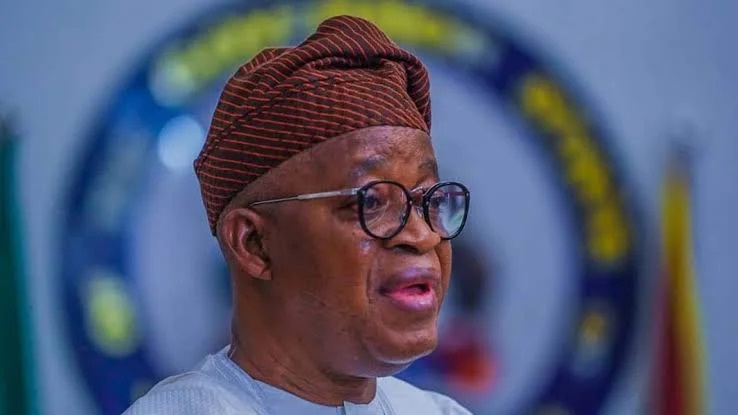
Minister of Marine and Blue Economy, Dr Adegboyega Oyetola, disclosed this while presenting the ministry’s three-year scorecard in a statement issued in Lagos by his Special Adviser, Dr Bolaji Akinola.
Mr Oyetola said the figures reflected the growing contribution of Nigeria’s maritime assets to national revenue, trade, investment and job creation, following reforms aimed at unlocking the economic potential of the country’s 853-kilometre coastline and extensive inland waterways.
He said the administration had moved beyond viewing the maritime sector primarily as a transport corridor to developing it as a broader blue-economy ecosystem capable of generating sustainable wealth from shipping, ports, fisheries, marine resources, offshore activities and inland waterways.
“At the heart of our mandate is a simple objective: to turn Nigeria’s vast marine resources into sustainable economic value for Nigerians,” he said.
The minister attributed the surge in revenue to digitisation, stronger revenue assurance, automation, closure of financial leakages and regulatory reforms designed to improve transparency and efficiency across maritime agencies.
According to him, the reforms are creating a more predictable and investment-friendly environment for both domestic and international investors seeking opportunities across Nigeria’s blue economy.
A major policy milestone, he said, was the approval of Nigeria’s first National Policy on Marine and Blue Economy in May 2025.
Mr Oyetola said the policy provided a unified framework for previously fragmented activities across shipping, fisheries and other marine-related sectors, while creating a roadmap for investment in emerging areas such as offshore energy, marine biotechnology and other blue-economy industries.
He said the policy was expected to provide greater certainty for investors and support the sustainable development of the entire maritime value chain.
The minister also linked the ongoing modernisation of major ports to Nigeria’s efforts to expand trade and reduce logistics costs.
He said upgrades were ongoing at Apapa, Tin Can Island, Onne, Rivers, Calabar and Warri ports, covering channels and cargo-handling infrastructure.
According to Mr Oyetola, the reforms have already attracted international recognition, with the World Bank and S&P Global ranking Tin Can Island Port 10th and Lagos Port Complex, Apapa, 12th among the world’s 20 most improved container ports.
He said government had also taken steps to ease congestion around the Lagos ports through an electronic truck call-up system, dedicated holding bays and expanded inland barging operations.
The minister said the Nigerian Ports Authority had acquired tugboats, pilot cutters and dredging equipment to improve operational efficiency and strengthen the competitiveness of Nigerian ports.
“We have moved from managing congestion to building a port system that can compete globally,” he said.
Mr Oyetola said plans were also underway to develop deep seaports in Akwa Ibom, Cross River and other parts of the country, while the operationalisation of inland dry ports, including the Funtua Inland Dry Port in Katsina, would take cargo clearance closer to businesses and consumers in the hinterland.
He said the initiative would reduce pressure on coastal ports, shorten cargo-delivery distances and lower logistics costs for businesses.
The minister said regulatory reforms had also produced direct financial benefits for port users, with interventions saving operators more than N86 billion in what he described as unjustified demurrage charges.
He added that nearly 300 commercial disputes had been resolved through Alternative Dispute Resolution, while unauthorised shipping charges had been eliminated.
According to him, freight and foreign exchange verification measures were also strengthened to reduce capital flight and ensure that more value generated from Nigeria’s maritime activities remained within the domestic economy.
Maritime security, Mr Oyetola said, had equally improved the investment climate, with Nigeria recording zero piracy in its territorial waters for four consecutive years.
He attributed the achievement partly to assets deployed under the Deep Blue Project, saying the improved security environment had removed costly piracy-related surcharges imposed on vessels operating in Nigerian waters.
The minister said Nigeria’s growing influence in global maritime affairs was further demonstrated by its return to the International Maritime Organisation’s Category C Council in November 2025, after a 14-year absence.
He also said the Nigerian Maritime Administration and Safety Agency secured the lifting of the 12-year United States Coast Guard Condition of Entry, a development he described as important to Nigeria’s maritime trade and international shipping reputation.
Mr Oyetola said efforts to strengthen indigenous participation in shipping were also progressing, including plans to revive a national shipping carrier through a public-private partnership.
He added that the disbursement of the Cabotage Vessel Financing Fund had commenced to enable Nigerian operators acquire modern vessels and increase local participation in the maritime industry.
The minister said human capital development was another area receiving attention, particularly through expanded seafarer training and sea-time placements.
He said the initiatives had contributed to an increase of more than 80 per cent in average earnings, while NPERA facilitated a N200,000 monthly minimum wage for workers.
Beyond shipping and ports, Mr Oyetola said the government was expanding the economic benefits of the blue economy through fisheries and inland-waterway interventions.
He said fish production reached 1.4 million metric tonnes in 2025, while compliance with Turtle Excluder Device standards reached 100 per cent.
The minister also cited the Naira-for-Crude logistics initiative, the distribution of thousands of life jackets and plans to replace wooden boats with fibreglass alternatives as part of efforts to improve safety, productivity and livelihoods across Nigeria’s inland waterways.
On institutional reforms, Oyetola said the digitisation of the Electronic Certificate Management System had improved maritime processes, while government had resolved a 16-year impasse over the operationalisation of the Regional Maritime Development Bank.
He said the development would improve access to financing for businesses operating across the maritime value chain and provide a stronger financial foundation for future investments.
Mr Oyetola said the reforms represented the beginning of a broader transformation aimed at positioning Nigeria’s marine and blue economy as a major contributor to economic diversification, revenue generation, trade competitiveness, employment and sustainable development.
He stressed that the objective was to ensure that Nigeria’s vast maritime resources generated greater economic value for citizens while strengthening the country’s position as a competitive maritime hub in Africa.
“Nigeria’s blue economy is no longer just a concept; it is increasingly becoming an engine of economic activity, investment and opportunity,” he said.

Police arrest Plateau varsity female students for assaulting colleague in viral video

Police arrest 70-year-old man for def!ling 8-year-old girl

Mutfwang declares ‘Hisbah’ activities illegal in Plateau

Three shot d3ad as bandits abduct traditional title holder in Kano

Mob beats two suspected robbers to d3ath in Calabar

NiMet predicts 3-day cloudiness, sunshine nationwide

If you marry only one wife, your life will be miserable in old age – Nigerian woman tells men

 Investigation3 days ago
DSS arrest arms supply kingpin, dismantles terroristsâ networks in Katsina and Nasarawa
- Investigation3 days ago
Fela is not the sole originator of Afrobeats, Oliver De Coque contributed â Singer, Tekno
- Investigation3 days ago
Camera captures daycare worker putting wet wipes in kidsâ mouths and âslammingâ child on table
- Investigation2 days ago
My husband was set up. What happened between him and late Favour was ââtransaction gone wrong’ – R@pe suspect, Odogwu Assaba’s wife says
- News3 days ago
Ayra Starr Sparks Dating Debate With Bold Confession About Money
- News3 days ago
I’ll reopen Nigeria’s land borders if elected – Atiku
- Investigation2 days ago
Tinubu in panic mode over subsidy plan â Atiku responds to FGâs transport fare reduction target
- News3 days ago
Drug trafficking: Court extends KC Luxury’s detention by 30 days, freezes accounts