News
Mad Cow Disease Confirmed in Scottish Cow as Authorities Restrict Animal Movement

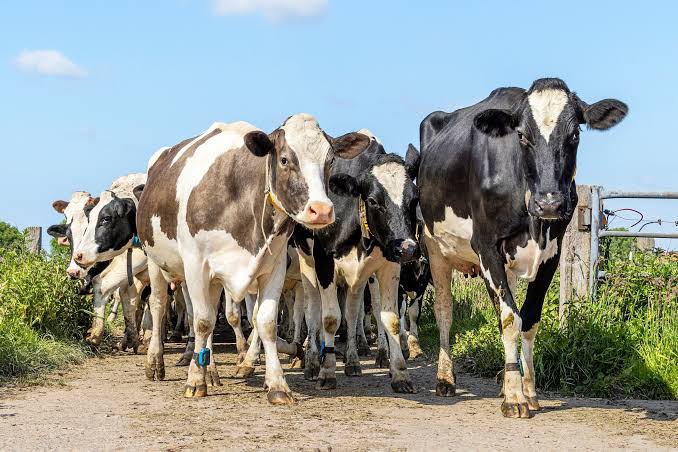
(Cows. Photo CREDIT: The Independent)
A cow on a farm in Dumfries and Galloway, Scotland, has been confirmed to have typical Bovine Spongiform Encephalopathy, also referred to as mad cow disease.
The Scottish Government disclosed the statement on Wednesday that precautionary movement limitations had been applied to the animal’s offspring and its cohort at the facilities in question.
Mad cow disease is an uncommon and deadly neurological disease that destroys cattle’s brains and nervous systems.
Four to five years after exposure, infected cows usually exhibit symptoms like anxiety, aggressiveness, or anxiousness.
Other symptoms include tremors, difficulties standing or walking, decreased milk supply, and weight loss in spite of a normal appetite.
Once clinical symptoms manifest, the disease is usually fatal.
There isn’t a proven cure or vaccination.
The government stated that the Animal and Plant Health Agency was still conducting investigations to determine the cause of the disease outbreak.
“Classical Bovine Spongiform Encephalopathy (BSE) has been confirmed in a cow on a farm in Dumfries and Galloway,” the announcement said.
“At the affected facilities, precautionary movement restrictions have been implemented for the animal’s progeny and its “cohort.” For a confirmed case of classical BSE, this is normal procedure.
“Our regular, thorough BSE surveillance and strict control mechanisms that are in place led to the identification of the case.
The animal did not enter the human food chain and Food Standards Scotland have confirmed there is no risk to human health as a result of this isolated case.”
The Scottish Government said the affected animals’ cohorts, including offspring, had been traced and isolated and would be destroyed in accordance with legal requirements.
It added that all animals over four years old that die on farms are routinely tested for BSE under Scotland’s surveillance system.
Agriculture Minister, Jim Fairlie, said the government and other agencies acted swiftly after the case was confirmed.
“Following confirmation of a case of classical BSE in Dumfries and Galloway, the Scottish Government and other agencies acted swiftly and decisively to protect the agriculture sector,” he said.
Fairlie said the quick detection demonstrated the effectiveness of the surveillance system.
“The fact we identified this isolated case so quickly is clear proof that our surveillance system for detecting this type of disease is working effectively,” he said.
He also thanked the owner of the affected animal for reporting the case promptly.
“I want to express my gratitude to the owner for their hard work.
Their quick response minimized the case’s impact on the larger business by enabling us to quickly identify and isolate it, according to Fairlie.
The government stated that stringent regulations are still in place to safeguard consumers, including the removal of some hazardous items from cattle carcasses meant for human consumption, such as the brain, skull, and spinal column.
In the 1980s and 1990s, a significant BSE outbreak in the UK resulted in the culling of millions of cattle and was connected to over 170 human deaths from the associated variation Creutzfeldt-Jakob disease.








ICPC begins tracking of N1bn FG projects in Osun

JUST IN: Pandemonium as gunmen attack Adeleke’s convoy in Osogbo

Husband and mother-in-law charged over Indian bride’s de@th

Okpebholo Charges Rongtai Company to Improve Safety Measures, Protect Lives

President Tinubu presides over first FEC meeting since June 29

Tinubu orders EFCC to channel recovered funds to student loan scheme

Media personality Do2dtun rains c*rses on X user after he allegedly mocked him over his child

 Investigation3 days ago
Osun election proves voters can beat rigging â Pat Utomi
- Investigation3 days ago
Osun election: No political deal with Tinubu â Adelekeâs camp replies Festus Keyamo after he remarked âAgreement is agreement.â
- Investigation3 days ago
âIâm tired of the bâ¬@ting, the l!es and the abus⬠in this marriage. I cannot take it anymoreâ â Nigerian woman shares video allegedly showing husband ass@ulting her
- National2 days ago
Vehicles: Lagos prohibits daily use of dealer plates
- National3 days ago
Kebbi 2027: Governor replaces deputy as running mate
- Politics2 days ago
Cameroon win first WAFCON title
- Politics2 days ago
AAU, Ekpoma Alumni protest election outcome
- News2 days ago
Many feared dead as gunmen attack Plateau community