World
Spain pushes migrants back to Morocco as fallout deepens over mass border breach

This Video Is Trending Right Now
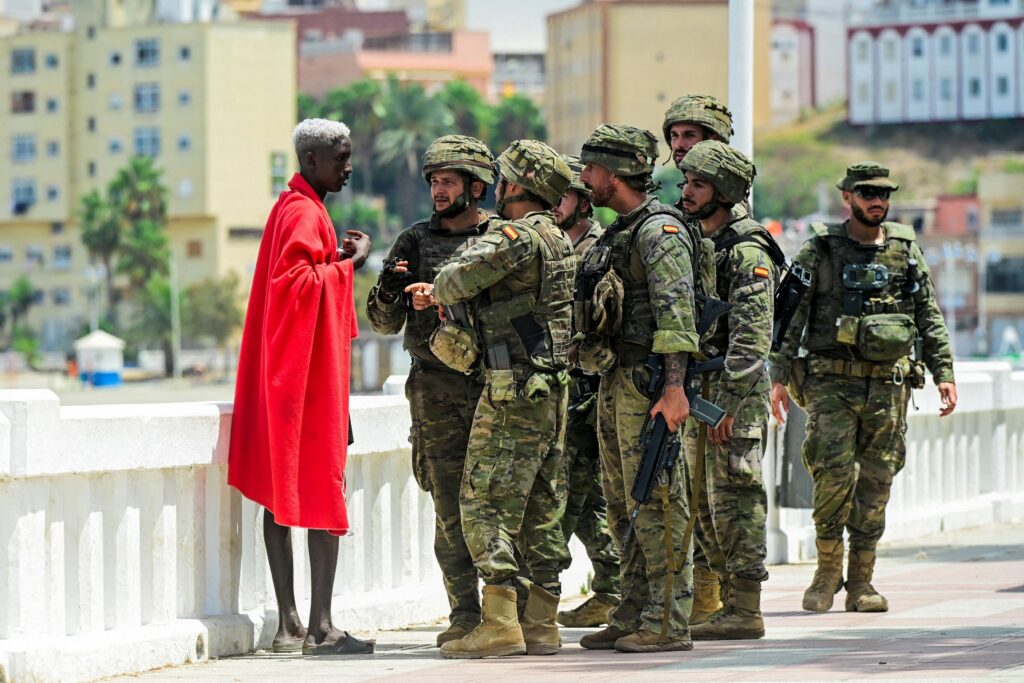
CEUTA, Spain — Tens of thousands of migrants were expelled from this tiny Spanish territory on the coast of North Africa almost as quickly as they came, and calm returned to the beaches and sidewalks, after a mass breach of the border from Morocco. For Spain, however, the political fallout and intrigue only deepened Saturday.
The crisis, which began Thursday, instantly became a touchstone in the global migrant debate, alarming European capitals and drawing outrage in Washington. But the highly unusual crowds pushing into Ceuta — still a ferry ride from European soil — raised suspicions that the viral incident was orchestrated and tied to international politics.
Spain succeeded in returning the vast majority of the up to 60,000 migrants who arrived in recent days and asserted Saturday that the exclave of 83,000 residents had returned to “normality.” At least 67 people died during the incident, officials said.
But critics of Spain’s center-left prime minister, Pedro Sánchez, seized on the moment to allege that he had lost control of the nation’s borders.
Speaking in Ceuta on Saturday, Alberto Núñez Feijóo, the leader of the conservative opposition, called on Sánchez to “answer the question everyone asks.” “How did Spain get here?” Feijóo said. “Our nation lacks an effective strategy to protect this border.”
Sánchez, whose government this year is rolling out a historic legalization plan for hundreds of thousands of undocumented migrants, has been held up as a symbol of migrant rights.
But his government on Saturday found itself rushing to install a new 1,640-foot floating barrier near its border with Morocco, and to hammer home a point: that while it might be humane and open to legalization, it is still tough on irregular migration.
“Obviously, those who entered our country irregularly in Ceuta on July 30 have no option of regularization,” Spanish Interior Minister Fernando Grande-Marlaska said Saturday. “This is why, in just over 24 hours, they have been returned to the origin” country.
Spain’s governing coalition seemed to split over who to blame for the crisis.
Sánchez and other key cabinet members defended Morocco and denied its involvement. “Morocco is no threat either to Ceuta or to the rest of Spain,” Grande-Marlaska said. “It is an absolutely reliable partner.”
But Sumar, a left-wing party, which is a partner in Sánchez’s coalition, openly denounced Morocco to the United Nations’ special rapporteur on human rights of migrants.
“The scale of these events — tens of thousands of individuals crossing simultaneously within a very short time frame — does not appear consistent with ordinary migratory flows, and may be indicative of active facilitation on the part of Moroccan authorities,” the party said.
Omar Naji, a human rights advocate with the Moroccan Association of Human Rights told The Washington Post that the sudden wave occurred after a noticeable reduction in border patrols along the Moroccan side of the border, based on observations by the group.
Sánchez is one of Europe’s most vocal opponents of the war in Iran and also a sharp critic of Israel.
Oscar Puente, Spain’s transportation minister, in a cryptic post on X, seemed to point a finger at Israel over the events in Ceuta.
Like Trump and members of the European right, prominent Israeli figures seemed to gloat over the Ceuta crisis.
“Spain, which never misses an opportunity to lecture Israel, has declared a state of emergency in Ceuta following the crisis over its immigration policy,” Danny Danon, Israel’s ambassador to the United Nations, wrote on X. “Maybe before it continues lecturing us, it’s time it explained to the world why it still maintains colonial enclaves in Africa.”
Puente referenced Danon’s post in his own, saying: “Well, things are starting to get pretty clear.”
In March, Michael Rubin, an American historian and political adviser at the Pentagon during the administration of President George W. Bush, wrote an article urging Morocco to send its citizens into Ceuta and Melilla, another Spanish exclave on the North African coast, to assert Moroccan sovereignty.
Rubin invoked the 1975 Green March, in which thousands of Moroccans marched into Western Sahara, then a Spanish colony. During his first term, President Donald Trump broke with 40 years of neutrality in the dispute and recognized Western Sahara as Moroccan territory.
“With Spain’s Socialist Prime Minister Pedro Sánchez embracing the language of decolonization, Mohammed VI should reclaim the spirit of the Green March to finalize the expulsion of Spanish colonists from Moroccan soil,” Rubin wrote. “Ceuta and Melilla … are a weak spot for European security since African migrants regularly rush the fence to claim asylum.”
“Moroccans should gather, send bulldozers to the border, and then enter Ceuta and Melilla unarmed to raise the flag,” Rubin wrote.
In Ceuta on Saturday, many businesses remained closed and evidence of the mass incursion, including debris in the streets and inner tubes on beaches, had yet to be cleared.
Several migrants who spoke to The Post said that security on the Moroccan side of the border was lax and they managed to cross easily. They said they were urged on by social media posts and videos that tapped into deep seeded despair over the future among many of the young Moroccans who rushed into Ceuta.
Mohammed Kahlil, 25, who swam into Ceuta said his path was unobstructed. The Moroccan government “didn’t care” about him crossing, he said, and it was only when he got to Ceuta that he “saw violence from the Spanish” — a sharp contrast with the harsher stance taken by Moroccan border authorities in the past.
Khalil added that he was motivated to cross after being invited to a Facebook group where people documented their experience entering the exclave.
Ayoub Karabani, 28, who crossed last week, said he also faced an unobstructed path on the Moroccan side “It’s weird, I don’t understand why they didn’t stop us,” Karabani said.
Milad Al Ramli, 30, said on Saturday that he crossed into Ceuta after learning on a Facebook page carrying local news that others had done so. Al Ramli said he wanted a better life in Spain: “There is nothing for us in Morocco.”
Another migrant, Mohammed Bardi, said a local politician had encouraged people to go. Several said they hoped the move would mean better prospects for employment and a route out of poverty.
“Our families are poor, there’s no jobs in Morocco, I have a college degree and no job” said Younes Murad, 28, who said he swam for hours to cross.
Khadija Almoufi, 20, who helps support her family said: “There’s poverty everywhere. I want to live a wonderful life. There are no services in Morocco or money.”
Morocco has used migrants to harass the Spanish exclave in the past, during diplomatic spats with Madrid. This time, speculation about whether the country had eased border enforcement, centered on Sánchez’s recent trip to Morocco’s adversarial neighbor, Algeria.
Naji, the human rights advocate, said many of the migrants faced harsh conditions while in Ceuta. “They didn’t have food or water” and so were forced to return, he said.
He said that most of the migrants were of Moroccan origin and that those who returned to Morocco were hauled off in trucks belonging to the Moroccan government.
Sánchez has been at odds with the European right and with Trump, who has frequently singled out Spain, threatening to severe trading with country of 48 million.
The crisis underscored the extent to which migration is a hot-button issue across the West.
On Saturday, a majority of European Union governments called for an urgent meeting of interior ministers to discuss the Ceuta crisis, while the Spanish government denounced the leveraging of the crisis by opponents and other governments.
E.U. officials said they would convene Sunday and Monday to discuss any further responses to the situation in Ceuta.
Giorgia Meloni, Italy’s right-wing prime minister, on Friday announced the nation was restarting border checks on flights and ships arriving from Spain, despite Spain being a member of a visa-free travel zone in Europe that covers 29 countries.
Sánchez dispatched a letter to E.U. leaders criticizing the reaction and complaining of a lack of solidarity from some member states. “The European Union cannot afford this kind of selfish, polarizing and unlawful reaction,” Sánchez wrote.
Without naming specific countries, Grande-Marlaska on Saturday described the positions of those being “unsupportive” of Spain as “absolutely selfish.” He noted that Ceuta is not part of Europe’s free travel zone, with arrivals from the exclave into European territory requiring appropriate travel documents and visas.
“We are talking about ignorance or bad faith,” he said.
Faiola reported from Rome and El Chamaa from Beirut. Imogen Piper in London and Ellen Francis in Brussels contributed to this report.


Tinubu appoints ex-Plateau gov’s son as Senior Special Assistant

Presidency to Cardinal Onaiyekan: Your lack maturity

Trump kisses gold Jesus as AI dump draws scorn: ‘Now I need brain bleach’

Makinde mourns veteran journalist, Ibadan chief Lekan Alabi

BREAKING: Former Adamawa Governor Bindow Resigns from ADC

Atiku: I fed Obasanjo’s family when he was in prison, clothed him after his release

Osun 2026: Governorship debate cancelled over candidates’ absence

 Investigation1 day ago
âSome of us are âpick meâ and we wouldnât know. I used to do things for men I liked when it was supposed to be the other way aroundâ â Lady reveals
- Investigation3 days ago
âItâs is an opportunity but not an obligationâ â FIFA president Infantino defends new proposal to sell FIFA World Cup rights to private company after facing backlash
- Investigation3 days ago
âWe are going to beat the f**king sh*t out of themâ – Trump issues sharp warning to Iran as diplomacy ends after surprise attack on US base
- Breaking1 day ago
âWe are going to beat the f**king sh*t out of themâ – Trump issues sharp warning to Iran as diplomacy ends after surprise attack on US base
- Investigation1 day ago
âTinubuâs comment on hunger insensitiveâ- Peter Obi
- Investigation1 day ago
Before you go about snatching someone else’s husband, please check the quality of what your’re snatching first- actress Rita Edochie shades an unnamed âhusband snatcherâ
- Investigation21 hours ago
âMy ex just logged me out of his Netflix and Prime because I said he is weird and I regret meeting him. That doesnât mean he should remove meâ â Nigerian lady reacts as ex revokes her access
 Investigation3 days ago
I hope Peller and Jarvis signed a prenup before getting married – Delta state govâs aide, Ossai Ovie Success