World
Egypt unveils trove of ancient artifacts it tries to boost tourism industry

Archaeologists have unearthed a set of ancient artifacts in Egypt including Pharaonic funerary furniture, remains of a Roman basilica and a marble head of Aphrodite, the ancient Greek goddess of love and beauty.
The discoveries, announced on Sunday, are part of the Egyptian government’s efforts to boost the country’s tourism industry and bring money into the troubled economy.
At the centre of these efforts was the November inauguration of the long-delayed Grand Egyptian Museum, a megaproject located near the famed Giza Pyramids and the Sphinx.
The remains of the basilica and Aphrodite’s head were found in an ancient necropolis in the province of Beni Suef, 80 miles south of Cairo, the tourism and antiquities ministry said.
The Ehnasiya necropolis, which is also known by its ancient Roman name, Heracleopolis Magna, was one of the most significant cities of ancient Egypt.
Archaeologist Mohammed Abdel-Badei, head of the antiquities department at the Supreme Council of Antiquities, said that they found large stone blocks supporting columns, weighing up to 45 tons, that had been used to build the basilica.
Three of the blocks remain standing in their original positions, he said.
Aphrodite’s head, measuring about 9.5ins by nearly 10ins, includes detailed features of the goddess’ face and curly hair, reflecting the classical artistic traditions of the Greek and Roman periods, he said.
Archaeologists found inscriptions linked to Senusret III, who ruled between 1837 BC and 1819 BC during the ancient 12th Dynasty.

The inscriptions include his throne, birth names of the Pharaoh, who is also known as Sesostris III, and was one of the most prominent rulers of Egypt’s Middle Kingdom.
Also unearthed were fragments of wall statues and terracotta moulds, believed to have been used in coin crafting during the Roman period.
The findings show that Ehnasiya had been an active economic and commercial hub when Egypt was part of the Roman Empire between 30 BC and AD 395, Mr Abdel-Badei said.
In Cairo, archaeologists found a nearly complete set of funerary furniture in the Matariya neighborhood of Cairo, which was once part of the ancient city of Heliopolis, the ministry said.
Mr Abdel-Badei said that they unearthed a mudbrick burial with gilded remains in a coffin, believed to be for a military figure. They also found a cache of cosmetic tools, including a copper mirror and alabaster kohl containers.

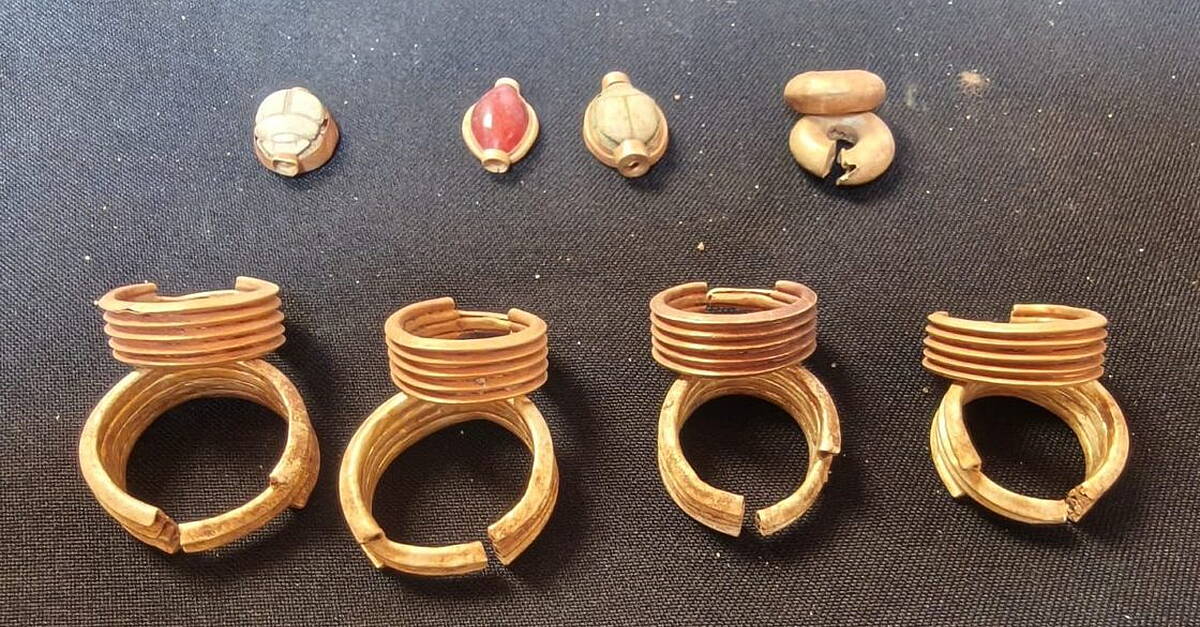
Also found was a collection of yellow metal earrings, consisting of five pairs of varying sizes, believed to be made of gold, he said.
The discoveries in Beni Suef and Cairo are the latest archaeological findings which the government hopes will boost the vital tourism sector, partially driven by antiquities sightseeing.
Tourism has suffered during years of political turmoil and violence after the 2011 uprising.
In recent years, it has started to recover from the coronavirus pandemic and economic effects of the Russia-Ukraine war – both countries are major sources of tourists visiting Egypt.
A record number of about 19 million tourists visited Egypt last year, a 21% increase from 2024, according to official figures.
In the first four months of 2026 6.1 million tourists visited the country, compared with 5.7 million during the same period in 2025, the prime minister’s office said in May.


EFCC presents fifth witness against ex-power minister in ongoing probe

LP unveils female deputy governorship candidate in Benue
Relax, it will all work out, says Trump, as Iran hangs up

Police recover 245 rustled cattle, foil kidnap attempts in Kaduna

Singer Nasboi questions President Tinubu over insecurity, asks why stronger action has not been taken against bandits and terrorists

Troops sustain onslaught on terrorists, recover 15 motorcycles, arms in Niger

APC denies Adamawa LP candidate’s claims of primary irregularities

 Breaking2 days ago
Nigeria confronted with outcomes of institutional neglect — Tunde Bakare
- News2 days ago
Seyi Makinde clinches APM presidential ticket
- World2 days ago
Raheem Sterling arrested for suspected drug driving amid ‘strain from career’
- Politics2 days ago
Osun NNPP concedes 50% of legislative tickets to female candidates
- News2 days ago
Saraki urges young women to prioritise education, skills for economic independence
- World2 days ago
Trump lashes out after removal of his name from Kennedy Center- 'System is rigged'
- News2 days ago
Liverpool confirm exit of head coach Arne Slot
- Business3 days ago
Dangote plans to process 130 crude grades – Report