World
How Milan's Olympic Village will become housing for 1,700 students after the 2026 Games

This Video Is Trending Right Now
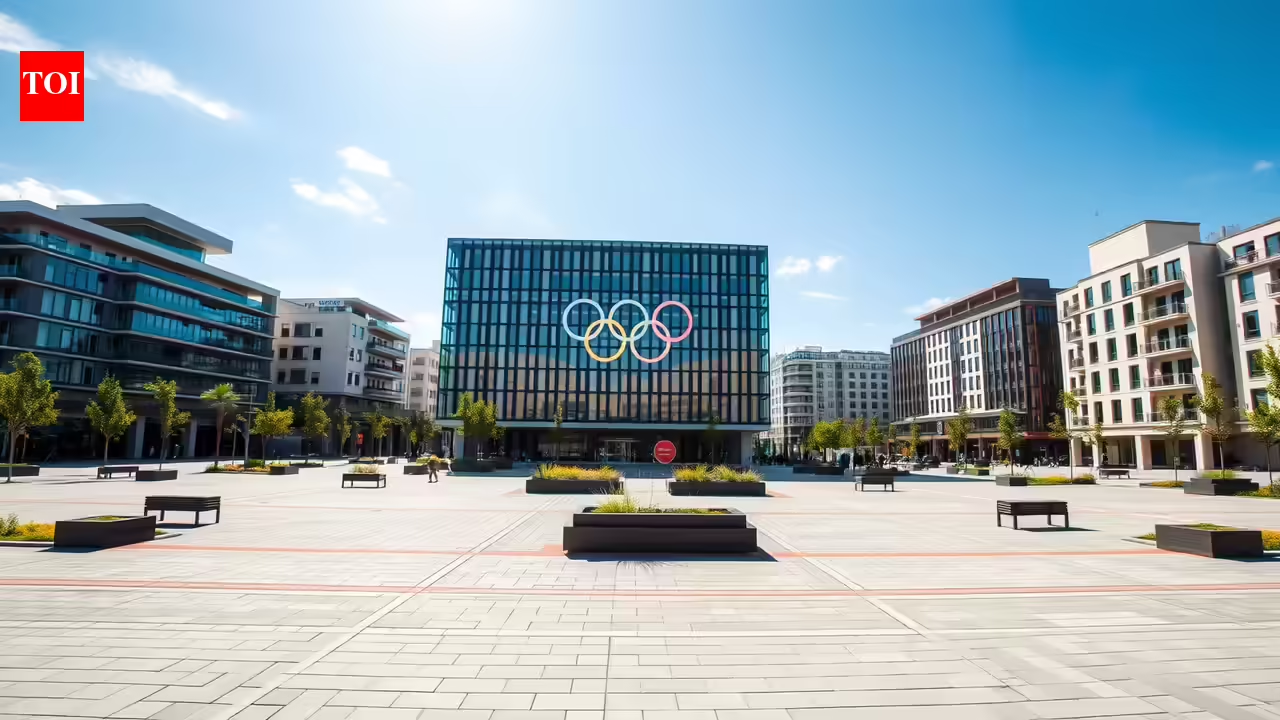
Every host city builds an Olympic village, and almost every host city then spends years deciding what to do with the empty buildings once the athletes leave. Milan skipped that problem. Architects at Skidmore, Owings & Merrill, working with Italian developer COIMA, designed the Milano Cortina 2026 Olympic Village on a 19th-century railway yard in the Porta Romana district, with its second life built into the blueprint, not added afterwards. The complex opened to 1,300 athletes in February 2026, and by September 2026, the same six residential buildings are set to reopen as Italy’s largest affordable student housing development, offering 1,700 beds for the academic year. The transformation is expected to take four months from the closing ceremony to student move-in.
Milan designed its Olympic Village to become student housing from day one
What sets the Porta Romana project apart is timing. According to SOM’s official project announcement, the firm was selected to design the Olympic Village in 2021, years before the Games, with its post-Olympic role as student housing built into the brief from the start rather than added later. COIMA founder and CEO Manfredi Catella described the approach as creating spaces, functions, and materials already designed for their eventual conversion. That early planning meant the project never had to choose between serving athletes well and serving students well afterwards; both uses were designed into the same architecture simultaneously, a sharp departure from the usual Olympic pattern of building first and worrying about reuse only once the closing ceremony has already happened.
What SOM and COIMA actually built in Milan’s Porta Romana district
The completed complex sits on a former 19th-century railway yard and combines six new residential buildings constructed in mass timber with two restored historic structures, including the former Squadra Rialzo locomotive workshop. According toSOM’s project page, the development covers a gross building area of roughly 53,380 square metres and includes 40,000 square metres of green space woven through the site. SOM design partner Colin Koop has said the buildings were designed to draw on Milan’s historic architectural scale and materiality rather than imitate the city’s older fabric directly. Construction began in January 2023 and, according to COIMA’s official press release, the buildings were handed over to the Fondazione Milano Cortina 2026 ahead of schedule.
How the four-month conversion from Olympic Village to student housing works
Because the conversion was built into the design rather than retrofitted afterwards, the turnaround between Olympic use and student housing is unusually fast. The Village welcomed 1,300 athletes when the Games opened in February 2026, and according to SOM, the same buildings are due to be permanently converted into Italy’s largest affordable student housing development by September 2026, in time for the new academic year. Around 30 per cent of the roughly 1,700 units will be offered at subsidised rents, with the development already pre-qualified for support under an Italian Ministry of Universities and Research funding decree that could reduce rents for residents for up to twelve years.
Why Milan’s Olympic Village avoids the usual Olympic legacy problem
Olympic infrastructure has a long history of being abandoned once the Games end, from empty venues left over from Athens 2004 to Rio’s underused 2016 Olympic Park. Milan’s approach treats the Games themselves as little more than a funding mechanism and a deadline, rather than the building’s true purpose. COIMA’s Catella has argued that the project sets a new benchmark for sustainability not only through its environmental performance but through what happens to it once the Games are over. SOM has similarly described the Village as representing a new model for sustainable Olympic development, one designed to continue serving its surrounding community for decades after the athletes have departed.
How the Olympic Village fits into Milan’s larger Porta Romana master plan
The Olympic Village is only the first piece of a far larger redevelopment. According to COIMA, the project forms the opening phase of the wider Scalo di Porta Romana urban regeneration plan, which is intended to eventually deliver around 105,000 square metres of residential buildings across the district, with half designated as affordable housing alongside new commercial space and public gardens. Once the conversion is complete, the Olympic Village Plaza is planned to become a neighbourhood square lined with shops, bars, restaurants, and cafés, while the surrounding park and railway-side buildings are converted into further affordable housing for the district as a whole.


Nigerian man filmed brut@lly assa@lting his woman (watch)
Edo to Set Up Special Court for Kidnappers, Cultists

Abuja court sentences three terrorists to d3ath by hanging

Georgian proverb of the day: 'That which we give makes us richer; that which is hoarded is lost'
Denrele Edun shares last voice note Alexx Ekubo sent him, says actor was checking on him while battling his own struggles

German archaeologists uncover 2,000-year-old Celtic prince's grave filled with gold, weapons and a wagon

'If Ukraine burns, Moscow burns': Zelenskyy makes good on his warning with massive drone strike

 News14 hours ago
Bandits Strike Under Rain Cover, Kill 2 and Make Shocking Abductions in Sokoto
- Investigation1 day ago
Dad, are you also leaving us? Congolese man married to South African woman addresses xenophobic individuals after his son’s heartbreaking question
- World2 days ago
Horror as woman 'gang-raped by men with handmade weapons' who 'dragged her from home'
- Investigation3 days ago
"Anytime Yul Edochie appeared on TV, Judy would tell me she loved him" â Actress Judy Austin’s ex-husband breaks down, shares marriage photos
- National3 days ago
A’Court Upholds N197m Damages, Awards 20% Interest Against Nigerian Bottling Company Over Obanikoro’s Crash
- World2 days ago
Trump slams Israel, praises Iran at G7 summit
- Investigation24 hours ago
Actor IK Ogbonna leads mourners as Alex Ekubo’s body arrives his hometown Arochukwu ahead of his funeral (videos)
- News1 day ago
Abdulsalami Says Nigeria Could Have Been Better Off If Buhari and Idiagbon Stayed Longer