World
Largest ‘floating city’ to carry 80,000 people and circle the globe every two years

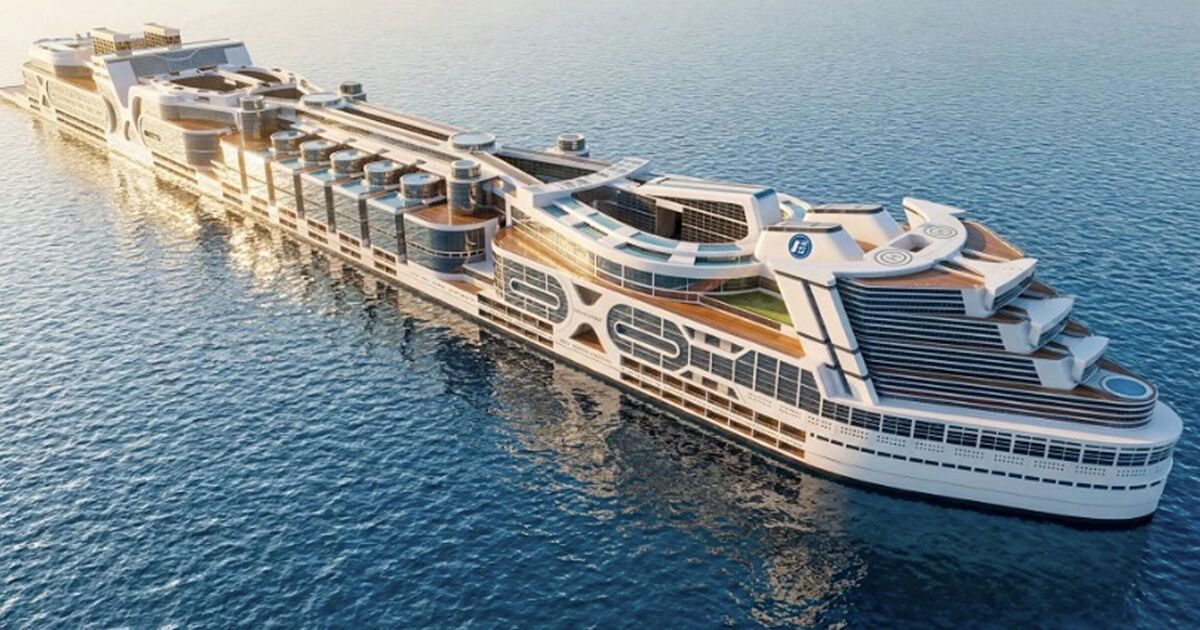
Freedom Ship would be home to up to 80,000 people and become the world’s largest passenger ship (Image: Harbor Rear)
A futuristic proposal for a mile-long floating city capable of housing tens of thousands of people has been revived, with backers claiming it could circle the globe every two years.
The concept, known as the Freedom Ship, envisions a vast vessel that would dwarf today’s cruise liners and operate as a permanent moving city at sea.
Designs for the vessel describe a structure around a mile in length and 800 feet wide, rising 30 decks high and costing an estimated £12bn to build.
It is intended to carry up to 80,000 people in total, including around 50,000 permanent residents, 10,000 visitors and 20,000 crew members.
The ship would function as a fully self-contained city, with schools, healthcare, housing, retail and leisure facilities spread across multiple decks.
What would life on board Freedom Ship look like?
Plans include a wide range of amenities more commonly found on land.
These include hotels, restaurants, shops, financial services, museums, a symphony hall and a water park.
A 15,000-seat sports stadium is also proposed, alongside a convention centre, aquarium, nightclub and a two-storey food hall.
Children would be educated from primary school through to college level, while commercial zones would host banks and retail businesses.
Eight helipads are also included in the design.
Read more: ‘Son of Concorde’ X-59 days from first flight – London to New York under 4 hours
Read more: Zelensky’s ‘silent death’ robots ‘crucial’ for monthly Russian casualty target
How would Freedom Ship actually move?
Developers say the vessel would travel continuously around the world at around seven knots, completing a global circuit roughly every two years.
Because of its size, it would not dock in any traditional port and would instead remain in international waters.
Passengers and supplies would be transferred using ferries and visiting vessels, with other cruise ships potentially able to moor alongside.
The concept was first developed in the 1990s by American engineer Norman Nixon, who died in 2012.
It has been revived and shelved several times over the past three decades before resurfacing again under the leadership of Roger Gooch of Freedom Cruise Line International.
Gooch says a 12-strong team is now working on the project and claims interest is strong, although significant funding is still required.
“We could almost justify building three ships,” he said.
However, he also acknowledged that raising capital remains the biggest obstacle.
“We feel very confident that we can put this together, but the capitalisation is key,” he added.
Where would Freedom Ship be built?
If financing is secured, construction would begin in Indonesia, starting with the hull.
The structure would be built in sections before being assembled offshore.
Developers estimate construction could take three to four years, with some residents moving on board before completion.
Maintenance would reportedly take place while the vessel is at sea, with the ship continuously travelling rather than operating from a fixed port.

Freedom Ship would have pleasure pools, shopping malls and even a 15,000 capacity stadium (Image: Harbor Rear)
How would Freedom Ship make money?
The business model is based on leasing commercial space to outside operators, similar to a city on land.
Retailers, restaurants and service providers would rent units, while the operating company would retain interest in certain ventures such as a casino.
Developers also say medical and research organisations have expressed interest in using onboard facilities.
One of the most ambitious proposals is a large hospital and research centre, with supporters suggesting the ship could operate beyond certain regulatory constraints.
Backers say the vessel would have environmental benefits, including reduced emissions through nuclear power.
They also claim it could help clean oceans as it travels.
However, the ship would remain offshore rather than overwhelm smaller ports, with visitors ferried out to experience its facilities at sea.
The concept has been shaped by Kevin Schopfer, an architect specialising in arcology, which combines architecture and ecological design.
Earlier iterations included floating city concepts designed to cope with rising sea levels, featuring large green spaces and walkable districts.
Plans for leisure spaces have also been discussed, including sports pitches and event areas, with developers joking that even major performers would be difficult to accommodate due to scale.


EPL: Arsenal to make Arteta highest-paid manager

Five police officers arraigned over death of musician OG Millan

Top Nigerian Newspaper Headlines For Today, Tuesday, 2nd June, 2026

UBA Unveils New Landmark Building at UNILAG

Fintiri inaugurates Health Week, inspects PHC projects

Largest ‘floating city’ to carry 80,000 people and circle the globe every two years

Man responds to X user who asked how he can politely tell his girlfriend to lose weight or hit the gym

 Breaking2 days ago
Nigeria confronted with outcomes of institutional neglect — Tunde Bakare
- World2 days ago
5/30: Saturday Morning
- News2 days ago
Seyi Makinde clinches APM presidential ticket
- World3 days ago
Raheem Sterling arrested for suspected drug driving amid ‘strain from career’
- News2 days ago
Liverpool confirm exit of head coach Arne Slot
- Politics2 days ago
Osun NNPP concedes 50% of legislative tickets to female candidates
- News2 days ago
Saraki urges young women to prioritise education, skills for economic independence
- World2 days ago
Trump lashes out after removal of his name from Kennedy Center- 'System is rigged'