World
Scientists found a 2,600-year-old brain inside an Iron Age skull and it was still intact

This Video Is Trending Right Now
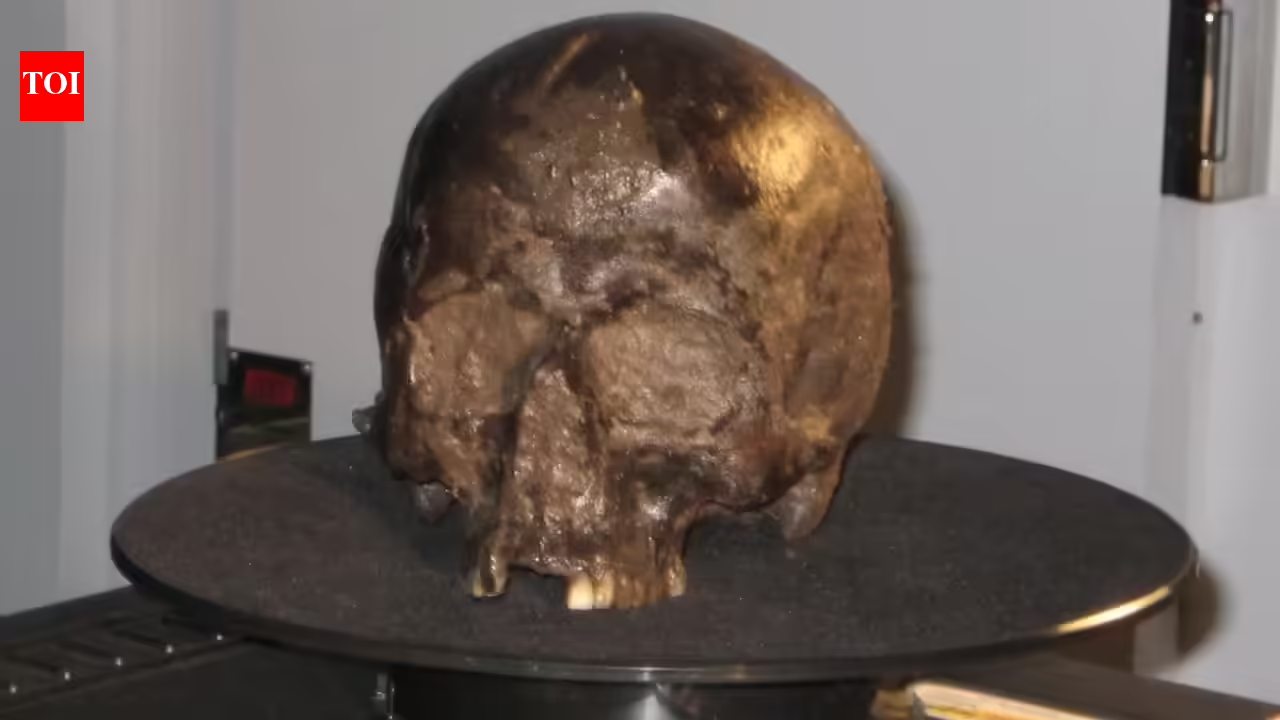
A human brain that may date back more than two millennia has been recovered from a skull unearthed near York, offering an unusual case of soft tissue survival in Iron Age archaeology. The remains were first excavated in 2008 from a waterlogged pit at Heslington, where conditions appear to have slowed the normal process of decay. What makes the discovery stand out is not just its age, estimated at around 2,600 years, but the fact that recognisable brain material was still present inside the cranium when it was cleaned in laboratory conditions. Archaeologists have described the find as highly uncommon, with ongoing discussion about how burial conditions in wet clay may have helped preserve the tissue over such a long period.
Hidden brain tissue discovered inside Iron Age skull during 2008 excavation
The skull was recovered during archaeological work carried out near Heslington, on the outskirts of York, an area long known for layered prehistoric and Roman-era remains, as reported by The BBC. It was initially catalogued as part of a broader Iron Age assemblage before specialists at the York Archaeological Trust identified something unexpected during post-excavation cleaning.Buried face down in a clay-rich pit, the skull did not appear unusual at first glance. Only later, when the base was examined more closely, did internal material become visible through a small opening at the underside of the cranium. Inside the skull, researchers encountered a dense yellowish mass with an unusual texture, later interpreted as preserved brain tissue. Such survival of soft tissue from this period is exceptionally rare, as organic material typically decomposes rapidly after burial.The environment at the site near Heslington is believed to have played a key role. The surrounding wet, oxygen-poor clay may have slowed bacterial activity, effectively limiting decay once the head was sealed in the ground.
Examination of the skull reveals signs of sharp force trauma
Forensic tests on the bones have revealed that this individual, believed to be a man who was around 26 to 45 years old at death, had endured a violent trauma to his neck. Moreover, the skull itself has marks that suggest that there was an attempted decapitation through a sharp instrument after the traumatic event.There were no other parts of the body discovered from the grave, meaning the only part of the burial site that survived was the skull. Researchers are still trying to find out what kept this specific brain material intact while everything else from the time period has deteriorated.


Fresh graduate, his father, brother and seven others k!lled in IED explosion on Zamfara road

Nigeria has demonstrated that democratic institutions can endure, adapt – Uba Sani

Major police update on Madeleine McCann as court issues bombshell ruling

Benue APC reaffirms support for Tinubu, Alia on Democracy Day

Woman and her husband arrested for attempting to sell off her sister’s baby

At least 20 injured in Germany after crash between school bus and cement mixer

Indian fraudster caught by alert store owner in Michigan, gets golden chocolate coins instead of $700k gold

 Breaking2 days ago
"Unless you’re d£ad, you must pay" â Young truck driver calls out motorist who allegedly damaged his side mirror and fled
- Breaking2 days ago
UNIJOS emerges top winner at JAMB Admissions Awards, receives ₦500m grant
- Breaking2 days ago
Nobody can stop me from visiting any part of Nigeria â Sheikh Gumi
- National2 days ago
Court Adjourns ₦337 Million Fraud Case Involving NASS Officials to September 23, 2026
- National3 days ago
Abia warns residents against fake N65,000 Otti giveaway
- Business3 days ago
NIPR Lagos to host forum on public trust
 Breaking3 days ago
Primaries: Protesters storm Lagos APC secretariat, express grievances
- Business3 days ago
FG unveils $1bn AfCFTA credit facility to boost Nigerian exports