World
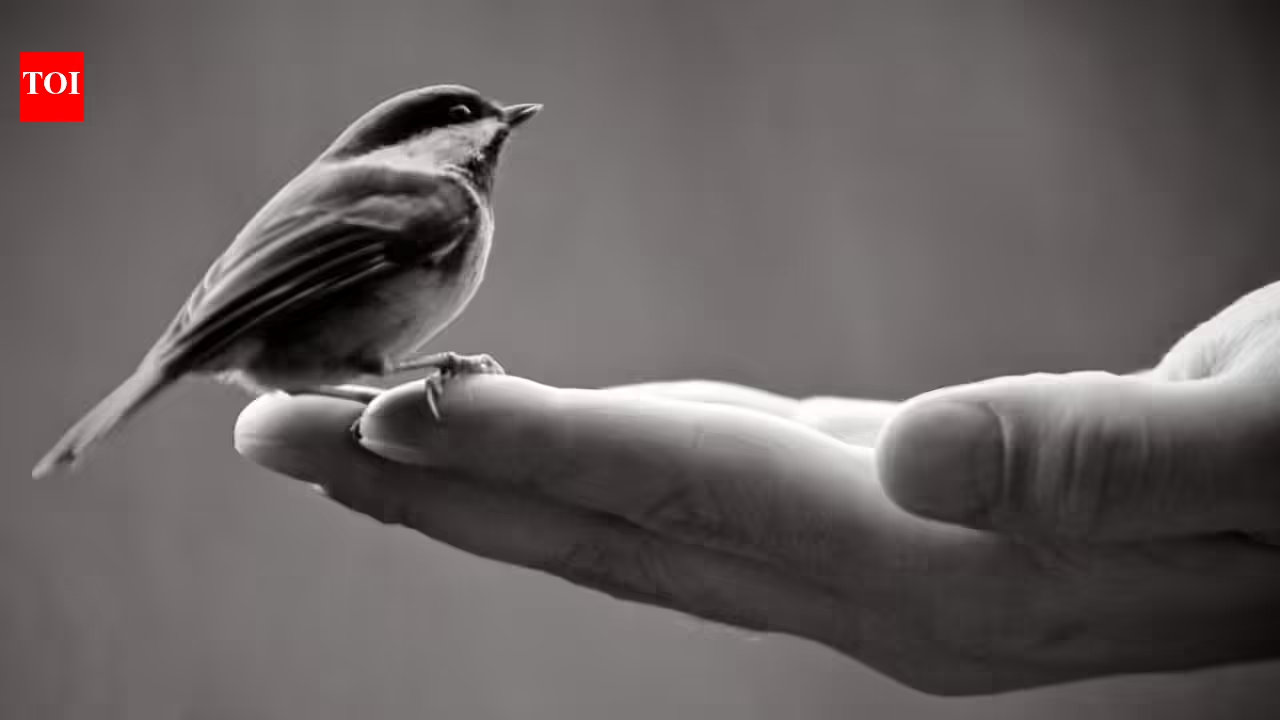
Spanish proverb of the day: 'A bird in hand is worth more than a hundred flying around'

This Video Is Trending Right Now
Imagine being offered $1,000 today or a chance to win $10,000 next month. Many people would be tempted by the larger reward. Yet history, economics and human experience suggest there is wisdom in choosing the certainty of what you already have.That idea lies at the heart of one of the most enduring proverbs in the Spanish-speaking world: “Más vale pájaro en mano, que cien volando.” Literally translated, it means, “A bird in the hand is worth more than a hundred flying around.” English speakers know it in a slightly different form: “A bird in the hand is worth two in the bush.”For centuries, the saying has reminded people that a guaranteed gain is often more valuable than a larger reward that remains uncertain.
A proverb older than most people realise
The proverb has deep roots in European culture. Its Spanish form is centuries old, but the idea itself predates modern Spanish.Many scholars trace the expression to medieval Europe, where variations appeared in several languages. Linguists have linked it to older Latin sayings that emphasised the value of certainty over possibility. The English version, “A bird in the hand is worth two in the bush”, appears in written records as early as the 15th century. Similar forms exist across Europe, suggesting a shared piece of folk wisdom that travelled across cultures and generations.The imagery is simple and memorable. A hunter holding one bird already possesses something real. Chasing many birds still flying overhead involves risk. The hunter could lose what is already secured while pursuing something better.
What does the saying mean?
At its core, the proverb is about weighing certainty against risk.It advises people not to give up something valuable that they already possess merely because a potentially better opportunity appears on the horizon.The saying does not suggest avoiding all risks. Rather, it warns against sacrificing a guaranteed benefit for a speculative one without careful consideration.In everyday life, people apply the proverb to countless situations:
- Accepting a stable job rather than gambling on an uncertain opportunity.
- Keeping a reliable investment instead of chasing unrealistic returns.
- Valuing an existing relationship rather than risking it for something untested.
- Choosing practical outcomes over wishful thinking.
The lesson remains relevant because uncertainty is a permanent feature of human life.
The psychology behind the proverb
Modern behavioural economics has shown that this old saying reflects how many people naturally think.Research by psychologists Daniel Kahneman and Amos Tversky, particularly through Prospect Theory, demonstrated that people often place greater value on avoiding losses than on acquiring equivalent gains. Their work helped explain why individuals tend to prefer certain outcomes over risky alternatives, even when the gamble might offer a larger reward.In simple terms, losing something already possessed usually feels worse than the pleasure gained from acquiring something new.
Why farmers, traders and families passed it down
Like many traditional proverbs, this one emerged from practical experience rather than abstract philosophy.For farmers, merchants and labourers, survival often depended on making careful decisions about limited resources. Taking unnecessary risks could have serious consequences.A farmer who sold reliable livestock in pursuit of a speculative opportunity might lose both. A trader who abandoned a secure deal while hoping for a better one could end up with nothing.The proverb became a warning against reckless ambition and poor judgement.Parents also passed it on to children as a lesson in patience and gratitude. Rather than constantly chasing something bigger or better, the saying encouraged people to appreciate what they already possessed.
Its relevance in the modern world
Despite being centuries old, the proverb feels contemporary.Modern life constantly encourages people to seek more. Social media platforms showcase seemingly perfect careers, relationships and lifestyles. Advertising encourages consumers to believe that something better is always available.The result can be a perpetual sense of dissatisfaction.The proverb offers a counterbalance. It reminds people that opportunities should be evaluated carefully and that existing achievements have value.The message is especially relevant in financial markets. Investors who chase unrealistic returns often expose themselves to greater risk. Financial advisers frequently encourage clients to focus on long-term stability rather than pursuing every promising trend.The same principle applies to careers. Leaving a secure position for a promising opportunity may sometimes be worthwhile, but the proverb encourages thoughtful analysis rather than impulsive decisions.
A lesson about human nature
Beyond practical decision-making, the proverb reveals something deeper about human behaviour.People often become so focused on what they do not have that they overlook what they already possess. Philosophers from Aristotle to modern thinkers have explored this tendency.The Spanish saying acts as a reminder to recognise existing value before pursuing uncertain rewards.Importantly, it is not an argument against ambition. History’s greatest achievements often required people to take risks. Instead, the proverb encourages balance. It asks a simple question: is the possible reward worth the potential loss?That question remains as relevant today as it was centuries ago.
Why the proverb endures
The enduring popularity of “Más vale pájaro en mano, que cien volando” comes from its universal truth.Every generation faces choices between certainty and possibility. Every person must decide whether to protect what they have or pursue something more.The proverb does not provide a rigid rule for every situation. Instead, it offers a timeless reminder to think carefully before trading reality for hope.In a world that constantly celebrates bigger dreams, faster success and greater rewards, the old Spanish saying still whispers a valuable piece of wisdom:Sometimes, the bird already in your hand is worth more than all the birds still flying in the sky.


Ilhan Omar under fire as husband’s income drops from millions to $200 in new disclosure

People must stand united in condemning Edinburgh attacks, says John Swinney

NWFL: Edo Queens, Nasarawa Amazons dominate Best X1 of the Season
People must stand united in condemning Edinburgh attacks, says John Swinney

Egungun festival not license to terrorise citizens – Olubadan warns masquerades, followers

Wowcher ‘extremely sorry’ over crocodile attack email
Wowcher ‘extremely sorry’ over crocodile attack email

 World3 days ago
Horror as woman gang raped by 5 men – piece of wood inserted into victim's body
- Investigation22 hours ago
Update: Abia police arrest man caught on camera ass@ulting woman
- Investigation2 days ago
Leave to live – Nigerian woman says as she shares photos of her sister in âabusive marriage and after separationâ
- Investigation2 days ago
FIFA ban England fanâs flag from World Cup
- Investigation2 days ago
Gestational Surrogacy can change oneâs life in a year
- Investigation2 days ago
"We came to a viewing centre, not the stadium" â Actor, Chinedu Ikedieze reacts after being charged $30 to watch world cup match in America
- Investigation2 days ago
Africa’s richest man, Dangote reveals the largest amount heâs made in a single year (Video)
- World6 hours ago
Russia burning as Ukraine launches massive attack on key waterway 160 miles from frontline