World
At an annual Cuban Revolution celebration, Raúl Castro is conspicuously absent

This Video Is Trending Right Now
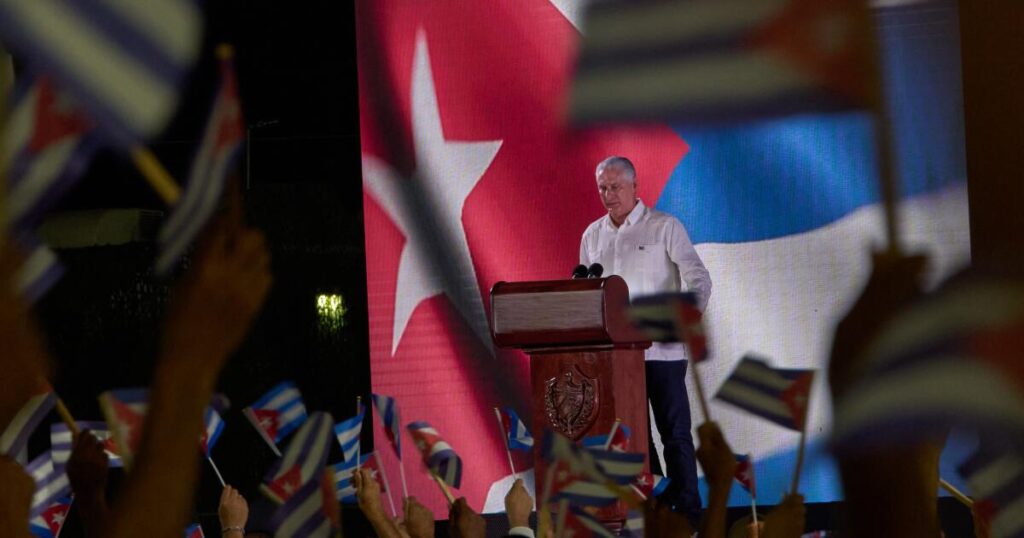
HAVANA — Cuba held a traditional rally Sunday to commemorate one of the revolution’s most important anniversaries, but former President Raúl Castro was conspicuously absent.
It was the first time in at least 30 years that Castro, now 95, did not attend the event, and no explanation was given. President Miguel Díaz-Canel read a congratulatory message from Castro to his compatriots at the rally, held in the eastern city of Pinar del Río.
The annual event commemorates the July 26, 1953, assault led by brothers Fidel and Raúl Castro on the Moncada and Carlos Manuel de Céspedes barracks in Cuba’s eastern region. The military action against dictator Fulgencio Batista failed, but it marked the beginning of the revolutionary struggle that culminated on Jan. 1, 1959.
Raúl Castro’s last public appearances were in June, during an event to establish the Ministry of the Interior, and on May 1 to celebrate Labor Day.
He no longer holds any formal positions, but his symbolic presence is strong, and he was recently identified as one of the negotiators in talks with the United States following the imposition of a U.S. energy embargo.
Facing a crowd of hundreds of people waving Cuban flags early Sunday, Díaz-Canel rejected a report that the U.S. State Department published last week that accused Havana of running a leftist espionage and influence network against the United States and Latin America for decades.
“Every day they issue a threat against the revolution, and every week they announce a new punishment for Cuban companies and officials,” the president said.
In May, Castro was charged in a U.S. indictment with murder and other crimes for his alleged role in the downing of two civilian aircraft operated by Miami-based exiles in 1996 off the coast of the Caribbean island.
The accusations were rejected by Cuba’s government.
Cuba is going through one of the worst periods in its historically tense relationship with the United States.
President Trump has said he hopes to “take over” the island after his January attack on Venezuela — a key ally of Cuba for decades — and he has imposed an oil embargo that has practically paralyzed the Caribbean nation, pressuring it to change its economic and political model.
“Cuba is the victim of a coldly calculated genocide,” Díaz-Canel said during his speech, in which he accused the Trump administration of imposing a policy of “maximum pressure” and intensified “economic strangulation.”
Daily blackouts are lasting more than 20 hours, workdays have been reduced, industrial production halted, and shortages of water and medicine are hitting a small country already undergoing a severe crisis in the last five years given previous sanctions imposed by the U.S. and an internal financial reform that sparked inflation.
Meanwhile, hotel chains including Spain’s Meliá, payment processors like Visa and Mastercard and airlines such as Air Canada and Air France have left the island as its economic and financial crises deepen.
Rodríguez writes for the Associated Press.


BBNaija 2026 premiere: Organiser unveils season 11 housemates [FULL LIST]

Inside Rams’ camp plan to limit Matthew Stafford and test Ty Simpson, Stetson Bennett

Daily Horoscope: July 27, 2026

ER Nurse impales himself on trekking pole in freak hiking accident and miraculously climbs 10 miles for help

Senate swaps 1997 NAICOM Act for tougher framework

Brazil’s Flávio Bolsonaro secures presidential bid despite headwinds

Europe fines Google $1 Billion for ‘Harming’ Rivals in first Penalty under sweeping online law

 National3 days ago
Nigeria’s democratic progress depends on all stakeholders — Akhaine
- News3 days ago
Man Turns ₦270k NELFUND Loan Into First Million
- National3 days ago
Nigerian Army Declares Soldier Wanted Over Links to Terrorists
- News3 days ago
Ngozi Nwosu Seeks ₦30m Help for Urgent Surgeries
- News3 days ago
Five Nigerian Politicians Children Graduate From UK Universities
- World3 days ago
Please Don’t Thank Us for the Land
- Investigation3 days ago
âThey must be held accountableâ â US govt condemns k!lling of nine members of popular cleric, Reverend Dachomoâs family members
- News3 days ago
How to apply for Tunde Onakoya’s ₦250m scholarship, free laptop