World
Democrats are hoping for a Nebraska or Montana Senate surprise

This Video Is Trending Right Now
Could Democratic control of the Senate be secured by two candidates without a “D” after their names?
High-profile independent candidacies in Nebraska and Montana are performing well in polls, lifting Democrats’ hopes of retaking control of the upper chamber in the midterms. Has Team Blue found a strategically savvy way to expand the Senate map into deeply red territory? Perhaps, but history suggests the gambit is highly likely to fail.
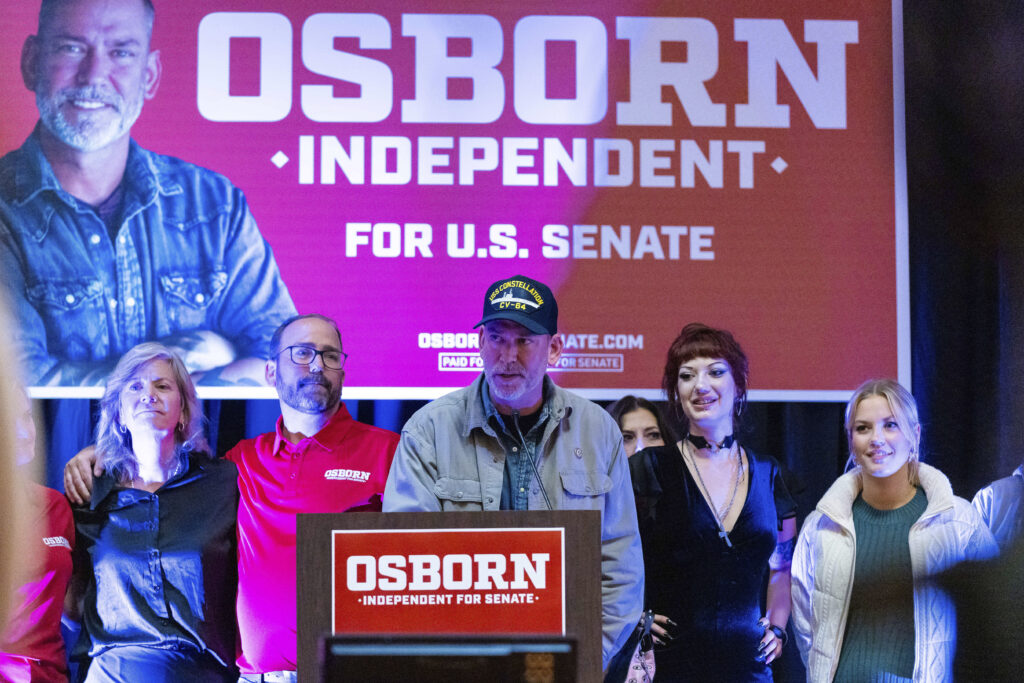
In Nebraska, independent Dan Osborn, who two years ago unexpectedly held Sen. Deb Fischer (R) to just a seven-percentage-point win (Donald Trump carried the state by 20 points), is back to challenge Republican Sen. Pete Ricketts. In Montana, independent Seth Bodnar, a former University of Montana president, is seeking to succeed outgoing GOP senator Steve Daines. Kurt Alme, a former U.S. attorney for the state, is the Republican nominee.
The idea animating both independent efforts is that an outsider candidate unburdened by the Democratic label can win over far more independents and weakly affiliated Republicans than a more conventional Democrat ever could. The theory seems sound, but in practice it runs into two significant obstacles.
First, it relies on the Democratic Party getting out of the way, since even a token candidate would siphon away crucial votes. Osborn has the one-on-one race he wants, since the Democratic Senate nominee in Nebraska, Cindy Burbank, has withdrawn. But Bodnar is still working to clear his path, which is blocked by Democratic nominee Alani Bankhead. Unlike Burbank, Bankheadinsists she’s in the race to stay and in fact has called on Bodnar to quit. That’s laughable; Bankhead has raised under $60,000 to Bodnar’s $3.2 million. This game of political chicken can continue until Aug. 10, the deadline for Bankhead to withdraw.
Second, it might not matter in the end, because history shows that even independent candidates who have gotten the one-on-one race they need have fallen far short.
Of three similar I vs. R Senate races in the past 12 years, Osborn’s 2024 campaign came closest to winning. Kansas independent Greg Orman lost by 10 points in 2014, and Utah independent Evan McMullin was beaten by 10 points in 2022. Each candidate probably did better than a Democrat would have, it’s true — but double-digit defeats are not close contests. (I’m not including independent Vermont Sen. Bernie Sanders and Maine Sen. Angus King because they serve in blue states.)
What about those tantalizing polls? Backers of Osborn and Bodnar can point to recent surveys showing that they are running close to their GOP foes, with one poll for each showing them even or ahead. But history is clarifying here, too. Polls in those earlier races suggested the contests were tighter than they turned out to be. In 2014, Kansas polls had Orman narrowly ahead on election eve, but he was thumped by Sen. Pat Roberts (R). In a July 2022 poll, McMullin was behind by only five points before GOP Sen. Mike Lee consolidated the GOP vote. Fischer outpaced late polling somewhat as well.
Montana’s 2020 Senate contest is also instructive. Popular multiterm governor Steve Bullock — a very strong candidate — was the Democrats’ nominee against Daines that year, and the final polls showed Daines either behind or with a small lead within the margin of error. Once again, the Republican significantly outpaced the polls.
It’s possible that these states’ demographic makeups are leading to polling errors. Each has large numbers of White voters without college degrees, and during the Trump era national polling has been hampered by difficulty reaching this group. Other states with large shares of these voters, such as Iowa, Kentucky and Maine, have seen polling errors of up to 14 points since Trump brought his powerful reality-distortion field to U.S. politics.
One more data point: The RealClearPolitics generic congressional ballot polling average also shows that Republicans have improved their standing between July 22 and the Election Day results in five of the past six elections.
Well, could this year be different? It’s true that those prior I vs. R contests all occurred in generally Republican years. The wind is clearly at the Democrats’ backs this cycle (although that could change). Osborn and Bodnar both appear to be talented candidates. In politics as in investing, past performance does not guarantee future results.
But the kind of independent-in-Democratic-clothing breakthrough being attempted here relies on everything going perfectly. Sometimes that happens! But not usually. In our hyper-partisan age, it strains credulity to think that Republican-leaning voters in solidly Republican states will desert their party in an hour of need.
The good news for Democrats is that they still have a path to Senate control without these races. They could hold all of their current seats, gain the Maine and North Carolina seats, and ride a combination of a strong year and strong candidates to victory in two out of four of Texas, Ohio, Iowa and Alaska. But adding Nebraska or Montana to that list would be putting hope before experience, never a good idea in politics, or love.


Gen Z-ers Are Ditching Sex. They Might Be On to Something.

Transfer: Arsenal prioritise deal for Yan Diomande, target four other stars

U.S. indicts Okeoghene Udugba for money laundering, defrauding FWS

Police top list as ICPC uncovers 908 fake workers across federal MDAs

Glen Powell and Richard Linklater Reteam for Lou Gehrig Biopic at Universal

Senate seeks to regulate foreign donations, data base on aid

Moment man challenged his landlady for asking for rent despite heavy flooding in her compound (video)

 Society2 days ago
Pepper Seller Caught On Camera Applying Pepper On Newborn Baby As Rituals To Usher Her Into The Business
- Society3 days ago
2026 Ballon d’Or: Top 4 players to win award after World Cup final revealed
- Investigation1 day ago
65-year-old married female teacher blindfolded and tied 10-year-old schoolboy to bed before having s3x with him
- World3 days ago
Spain earns $51 million for World Cup win and runner-up Argentina gets $34 million as total payout for all 48 teams hits record-high $871 million
- Investigation1 day ago
"I ‘m fine and healthy" – Video of late Mary Habila debunking her d3ath rumours 3 days before she d!ed at Umahi’s residence
- Investigation1 day ago
âBusinesses are dy!ng in South Africa. Nobody is making money – South African man decries low patronage days after anti-immigrant protest
- Investigation2 days ago
âResurrection of the Christâ writer reveals actor Mel Gibsonâs dark spiritual warning about âPassionâ sequel
- Investigation3 days ago
Choirmaster sentenced to 25 years imprisonment for r@ping 16-year-old girl during âdeliveranceâ in Anambra