World
Did the Cyclospora Outbreak Start Here? ‘They’re Always Going to Blame Us’

This Video Is Trending Right Now
When Carmen Ramírez learned that a parasite was turning Americans’ bowels into gurgling time bombs — and that the outbreak had been traced to Guanajuato, her home state in central Mexico — she could not help but giggle.
“I found it pretty funny,” Ms. Ramírez, 31, said while helping her father staff the counter at their family-owned grocery store in Doctor Mora, a quiet agricultural town of about 30,000 people.
“Now we’re mostly known because of the diarrhea in the U.S.,” she said.
But she grew concerned when she saw that health officials said they had traced cases of tainted iceberg lettuce back to her hometown — specifically, to a shredding facility owned by Taylor Farms, a producer of vegetables and salad kits that has become a household name in the area. The California-based company is known for being the region’s most important employer, including for young adults and single mothers.
Even the hint that cyclospora — the parasite behind the outbreak that has taken over the news and inspired memes and songs — may be linked to Taylor Farms could jeopardize the livelihoods of company employees, lettuce growers, market vendors and their families.
“This could hit us pretty hard,” Ms. Ramírez said.
On Sunday, Taylor Farms announced that the Food and Drug Administration had apologized after a test for cyclospora turned out to be a false positive. The F.D.A. denied having offered an apology and said that the false positive did not change the “overwhelming epidemiological data” driving its inquiry into Taylor Farms.
“F.D.A.’s traceback investigation and outbreak data continue to converge on shredded iceberg lettuce from Taylor Farms locations in central Mexico,” the agency said.
Taylor Farms has removed all iceberg lettuce sourced from Guanajuato from the U.S. market as grocers and retailers pull its products from shelves.
While health officials in the United States have reported more than 11,000 confirmed and suspected cases of the illness, the Mexican health authorities on Tuesday ruled out an outbreak in their country, indicating that only three cases have been detected.
The illness caused by the parasite is marked by violent cramps, unrelenting nausea and, in many cases, sudden, urgent bursts of diarrhea.
“You’re barely able to make it to the toilet,” said Alejandro Macías, an epidemiologist and physician at the University of Guanajuato.
Dr. Macías agreed that not enough cases have been detected in Mexico to declare an outbreak, but noted that cyclosporiasis is not an infection regularly tracked by the country’s health officials. No deaths have been documented in either country.
Several residents in Guanajuato — Mexico’s undisputed lettuce powerhouse, which sends much of its harvest to the United States — insisted they had not fallen ill. Mexican stomachs, they joked, are simply built stronger than American ones.
“I’m going to keep eating lettuce as usual,” said Germán Buenrostro, 20, a student in San José Iturbide, a city of about 90,000 near the Taylor Farms facility. “If I end up with explosive diarrhea, at least I’ll lose some weight. Saves me a trip to the gym.”
Some were skeptical about the findings announced by U.S. officials.
“They’re always going to blame us Mexicans,” said Renato Ferro Mendoza, 44, as he stacked heads of lettuce at his market stall. “You can’t trust anything Americans say.”
This is not the first time the company or its processing facility in Guanajuato, which sources from many farms in the region, have been the focus of F.D.A. investigations.
Following a cyclospora outbreak in 2013 that sickened more than 600 people in the United States, officials identified the culprit: a bagged salad mix packed at the Taylor Farms processing plant in central Mexico. The investigation, however, failed to pinpoint the exact place, water source or person that enabled the parasite to enter the supply chain. Taylor Farms resumed operations at its Mexican processing facilities shortly after.
The current cyclospora cases in the United States have set off fears of changes in trade policy that could ripple through the local economy in Mexico.
“These issues can really affect our town, our quality of life, what little business we have, and our few sources of income,” the mayor of Doctor Mora, Edgar Javier Reséndiz Jacobo, said in an interview. “Imagine all that production from local growers just sitting idle, with them having no clue what to do with it. And the people working on those processing lines — what becomes of them now? That’s the real concern.”
The outbreak comes at a sensitive time for trade relations between the United States and Mexico.
The two countries will continue talks this week to review their trilateral trade agreement with Canada — which on Monday was slapped with punishing new U.S. tariffs on many of its exports. Mexico is also dealing with its own set of tariffs and levies imposed by the Trump administration, including a 17 percent duty on most of its tomatoes.
“It’s going to get ugly,” Héctor Enrique López Espitia, an agronomist in Guanajuato, said about the investigation into Taylor Farms and Mexico’s lettuce. “What’s Trump going to say about this? They’re going to roll out a mountain of new rules to shield the U.S. market and completely screw over Mexican trade.”
On Tuesday, Mexico’s health minister, David Kershenobich, said at a news conference that the health authorities had collected several samples from farms in Guanajuato and were testing them for cyclospora.
“So far, no evidence has been found that would allow us to conclude that it originated there,” he told reporters. “However, we are taking every precaution in the event that it did.”
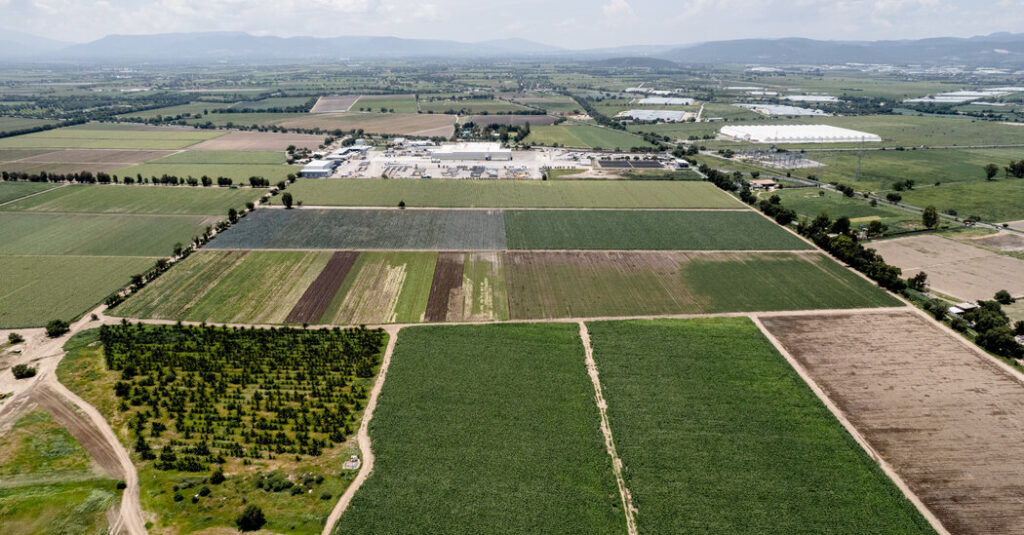
A spokeswoman for Taylor Farms, Mindi Mayhew, did not respond to specific questions. New York Times journalists went to the company’s processing plant in Doctor Mora — a sprawling complex surrounded by towering fences, vast vegetable fields and sparse nurseries — but were refused entry and were told to communicate with Ms. Mayhew.
At the entrance on Monday, a visitors’ log showed that inspectors from Cofepris, Mexico’s federal health regulatory agency, were touring the facility.
At a nearby market in San José Iturbide, Silvia Soto washed shredded lettuce before assembling tortas for a line of hungry breakfast customers.
“The product is supposed to get tested before export, so whether it was a mistake or whatever happened, that’s an investigation best left to the experts,” Ms. Soto, 29, said when asked about the cyclospora outbreak. “But sheesh, it definitely hurts us because people start second-guessing the food with all the buzz the story is making.”
Miguel García Lemus contributed reporting from Celaya, Guanajuato, and David Shortell from Mexico City.


Senate moves against MDAs for shunning finance committee’s investigative hearings

Police Recover Stolen Toyota Hilux, Arrest Two Suspected Vehicle Thieves in Plateau

Married woman humiliated after allegedly being caught cheating on her husband with another man in Kogi community

‘Words in their dead mouths’: Rage mounts as Trump accused of exploiting fallen soldiers

Model recruiter who introduced young women to Jeffrey Epstein found dead in France
Model recruiter who introduced young women to Jeffrey Epstein found dead in France

Davido’s Sister Sharon Adeleke Urges Celebrities to Embrace Repeating Outfits

 Society2 days ago
Pepper Seller Caught On Camera Applying Pepper On Newborn Baby As Rituals To Usher Her Into The Business
- Society2 days ago
2026 Ballon d’Or: Top 4 players to win award after World Cup final revealed
- Investigation1 day ago
65-year-old married female teacher blindfolded and tied 10-year-old schoolboy to bed before having s3x with him
- World3 days ago
Spain earns $51 million for World Cup win and runner-up Argentina gets $34 million as total payout for all 48 teams hits record-high $871 million
- Investigation1 day ago
"I ‘m fine and healthy" – Video of late Mary Habila debunking her d3ath rumours 3 days before she d!ed at Umahi’s residence
- Investigation24 hours ago
âBusinesses are dy!ng in South Africa. Nobody is making money – South African man decries low patronage days after anti-immigrant protest
- Investigation2 days ago
âResurrection of the Christâ writer reveals actor Mel Gibsonâs dark spiritual warning about âPassionâ sequel
- Investigation3 days ago
Choirmaster sentenced to 25 years imprisonment for r@ping 16-year-old girl during âdeliveranceâ in Anambra