News
Reps Halt Edible Oil Ban Bill After Heated Debate Over Health and Livelihood Concerns

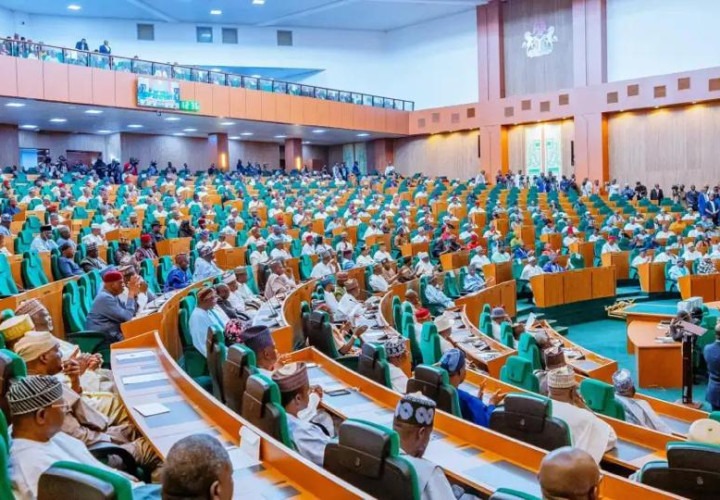
(House of Representatives. Photo Credit: Punch News)
A bill intended to outlaw the manufacture, importation, distribution, sale, and consumption of unbranded and unfortified edible oils in Nigeria was withdrawn by the House of Representatives on Wednesday after much discussion among lawmakers regarding the bill’s possible effects on public health, current legal frameworks, and rural livelihoods.
The proposed legislation, which was sponsored by Chike Okafor, the member representing Imo State’s Ehime/Mbano/Ihitte Uboma/Obowo Federal Constituency, was brought up for second reading during plenary but was postponed after members voiced concerns about the bill’s provisions and the insufficient distribution of copies.
Okafor, who led the discussion, stated that the law was intended to address the increasing threats to public health posed by the nation’s pervasive use of unbranded and unfortified cooking oils.
According to the figures that are currently available, just 31% of edible oils in circulation in Nigeria are fortified, although over 67% of Nigerians use unbranded edible oils.
The congressman said that food fortification is still “a proven, cost-effective strategy to address micronutrient deficiencies and improve public health,” citing a World Health Organization (WHO) report.
He claims that “the bill requires cooperation between research institutes, universities, and state ministries to improve seedlings and establish cooking oil processing mills through public-private partnerships, while also prohibiting the production, importation, distribution, and sale of unfortified and unbranded edible oils.”
Okafor clarified that despite allowing a transitional period for current producers, the proposed legislation also imposes penalties, including jail time for violators and businesses to comply with the new requirements.
“This is a life-or-death situation. It’s an appeal to safeguard Nigerians’ health,” he stated.
But during the debate, resistance to the bill surfaced, with some MPs cautioning that its implementation could negatively impact thousands of small-scale producers, especially in rural areas where locally processed palm oil is a significant source of revenue.
Paschal Agbodike, the representative for Anambra State’s Ihiala Federal Constituency, encouraged the House to proceed cautiously, claiming that the measure may jeopardize the livelihoods of regional palm oil growers.
“This bill is unacceptable. A large number of my people work in the local palm oil industry.
The livelihood of those who live in rural areas, like my people, is crucial, so we need to be cautious when drafting laws,” he stated.
Gaza Gbefwi, the member representing Nasarawa State’s Karu/Keffi/Kokona Federal Constituency, also opposed the measure, claiming that the National Agency for Food and Drug Administration and Control already has the legal authority to control edible oils and other food items.
“I don’t think excessive legislation is necessary. We should improve current regulations and oversight rather than attempting to do more.
The Nigerian Standards Organization and NAFDAC are already in place. We can request modifications to the Acts creating these agencies if they include any gaps,” he stated.
Wale Raji, the member for Lagos State’s Epe Federal Constituency, agreed with him and warned against what he called the needless proliferation of legislation.
“NAFDAC is already regulating food and drugs,” he said. Since NAFDAC’s mandate already addresses the goals of this bill, let’s examine the legislation that established it.
Sada Soli, the member for Katsina State’s Jibia/Kaita Federal Constituency, supported the proposed legislation, arguing that it enhances rather than replaces NAFDAC’s duties.
The bill takes NAFDAC into consideration. The goal of this act is to enhance an already-existing structure, which is beneficial.
“Local palm oil production is not opposed by this bill,” he stated.
Billy Osawaru, the member for Edo State’s Orhionmwon/Uhunmwonde Federal Constituency, said during the discussion that many members had not gotten copies of the bill, making it challenging for them to contribute intelligently.
He maintained that without first reviewing the legislation’s specific provisions, legislators could not engage in serious debate.
After the interventions, Okafor asked Benjamin Kalu, the Deputy Speaker who oversaw the session, to postpone the bill to another legislative day so that it could be circulated more widely and members’ concerns could be addressed through more consultations.
The request was granted by the Deputy Speaker.
Concerns about food safety and nutrition in Nigeria are developing at the time of the proposed legislation.
To prevent nutritional deficits, especially in children and pregnant women, health professionals have long recommended fortifying staple foods, including edible oils, with vital micronutrients like vitamin A.
While NAFDAC and the Standards Organization of Nigeria are in charge of regulating food quality, safety standards, and compliance, Nigeria currently runs mandated food fortification programs for specific food products.
However, the proliferation of unbranded and improperly processed edible oils, particularly in open markets, has continued to spark discussion about the necessity of stricter enforcement and the efficacy of current regulations.






Israeli Banks Threaten to Cut Off Palestinian Economy, Deepening Crisis

2,000 volunteers join a painstaking effort to restore massive skeleton of prehistoric predator

Spain’s World Cup winner Gavi says he does not want Argentina players suspended after he was attacked

A top White House official is escalating the fight over Moonshot AI’s viral Kimi K3 model

I Used Puma Drink And Salt To Abort My First Child — JHS Student Boldy Says

Trump commends Tinubu days after Atiku lobbyist’s petition against him

13-Year-Old Arraigned In Lagos Over Alleged Sexual Harassment

 Society2 days ago
Pepper Seller Caught On Camera Applying Pepper On Newborn Baby As Rituals To Usher Her Into The Business
- Society3 days ago
2026 Ballon d’Or: Top 4 players to win award after World Cup final revealed
- Investigation1 day ago
65-year-old married female teacher blindfolded and tied 10-year-old schoolboy to bed before having s3x with him
- World3 days ago
Spain earns $51 million for World Cup win and runner-up Argentina gets $34 million as total payout for all 48 teams hits record-high $871 million
- Investigation1 day ago
"I ‘m fine and healthy" – Video of late Mary Habila debunking her d3ath rumours 3 days before she d!ed at Umahi’s residence
- Investigation1 day ago
âBusinesses are dy!ng in South Africa. Nobody is making money – South African man decries low patronage days after anti-immigrant protest
- Investigation2 days ago
âResurrection of the Christâ writer reveals actor Mel Gibsonâs dark spiritual warning about âPassionâ sequel
- Investigation3 days ago
Choirmaster sentenced to 25 years imprisonment for r@ping 16-year-old girl during âdeliveranceâ in Anambra