World
In Area Hit by Blaze, French Officials Failed to Enforce Wildfire Rules

This Video Is Trending Right Now
After fires tore through forests outside Bordeaux in 2022, President Emmanuel Macron of France called on rural villages to finally implement long-ignored forestry rules meant to prevent such a vast blaze in the future.
Among other requirements, residents in that region were instructed to clear all bushes and prune low-hanging tree branches within 50 meters, or roughly 54 yards, of their homes, making it harder for fires to reach the villages. Mayors were meant to issue fines of roughly $860 to those who didn’t comply.
Four years to the month later, officials have rarely ensured that residents adhere to those rules in the forests west of Bordeaux, according to the president of a union of regional forest owners, four local mayors, two experts and a New York Times analysis of satellite imagery of 23 evacuated villages. Many residents did not clear vegetation near their homes because they could not afford the high annual cost and because they did not own the land where the brush was growing, according to the mayors.
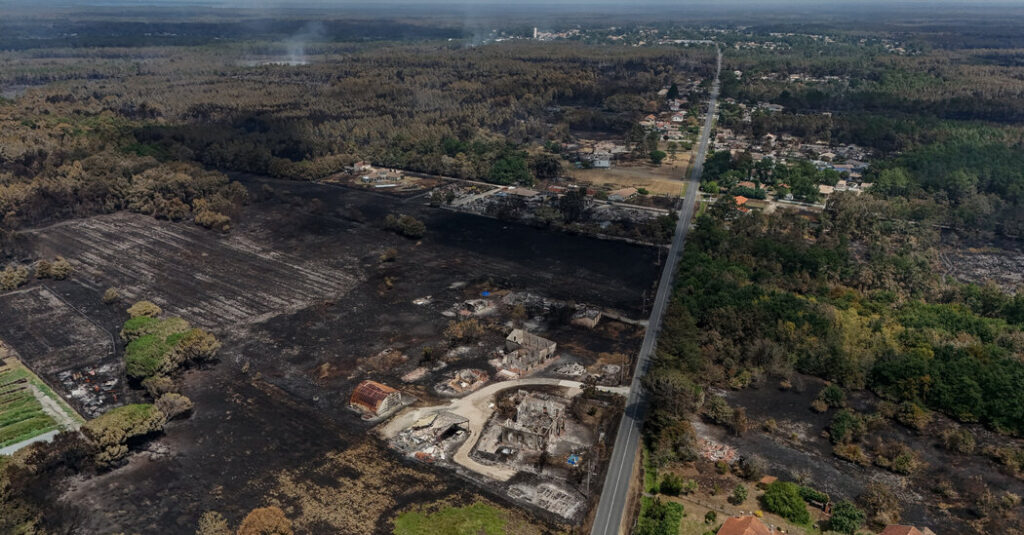
The experts said that lapse may be among the reasons that another fire tore so easily through villages in the region this month, spurring the largest peacetime evacuation in French history. The fire, France’s biggest in decades, burned more than 42,000 hectares and destroyed at least 240 houses.
Prosecutors said the fire’s initial spark came from a brush-clearing machine, used by contractors for an electricity company near a high-voltage power line on the outskirts of one town, Saumos. The authorities have announced no firm conclusions about why the fire then spread so fast, and their investigations are likely to take months.
In general, such fires are occurring more often and becoming more intense, scientists say, because the burning of fossil fuels has made hotter temperatures more likely. In turn, that dries out the landscape, making it easier for fires to spread. For the first time in France, this fire became so hot that it created a rare weather phenomenon known as a fire cloud, which made the blaze even harder to contain, officials said.
In this case, The New York Times found that flawed landscape and forest management in the Bordeaux region likely added to the risks. Those flaws included:
Across the 23 towns evacuated during the fire, scores of homes had vegetation close to houses, The Times found.
Firefighters sent to quell the blaze have found themselves battling fires in vegetation that had been allowed to grow next to buildings, according to the national firefighters’ union.
Nationally, more than 60 percent of French properties don’t comply with the state regulations, according to Christophe Chantepy, a fire expert at the National Forests Office, citing visits that officials make to roughly 10,000 properties each year.
“There were very few actual changes made after 2022,” said Arthur Guérin-Turcq, an academic at the Sorbonne University, who wrote his doctoral thesis on the aftermath of the 2022 fires and grew up in the area. His relatives fled their cottage after the fire broke out about nine miles away.
“There were no new fuel breaks or land management adjustments, and very few new firebreaks were created,” he said. After 2022, he added, “We basically went right back to business as usual.”
‘We All Fell a Bit Short’
The forest west of Bordeaux, called Landes de Gascogne, sprawls across roughly three million acres, filling the southwest corner of France. It was planted in the 1850s after Napoleon III ordered regional swamps drained and pines seeded, for both his government and private landowners to use. Since then, it’s become Europe’s largest commercial forest, with tens of thousands of landowners harvesting the pines for paper, cardboard and wood.
In 2022, fires broke out in two places in the forest, burning through 80,000 acres. That disaster caused the government to adapt its firefighting strategy for the climate-change era and double down on its brush-clearing regulations.
But few have been enforced.
Bruno Lafon, the mayor of Biganos, a town roughly 12 miles south of where this summer’s fire started, estimated that only 20 percent of residents with land abutting the forest had followed the rules, despite his repeated messages and annual meetings about them.
In the nearby town of Lanton, where 15 homes burned down this week, Mayor Loïc Ballongue estimated the rate was between 10 to 20 percent.
“I think we all fell a bit short,” Mr. Ballongue said.
Many firefighters, trying to stop fires reaching such villages, were frustrated to find uncleared brush ablaze right next to homes, said Éric Brocardi, a veteran firefighter and spokesman for the national union, who spent two days meeting with firefighters on the ground.
“We’re putting firefighters in harm’s way because there are houses that need defending but haven’t taken steps to make themselves defendable,” he said. “Honestly we’re even asking ourselves if, in the future, firefighters are going to put their lives on the line for houses that haven’t followed legal brush-clearing rules?”
Some mayors say it’s unfair to blame homeowners for the lack of enforcement, since residents often don’t own the land that they’re expected to clear. More than 90 percent of the forests are owned privately, by 150,000 small and big landowners, according to Stéphane Latour, the regional director of a state-funded forestry agency.
Cost is also an issue. Some villagers can’t afford the price of clearing brush, which can cost thousands of euros and needs to be repeated annually.
“For the average person, it is incomprehensible,” Mr. Ballongue said.
Mr. Lafon, the mayor of Biganos, said he had pushed unsuccessfully “for a tax exemption or financial contribution to incentivize people to do this work.”
“If we don’t have that, we’re never going to get there,” he added.
Olivier Halard, the mayor of another town damaged by the fire, Le Temple, said the regulations were too weak and that the state should organize the clearance of all trees and brush within at least 50 meters of homes.
Still, Mr. Chantepy, the fire expert, said it makes sense to expect homeowners to pay for the tree felling instead of forest owners, because the houses were often built long after the forest was seeded.
“The forest owner didn’t ask for a house to be built next to his forest,” he said. Plus, it was in the homeowner’s interest to follow the law, he said. In 90 percent of post-fire inspections in the past two decades, forestry agents find that the areas around burned houses were not properly cleared.
‘Can We Do Something Other Than Forestry?’
According to some experts, the installation of more buffer zones near villages would only have achieved so much. Just as problematic was the failure to erect more firebreaks in areas of the vast forest that are far from human habitation.
Bad storms in 1999 and 2009 destroyed large plantation blocks in the forest, leading foresters to fill the gaps by planting many new pines.
That created large, contiguous blocks of trees of the same age and size — without open spaces and breaks in the landscape that help prevent fire from spreading, according to a 2023 report from France’s top auditing institution.
“It’s truly as if they were matches stuck in the ground, and as soon as the fire hits the bottom, it climbs right up to the top,” Mr. Guérin-Turcq said.
After the 2022 fires, Mr. Macron said that more fire breaks should be built inside the forest, “especially when fire is a risk — which is to say, almost everywhere.”
That, experts, landowners and mayors said, has not happened.
For example, between Saumos, where the fire started, and Le Porge, where 185 houses burned in recent days, “There were no adequate firebreaks to slow down the fire,” Mr. Guérin-Turcq said.
According to Mr. Lafon, the process has been hampered by administrative roadblocks, objections from environmentalists and forest owners themselves, who are loath to give up part of their plantations for no return.
Even during the current fires, the local authorities took two days to approve the cutting of a new network of firebreaks, according to Mr. Lafon. The local prefecture did not respond to requests for comment.
Once permission was granted, Mr. Lafon’s regional fire prevention association was able to cut 79 miles of new tracks, each more than 55 yards wide, in little more than two recent days, he said.
Still, single firebreaks can only do so much against a fire of this intensity. Christopher Maya-Torrico, a local farmer with a plot that is 90 meters wide, said the fire simply jumped over it.
The longer-term solution, experts like Mr. Guérin-Turcq said, is to break up the forest with different kinds of land use.
“The real question is: Can we do something other than forestry in the Landes forest? Couldn’t we also bring in more agriculture or pastoral farming?” he said. “We need to step away from monoculture to better protect the forest. And that is the crux of the problem.”
Giulia Imbert contributed reporting from Paris and Jason Horowitz from Madrid.


Tyla Removes Lagos from World Tour Schedule Over Xenophobic Attacks

Fortnite Ironmouse Sprite Release Date Confirmed After Being Vaulted

Chairman Wontumi Escorted From Court After Request for More Time by New Lawyer

Niger: Police smash kidnap ring, recover 10 AK-47 rifles

UNILORIN announces Post-UTME dates for 2026/2027 admission

Previously convicted Nigerian felon pleads guilty to illegal possession of Glock 19 pistol with 17-round magazine in US

Peter Obi Slams Tinubu Over Hunger Comments Amid Rising Economic Hardship

 Investigation3 days ago
Missing his wedding sends the wrong message that success makes you forget the people who helped you rise- Delta state govâs aide berates Davido for failing to attend Sosoâs wedding
- Investigation3 days ago
âNothing we can doâ- INEC rules out extension of voter registration
- News3 days ago
Retired AIG, Senior Police Officer Die Days Apart
- News3 days ago
Makinde Begins ₦3 Billion Gratuity Payment to Oyo Retirees
- Breaking3 days ago
ââDo not shake hands”- UNILAG shares anti-r@pe advisories to female students
- World2 days ago
My daughter’s squishy toy burst on her legs. We ended up in the emergency room.
- World3 days ago
‘Forgotten’ Wolfenstein Game Could Soon Get a Remaster
- Investigation3 days ago
Footballer Mauro Icardi releases statement overâ outrageousâ demands from ex-wife Wanda Nara amid divorce battle