World
John Pardon Untangles the Theoretical Loops

This Video Is Trending Right Now
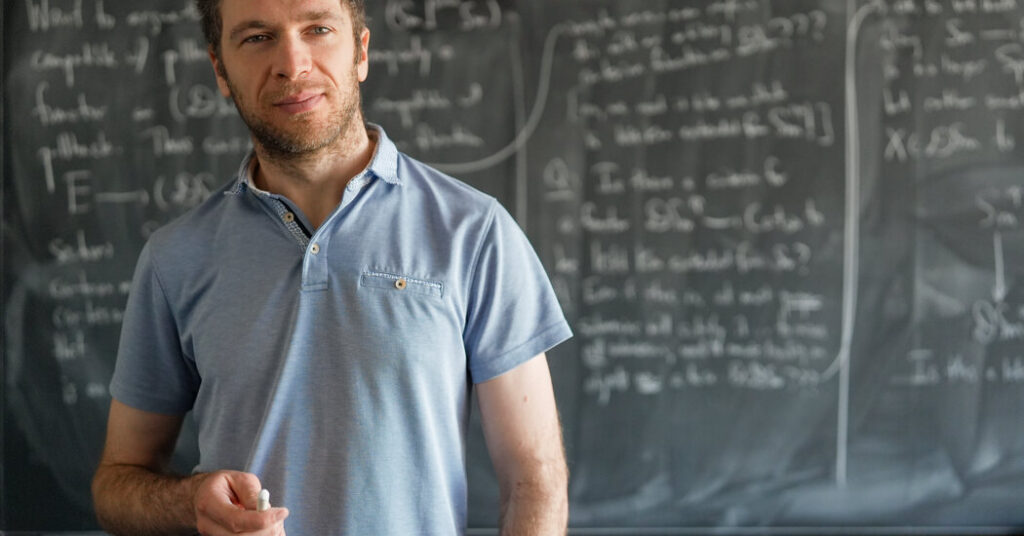
John Pardon is a recipient of a Fields Medal, awarded to the top mathematicians under the age of 40. But he started at a much younger age. He published his first math research paper while he was in high school in North Carolina.
“My dad suggested I do a research project to submit to the Intel Science Talent Search,” Dr. Pardon, 37, said in an interview when he joined the faculty of Stony Brook University in 2022. “I find it easier to think visually and spatially, so geometry and topology come much more naturally to me, and I eventually settled on a very concrete geometry question.”
While he was an undergraduate student at Princeton University, he published more mathematical papers, including his first major result, which answered a question that Mikhael Gromov, a prominent Russian-French mathematician, had asked in 1983.
That problem was also geometric in nature and involved knots. For mathematicians, a knot can be thought of as a loop of rope that cannot be untangled without cutting the rope.
In essence, Dr. Gromov wondered whether all loops, no matter how tangled, could fit within a certain measure of how bendy the loop was. Dr. Pardon proved that they could not.
Math was not the only difficult class he took in college. He also became fluent in Mandarin Chinese.
“I was signing up for classes as a freshman in college, and I heard Chinese was pretty difficult, so I wanted a challenge,” Dr. Pardon said in a video shown on Thursday during the presentation of the Fields Medals.
The video shows him quizzing his sons, Alexandros and Andreas, on identifying Chinese characters plastered on their bedroom wall. “I talk to them in Chinese a lot,” he said. “We learn the characters. I read to them. I make them read to me.”
Once, he recalled, Alexandros turned to Andreas and asked whether their father was born in China.
Yakov Eliashberg, who was Dr. Pardon’s adviser when he was a doctoral student at Stanford University, said Dr. Pardon’s greatest achievement was not in proving any particular theorem. Rather, Dr. Eliashberg said, great scholars are those who figure out the mathematical landscape underpinning the problem.
“That’s his power,” Dr. Eliashberg said. “That’s what he was able to demonstrate again and again in different situations.”


TikTok removes 4.8m violative videos in Nigeria in Q2 2026

John Cena said his fitness routine at 49 includes something he hates

Father Sentenced To Life For R@ping And K!lling Son’s Friend During Sleepover

Oil activities are threatening livelihoods in Bayelsa – Traditional Leader

Former Kenyan governor and two co-accused convicted of his pregnant girlfriend’s murder

Education Dept. eliminates tool used to prove racial discrimination

Kenya Mandates One-Year Warranties and Return Policies for Electronic Devices

 Investigation2 days ago
65-year-old married female teacher blindfolded and tied 10-year-old schoolboy to bed before having s3x with him
- Investigation2 days ago
âBusinesses are dy!ng in South Africa. Nobody is making money – South African man decries low patronage days after anti-immigrant protest
- Investigation2 days ago
"I ‘m fine and healthy" – Video of late Mary Habila debunking her d3ath rumours 3 days before she d!ed at Umahi’s residence
- World3 days ago
Trump Is Caught in the Trap He Set
- Investigation3 days ago
âTimi Dakolo, youâve proven you lack integrityâ â DJ Timmy intensifies criticism of singer amid contract dispute
- Investigation3 days ago
FIFA President Gianni Infantino presents Spanish players with their FIFA World Cup winnersâ rings (Video)
- National2 days ago
CBN opened domiciliary accounts for Gbajabiamila-linked PFIPC on accountant-general’s order before N400 million bribe probe: Cardoso
- National2 days ago
INEC Officials Accused of Demanding ₦2,000 for PVCs in Onitsha [VIDEO]