National
South East governors to support Tinubu in 2027 — Uzodimma

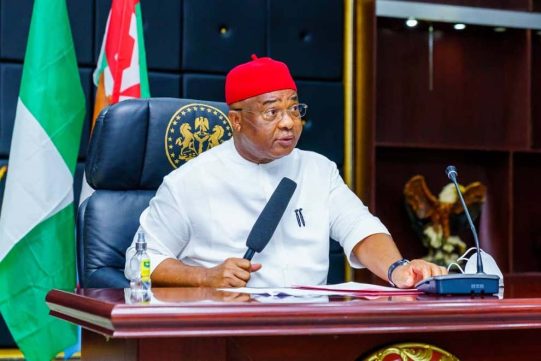
In appreciation of his developmental initiatives in the five South East states, the governors have resolved to fully support the re-election of President Bola Ahmed Tinubu, says the Imo State Governor, Senator Hope Uzodimma.
Although the governors belong to three separate political parties, their resolve is based on the fact that no president since 1999 has addressed the welfare of Ndigbo more than Tinubu.
Uzodimma announced this in Owerri, the Imo State capital, at a meeting with traditional rulers and members of the State Elders Council.
He said contrary to the grandstanding of some enemies of Ndigbo, the people are fully aware that Tinubu serves their best interests and would therefore repay his magnanimity in 2027.
The Chairman of the South East Governors Forum and Progressive Governors Forum cautioned politicians against the use of Igbo platforms to canvass propaganda that has no factual basis.
He declared: “The Igbos are too discerning and too results-driven to trade tangible infrastructure for political speeches.
“The South-East will stand with the Tinubu administration that has favoured them.”
Uzodimma said the governors had reviewed the performance of the Tinubu administration as it affects the development of the South East and unanimously agreed that the region would continue to identify with the President and the Renewed Hope Agenda because of the tangible dividends already delivered.
The Governor said the South East could no longer be swayed by political rhetoric when the evidence of federal intervention across the zone was visible.
He said: “We, the five governors of the South East have reviewed all options and decided that we will work with President Bola Tinubu because we want to be part of Project Nigeria.”
He added that the governors would soon pay a joint courtesy visit to President Tinubu to further strengthen their partnership with the Federal Government.
According to him, the decision was informed by the administration’s record of addressing long-standing developmental concerns in the South East, including the establishment of the South-East Development Commission (SEDC), a demand that had remained unmet since the end of the civil war.
The Governor noted that President Tinubu signed the South East Development Commission Act into law on July 24, 2024, inaugurated its governing board in February 2025, and ensured that the commission commenced operations with funding.
He also highlighted the rehabilitation and commencement of commercial operations on the Port Harcourt-Aba rail line, describing it as the first practical step towards reconnecting the South-East to the national rail network.
Uzodimma further praised the President’s approval of a $3 billion reconstruction of the Eastern Rail Corridor stretching from Port Harcourt through the South-East to Maiduguri, saying the project would significantly boost commerce and regional integration.
On road infrastructure, the governor commended the Federal Government for executing the Phase 2A and 2B access roads to the Second Niger Bridge, including the dual carriageway linking Umunya, Ogbunike, Ogidi, Nkpor and Asaba, with seven bridges along the corridor.
He also referenced the approval of the 108-kilometre Otuocha-Anam-Abaji Road and the 150-kilometre Oba-Nnewi-Uga-Ihube/Okigwe Junction Road, projects he said would strengthen economic connectivity between Anambra, Imo, Abia, and other parts of the country.
He argued that beyond projects specific to the South East, the region had equally benefited from national policies of the Tinubu administration, including increased allocations to states, student loan programmes, improved security efforts and fiscal reforms aimed at reducing the cost of doing business.
He said: “The South East has decided.
“Our people judge governments by performance and not by political sentiments.
“The evidence is on the ground.”
Turning to state matters, Uzodimma urged the Imo State Elders Council and traditional rulers to remain committed to the implementation of the state’s Charter of Equity, insisting that the law remained the foundation for lasting peace, justice and political stability in Imo.
He recalled that upon assuming office in 2020, he inherited a deeply divided state and initiated reforms aimed at restoring order, rebuilding trust and ensuring inclusiveness in governance.
According to him, the enactment of the Charter of Equity by the Imo State House of Assembly was designed to institutionalise fairness in the rotation of political power and guarantee that every part of the state had a sense of belonging.
“The Charter of Equity is real, and I need your mandate to implement it because that is what will bring lasting peace to Imo State,” he said.


Over 600 complaints received over human rights violations in Borno – NHRC

Oyo Governor Makinde Hands Over Power to Deputy, Gives Reason

Oloyede inaugurates N1bn JAMB mega CBT centre in Borno

FG Launches YOUTHCRED Loans for Young Entrepreneurs

Never-Before-Seen Pokémon Starters Found in Lost Diamond and Pearl Documentary

The real money behind football’s biggest prizes

Wike’s daughter bags law degree from UK university + Photos

 Investigation2 days ago
65-year-old married female teacher blindfolded and tied 10-year-old schoolboy to bed before having s3x with him
- Investigation2 days ago
âBusinesses are dy!ng in South Africa. Nobody is making money – South African man decries low patronage days after anti-immigrant protest
- Investigation2 days ago
"I ‘m fine and healthy" – Video of late Mary Habila debunking her d3ath rumours 3 days before she d!ed at Umahi’s residence
- World3 days ago
Trump Is Caught in the Trap He Set
- Investigation3 days ago
âTimi Dakolo, youâve proven you lack integrityâ â DJ Timmy intensifies criticism of singer amid contract dispute
 News3 days ago
Alleged fraud: Court grants ex-Warri refinery MD, Jimoh Yisawu ₦500m bail
- National2 days ago
CBN opened domiciliary accounts for Gbajabiamila-linked PFIPC on accountant-general’s order before N400 million bribe probe: Cardoso
- Investigation3 days ago
âIâm single and not going back anywhere! I do not live there anymore!â – Actress, Annie Macaulay continues to dismiss reports of being back with ex-husband, 2Face Idibia