Breaking
China’s imports from Nigeria rose by $2.3bn in 6 months — Envoy

Advertisement
Advertisement
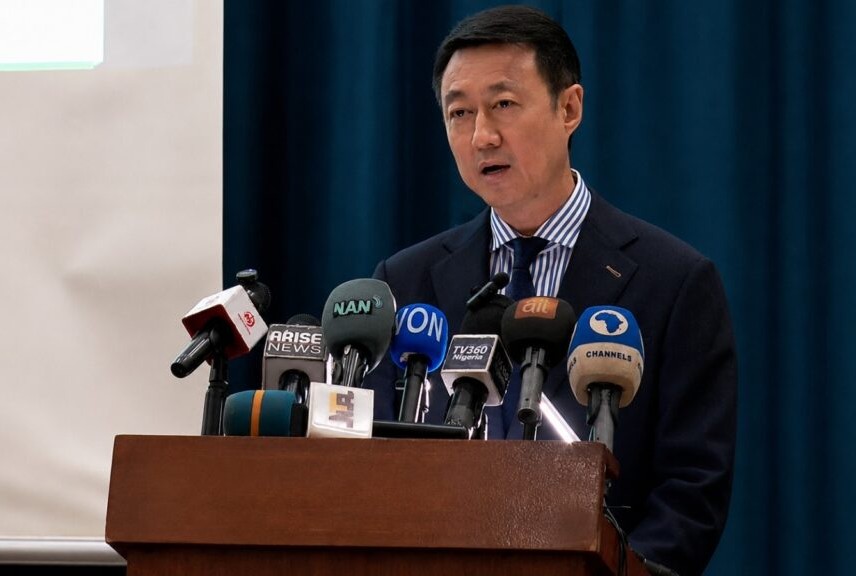
Chinese Ambassador to Nigeria, Yu Dunhai, says China’s imports from Nigeria rose by about 2.3 billion dollars in the first half of 2026, an increase of 80 per cent.
Yu disclosed this during an international seminar on “China’s Zero-Tariff Measures and Africa’s Economic Structural Transformation”, organised by the Centre for China Studies (CCS) on Friday in Abuja.
According to him, the surge follows the implementation of China’s zero-tariff policy for African countries.
The ambassador said Nigeria-China bilateral trade also reached 18 billion dollars within the same period, representing a 35 per cent year-on-year increase.
He said the figures demonstrated the immediate impact of China’s zero-tariff policy, which took effect on May 1 and covers all 53 African countries with diplomatic relations with China.
“Chinese imports from Nigeria surged 80 per cent to 2.3 billion dollars, with monthly growth exceeding 40 per cent in both May and June,” Yu said.
According to him, the policy has already contributed to an estimated six per cent increase in overall African exports to China.
He said China-Africa trade reached a historic 207 billion dollars in the first half of 2026.
According to him, Chinese imports from Africa rose to 29 billion dollars in May and June alone, representing a 24 per cent year-on-year increase.
Yu said the policy had reduced trading costs for Nigerian exporters, citing savings recorded on commodities such as sesame, cattle bone granules and liquefied propane.
“Every 100 tons of sesame exported saves 11,000 dollars in costs, while Nigeria’s annual export of 7,000 tons of cattle bone granules saves nearly 450,000 dollars,” he said.
He added that a single shipment of 23,000 tons of Nigerian liquefied propane attracted about 300,000 dollars in tax savings under the policy.
The envoy, however, noted that the removal of tariffs alone would not guarantee Nigeria’s economic transformation.
According to him, there is need for improved product quality, reliable supply chains and local processing.
He urged Nigerian businesses to increase investment in value addition and meet Chinese market standards to sustain access to the country’s 1.4 billion consumers.
Yu also called for stronger trade and investment cooperation, including industrial parks, technology transfer and training, saying China was ready to support Nigeria’s efforts to process raw materials locally.
“China aims to accelerate negotiations on trade facilitation, investment protection and quarantine standards to offer a stable institutional environment for investors,” he said.
He urged Nigerian exporters and small businesses to take advantage of platforms such as the China International Import Expo, Canton Fair and China-Africa Economic and Trade Expo to connect directly with Chinese buyers.
The Minister of Foreign Affairs, Amb. Bianca Ojukwu, said the zero-tariff policy was an opportunity to transform Nigeria from an exporter of raw materials into a producer of value-added goods.
“The objective should be to ensure that a greater proportion of the value generated from Africa’s resources remain within Africa,” the minister, represented by the ministry’s Permanent Secretary, Dunoma Ahmed, said.
Also speaking, the Minister of State for Agriculture and Food Security, Sen. Aliyu Abdullahi, said Nigeria must focus on exporting rather than merely exporting.
“The question before us is not, can Nigeria export more? The question should be, can Nigeria export better?” Abdullahi said.
He identified processed cassava, premium rice, spices, hibiscus, cashew products, soybean products, fruits and vegetables as areas with significant export potential.
Abdullahi also said that Nigeria must complement tariff-free access with modern processing industries, efficient logistics, quality assurance, traceability, storage infrastructure and export certification.
The Director of the Centre, Charles Onunaiju, said the seminar was designed to move discussions on China’s zero-tariff policy from policy announcements to practical implementation.
He said the policy represented an opportunity for Africa to address structural economic challenges, but warned that African countries must develop strategies to fully exploit market access.
Onunaiju said the African Continental Free Trade Area (AfCFTA) could play a critical role by harmonising standards, strengthening regional value chains and creating economies of scale for African exporters.
He said the seminar’s objective was to bring together critical stakeholders to identify practical solutions to challenges that could prevent African businesses from benefiting fully from the Chinese market.
Onunaiju urged African countries to treat the zero-tariff policy as “a starting point” for deeper industrialisation rather than an end in itself.
NAN reports that the seminar brought together government officials, farmers, manufacturers, exporters, traders and other stakeholders to examine how African economies could maximise the new market access.(NA

Aridin – Singer, Davido slams Omoyele Sowore for referring to his Uncle as a governor who has ânothing upstairsâ

Man allegedly beheads woman in Adamawa hotel

Reality TV star, Dabota Lawson reacts as Nigerians slam her after former friend Diiadem accused her of having "obvious admiration for Olori Atuwatse’s husband"

I left him to marry his mother – Nigerian woman opens up about her 7-year marriage to a "mummy’s boy"
Police dogs deployed to Osun ahead of state governorship election (video)

China’s imports from Nigeria rose by $2.3bn in 6 months — Envoy

Kebbi man arrested over alleged ritual desecration of Qurâan after burying it in pit with sâ¬men to make woman more submissive to her husband

 Investigation3 days ago
âThey are jealous of me because they cannot danceâ – Gov. Adeleke replies critics
 Investigation3 days ago
I donât t have money for a Jeep – Mother who gifted son a goat to celebrate his graduation speaks
- Investigation3 days ago
âTinubu practices Muslim-Christian ticket with First Lady in the other roomâ â Kwankwaso replies Sheikh Jingir
- Investigation3 days ago
Cristiano Ronaldo marries longtime partner Georgina RodrÃguez in âintimateâ wedding in Portugal (Photo)
- Investigation2 days ago
Osun Poll: Police, military, INEC donât belong to APC â Atiku
- Investigation3 days ago
OSUN 2026: âThe k!ll accord video posted by Davido is an AI videoâ – Senator Fadahunsi denies asking APC members to k!ll Accord members
- Investigation2 days ago
Osun Police summon APC senator, Fadahunsi over âk!ll Accordâ comment
- Investigation2 days ago
No Nigerian singer has more hits than me â Davido boasts