News
FG Set to Make Agricultural Training 80 Percent Practical


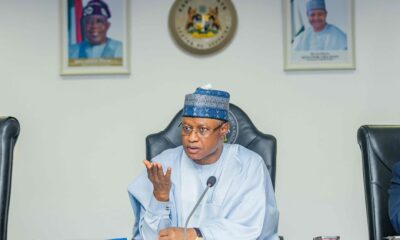
(Dr Tunji Alausa, Minister of Education. Photo by vanguard News)
The Federal Government has announced plans to restructure agricultural education across polytechnics and colleges of education, elevating practical training to 80 per cent of the curriculum.
The reform seeks to equip Nigerian youth with actionable skills enabling them to establish businesses and generate employment within the agricultural sector.
The Education Minister disclosed the initiative on Thursday whilst receiving the committee report responsible for implementing reviewed agricultural curricula.
The overhaul forms part of the current administration’s agenda to reposition agriculture from a predominantly theoretical academic discipline into a skills-centred sector capable of generating employment, improving productivity and creating economic prospects for young Nigerians.
The shift from a previous 70 per cent theoretical and 30 per cent practical framework to 80 per cent practical and 20 per cent theoretical represents a significant development in the government’s skills advancement strategy.
The reviewed curriculum ensures that graduates obtain not merely credentials but also functional competencies applicable immediately to farming, agricultural processing, agribusiness and other agricultural value-chain sectors.
The reform addresses the gap between classroom instruction and workplace requirements, promoting agriculture’s recognition as a productive, skills-centred industry rather than purely an academic field.
The reviewed curricula alongside developed national occupational standards would furnish Nigerian youth with technical proficiencies enabling meaningful participation in the agricultural economy and national contribution.
The minister cautioned that reform success depends on effective implementation, calling for extensive awareness activities targeting industry professionals, academics, educators and stakeholders.
He emphasised the necessity for adequate educator training and provision of appropriate facilities and institutional backing to permit polytechnics and colleges to deliver the practical-focused curriculum effectively.
The committee produced 36 new and reviewed National Diploma and Higher National Diploma curricula, three National Certificate in Education curricula and 31 national occupational standards.
Twenty-seven occupational standards were developed from inception, whilst four existing standards underwent review, expanding the national agricultural skills framework.
The ministry committed to continued collaboration with educational institutions, industry and stakeholders to translate the revised curricula from policy documents into classroom and training centre implementation throughout the country.
The government’s emphasis remains equipping youth with practical, market-relevant competencies, strengthening the agricultural workforce and converting the nation’s agricultural capabilities into productive economic opportunities.







Cleric shot d3ad as bandits abduct villagers in Sokoto

Police rescue abducted Kwara monarch and two other victims, k!ll kidnapper

Kano water rehabilitation projects to be completed by December — Commissioner

Ex-Bosnian Serb warlord, Ratko Mladic d!es in prison at 84

UEFA threaten legal action against FIFA president Gianni Infantino over World Cup sell-off plan

Gov. Sani approves N810m startup grants for 4,050 Kaduna skills graduates

Abducted 2-year-old boy rescued in Cross River

 Investigation3 days ago
Former BBNaija star Ike Onyema issues warning amid photographer David Martins and wife Alicia Daniellaâs drama; claims that gospel singer Neon Adejo flirted with Alicia
- Investigation2 days ago
K!ller Robots could target humans â UN and Red Cross warn
- Investigation2 days ago
Kano man opens fire at neighbourâs wedding ceremony over loud music, k!lls one guest and injures four others
- Investigation2 days ago
Judge rejects Ghislaine Maxwellâs bid to throw out conviction for aiding Jeffrey Epstein s3xually abuse teenage girls
- Society2 days ago
Government Of Ghana Declines MTN’s GH¢20 Million Donation For Victims Of South African Xenophobic Attacks
- National3 days ago
Nigeria’s envoy to India presents letters of credence
- National3 days ago
Lagos gives ultimatum to occupants of public setbacks
- National2 days ago
Osun: Oyetola condemns post-election violence, calls for justice